
Bachelor in Political Sciences : General
-
Schedule
regular course
- ECTS Credits 180
Overview
Your bachelor’s program begins with a broad foundation in the humanities (political economy, law, philosophy, history, sociology, media studies) and analytical tools (qualitative methods, statistics, and databases).
You’ll learn to master the fundamentals of the discipline’s four major areas: political sociology, the analysis of public policy, the theory and history of political ideas, and international and European relations.
Starting in the second block, you’ll be immersed in the specifics of political science! You’ll gain a thorough understanding of Belgian politics and the dynamics of power at the national, European, and international levels. The international focus of your program is further enhanced through courses in economic relations, international relations, public law and European institutions, international economic policy… as well as through meetings with professionals in the field.
You're off to a good start
- You want to understand how our company operates;
- you want to play a direct role in managing our company and shaping its future;
- You are passionate about current events and political issues at the national, European, and international levels;
- you have an analytical and critical mind;
- you communicate fluently both orally and in writing and would like to do so in other languages.
Teaching Methods
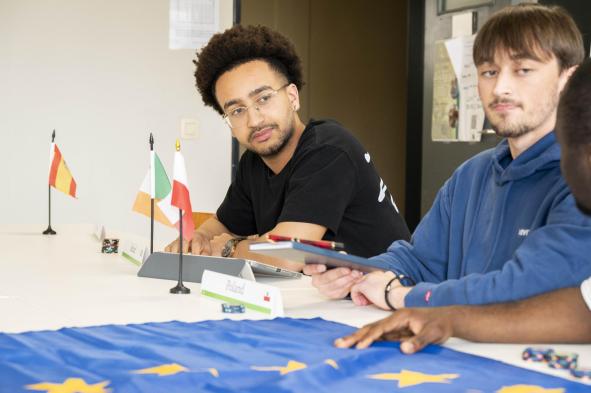
Classes, practice sessions, project coaching, meetings with industry professionals… every effort is made to ensure a thorough understanding of the concepts and the development of practical skills.

From the very beginning, you’ll learn to identify political issues, research information, analyze data, and propose concrete actions to address various institutional, economic, social, and diplomatic challenges.
Throughout your program, you’ll develop communication skills, not only in French but also in two other languages: English and either Dutch, German, or Spanish. Starting in Block 2, several courses are taught entirely in English and are based on independent and guided reading, learning discipline-specific vocabulary, and group discussion sessions…
During seminars and numerous practical assignments, you will meet leaders of international institutions, Belgian politicians, and representatives of civil society. Thanks to their experiences, you’ll gain a fresh perspective on the pillars of political science and become specialists in the field.
Développez vos compétences linguistiques ! |
| En plus de l’anglais, vous apprenez une seconde langue (allemand, espagnol ou néerlandais) dans une perspective concrète et directement intégrée dans vos projets. Quel que soit votre niveau, vous progressez grâce à des activités immersives : excursions, tables de conversation, tandems… |
Learning by Doing
Get involved in political issues starting in high school!

At the heart of political issues right from the baccalaureate!
Project-based learning integrates and applies your knowledge from multiple disciplines to real-world scenarios.
Just like real policy experts, you’ll learn to work collaboratively and demonstrate a range of skills:
- from observation, literature review, source criticism, data collection, and analysis;
- to producing a high-quality report—in some cases, including a policy brief written in English—which you and your team present to a panel.
To boost your soft skills in foreign-language communication, your language instructors provide coaching.
The “Learning by Doing” Approach |
| Projects play an increasingly important role throughout your bachelor’s program, through concrete and diverse case studies in political science: |
BLOCK 1:
|
BLOCK 2:
|
IN BLOCK 3:
|
International experience
Upon completing your bachelor’s degree, you have the opportunity to study abroad, particularly in France (University of Montpellier, Catholic University of Lille…), the Netherlands (Maastricht University), the United States (Creighton University), Spain (University of Valencia, Loyola University Andalusia), Italy (Sacro Cuore University of Milan, University of Salerno), or in Germany (University of Trier).
Support for Success
Succeeding in a year of college involves many challenges.
To help you overcome them, UNamur supports you in developing your academic, methodological, and interpersonal skills—with the assistance of many professionals.
Preparatory courses, individualized assistance…
After the bachelor's degree: the master's degree
The bachelor’s degree program in political science at UNamur provides access to master’s programs at all universities in the Wallonia-Brussels Federation, such as the master’s in political science (general track or international relations), the master’s in public administration, or the master’s in European studies.
However, many students from the University of Namur choose to continue their studies at prestigious universities abroad (Sciences Po Paris, King’s College London, the University of Edinburgh, the School of Oriental and African Studies—SOAS, the University of Amsterdam, etc.).
Contacts
Faculty of Economics, Management, and Communication, Sciences Po
Rempart de la Vierge, 8 • B-5000 NAMUR
Department of Social, Political, and Communication Sciences Office
Tel.: +32 (0) 81 72 48 11
secretariat.scpo@unamur.be
-
Choice of course
-
International Relations Department
Code Name Staff Th.+Ex. Credits/Block 1 2 3 Cyclic course organized this yearImage
LHISB005 Historical introduction to the main non-European civilisations ("Arab-Muslim world - Sub-Saharan Africa" module) Cornet Anne Renard Etienne 45h th. 5 Cyclic course not organized this yearImage
LHISB006 Historical introduction to the main non-European civilisations (India-China module) 45h th. 5 LHISB319 War and Strategy in Late Modern History Tixhon Axel 30h th. 5 EFASB359 International economic relations Trimarchi Lorenzo 30h th. 5 -
Democracies and Society Transitions stream
Code Name Staff Th.+Ex. Credits/Block 1 2 3 EPOLB216 New social and political conflicts Borriello Arthur 30h th. + 15h ex. 5 EPOLB308 Theories of democracy and democratic innovations De Briey Laurent Vertongen Youri Lou 30h th. + 15h ex. 5 Sustainable developmentImage
EPOLB309 Ecological governance Jacquet Vincent 30h th. + 15h ex. 5
-
-
Political Science
Code Name Staff Th.+Ex. Credits/Block 1 2 3 EPICB160 Political Science Dodeigne Jérémy 45h th. + 15h ex. 5 EPOLB118 Introduction to diplomacy Bled Amandine Braspenning Thierry 30h th. + 15h ex. 5 EPOLB217 Democracies, Populisms and Extremism Groz Arthur Ronderos Abuchaibe Sebastian-Eduardo Borriello Arthur 30h th. + 15h ex. 5 EPOLB260 History of political ideas De Briey Laurent Majastre Christophe 30h th. + 15h ex. 4 LHISB204_Prêté Belgian political structures and institutions in contemporary times Dodeigne Jérémy Tixhon Axel Vertongen Youri Lou 45h th. 5 EPOLB317 Public governance Petit Jean Maxime 30h th. + 15h ex. 5 EPOLB362 International Relations Theories Braspenning Thierry 30h th. + 15h ex. 5 Soft skillsImage
EPOLB364 Belgian and comparative policy issues Versailles Alban Versailles Alban Dodeigne Jérémy Dodeigne Jérémy 45h th. + 15h ex. 5 -
Law
Code Name Staff Th.+Ex. Credits/Block 1 2 3 ECGEB130 Foundations of law De Streel Alexandre 45h th. + 15h ex. 5 DROIB102_Sc po Constitutional law Vuye Hendrik 60h th. + 6h ex. 5 EPOLB315 History and law of international relations Jouan Quentin 30h th. 3 DROIB210 EU Institutional law De Streel Alexandre 45h th. 5 -
Economy
Code Name Staff Th.+Ex. Credits/Block 1 2 3 Sustainable developmentImage
ECGEB170 Economic facts and decisions De Crombrugghe De Picquendaele Alain 45h th. + 15h ex. 5 ECGEB270 Macroeconomics Kiedaisch Christian De Callatay Etienne 45h th. + 15h ex. 5 EPOLB304 Analysis of (inter)national economic discourse Borriello Arthur 30h th. + 15h ex. 4 -
Humanities
Code Name Staff Th.+Ex. Credits/Block 1 2 3 ECGEB140 Sociology Djelloul Ghaliya 45h th. + 15h ex. 5 ECGEB121 Economic and social history Roekens Anne 45h th. + 7.5h ex. 5 ECGEB120 Philosophy De Briey Laurent 45h th. + 15h ex. 5 ECGEB221 Psychology Buxant Coralie 30h th. 3 Service learningImage
EPICB322 Anthropology 30h th. + 22.5h ex. 4 EPICB141 Communication fundamentals and news analysis Collard Anne-Sophie Haineaux Esther 30h th. + 30h ex. 5 -
Methods
Code Name Staff Th.+Ex. Credits/Block 1 2 3 ECGEB110 Data Organization and Processing Burnay Corentin Verlaine Bertrand 30h th. + 15h ex. 4 ECGEB152 Statistics for the Humanities I Bugli Céline 30h th. + 15h ex. 5 EPOLB214 Criticism of information sources Haineaux Esther Collard Anne-Sophie 30h th. + 15h ex. 5 EPICB225 Statistics for the social sciences De Bodt Cyril 15h th. + 30h ex. 4 -
Project
Code Name Staff Th.+Ex. Credits/Block 1 2 3 EPOLB221 Research Project : Policy-making in transforming societies MINSART Elisa Pennetreau Damien Cordier Lionel Burnay Nathalie 75h th. + 15h ex. 10 Sustainable developmentImage
Soft skillsImage
EPOLB322 Project : European Integration. Learning Theories in Negotiation Role-plays Randour François Pennucci Nicolo Borriello Arthur Dodeigne Jérémy 60h th. + 50h ex. 10 Soft skillsImage
EPICB132 Project: Decoding political communication Borriello Arthur 37.5h th. + 30h ex. 5 -
Languages
Code Name Staff Th.+Ex. Credits/Block 1 2 3 Soft skillsImage
ECDLB190 Anglais 1 (niveau B1+) Bulon Amélie Dupal Jérémie 30h th. 3 ECDLB290 English 2 (level B1+ or higher) Hoorelbeke Christelle 30h th. 3 ECDLB390 English 3 (level B2) Hoorelbeke Christelle Foissac Patrick 30h th. 3 -
Spanish
Code Name Staff Th.+Ex. Credits/Block 1 2 3 ECDLB196 Spanish 1 (minimum level A2) Marsily Aurélie Perez Fernandez Sofia 30h th. 3 ECDLB296 Español 2 (nivel B1 o superior) Marsily Aurélie Perez Fernandez Sofia 30h th. 3 ECDLB396 Español 3 (nivel B1+ o superior) Marsily Aurélie Mil-Homens Cavaco Noémie 30h th. 3 -
German
Code Name Staff Th.+Ex. Credits/Block 1 2 3 ECDLB192 German 1 (minimum level A2) Palm Christian 60h th. 3 ECDLB193 German 1 (A1+) Palm Christian 30h th. 3 ECDLB292 Deutsch 2 (Level B1) Palm Christian 30h th. 3 ECDLB392 Deutsch 3 (mindestens level B1+) Palm Christian 30h th. 3 -
Dutch
-
Course 1 - intermediate level
Code Name Staff Th.+Ex. Credits/Block 1 2 3 ECDLB191 Elementair Nederlands: basisgrammatica, -woordenschat en dagelijkse situaties Miceli Marc 30h th. 3 ECDLB291 Mondelinge en schriftelijke communicatie in het alledaagse Nederlands Naveau Sophie 30h th. 3 ECDLB391 Mondelinge en schriftelijke communicatie op de werkvloer -B1 Hoorelbeke Christelle Miceli Marc 30h th. 3 -
Course 2 - advanced level
Code Name Staff Th.+Ex. Credits/Block 1 2 3 ECDLB181 Kritische benadering van socio-economische onderwerpen Naveau Sophie 30h th. 3 ECDLB281 De Vlaamse/Nederlandse bedrijfswereld - interculturaliteit Miceli Marc 30h th. 3 ECDLB381 Bedrijfscommunicatie en sollicitatiegesprekken – B2 Hoorelbeke Christelle 30h th. 3
-
-
-
-
Code Name Staff Th.+Ex. Credits/Block 1 2 3 UNAM0059 Religions, Society, and Politics Lefebvre Perrin 24h th. 3 UNAM0060 The philosophical question of God Malvaux Paul 24h th. 3 UNAM0061 Comparative religions Malvaux Paul 24h th. 3 UNAM0062 Science and religion: a history of controversies Malvaux Paul 24h th. 3 UNAM0063 Cazalis Roland 30h th. 3 -
Code Name Staff Th.+Ex. Credits/Block 1 2 3 UNAM0057 Taking action for the planet Henry Sabine 8h th. + 30h ex. 3
-
-
-
Code Name Staff Th.+Ex. Credits/Block 1 2 3 Sustainable developmentImage
MMEDB360 One Health Wieërs Grégoire Lachapelle Amélie Canon Caroline 15h th. 3 Course not organized this yearImage
UNAM0064 Environmental philosophy 20h th. 3 UNAM0065 Thinking in systems Béreau Sophie 26h th. 3 Sustainable developmentImage
UNAM0043 Global change and the Anthropocene Yans Johan Dendoncker Nicolas Yans Johan Linard Catherine Houssiau Laurent Henry Sabine 24h th. 3 Sustainable developmentImage
Soft skillsImage
UNAM0047 Law, sustainable development and transition Lachapelle Amélie 24h th. 3 Sustainable developmentImage
Soft skillsImage
UNAM0055 JEDDT Lachapelle Amélie 30h th. 3 Sustainable developmentImage
Soft skillsImage
UNAM0055_Part 1 JEDDT Lachapelle Amélie 10h th. 1 -
Code Name Staff Th.+Ex. Credits/Block 1 2 3 UNAM0066-50 History of astronomy Libert Anne-Sophie 30h th. 3 UNAM0066-51 Medical engineering for Space and Earth Libert Anne-Sophie 30h th. 3 UNAM0066-52 Space Innovation, Business & Law Libert Anne-Sophie 30h th. 3 UNAM0066-53 English C1: Terms and Concepts of Space (Winter) Libert Anne-Sophie 30h th. 3 UNAM0066-54 English C1: Terms and Concepts of Space (Summer) Libert Anne-Sophie 30h th. 3 UNAM0066-55 Let's talk über l´espace - Trilingual Online Course: French, English and German (Winter) Libert Anne-Sophie 30h th. 3 UNAM0066-56 Let's talk über l´espace - Trilingual Online Course: French, English and German (Summer) Libert Anne-Sophie 30h th. 3 UNAM0066-01 Page & Screen : exploring narratives of space Malcolm Ophélie Bar Vanina 3 UNAM0066-02 Introduction to Space Sciences Fuzfa André Zimmer Carole 3 UNAM0066-03 Science for all: effective science communication in English 10h th. + 40h ex. 3 -
Code Name Staff Th.+Ex. Credits/Block 1 2 3 UNAM0048 Artificial intelligence: challenges and opportunities Frenay Benoît 24h th. 3 Soft skillsImage
UNAM0049 Science for all : Introduction to popular science Schutz Natassia Hansel Aude 24h th. 3 UNAM0054 DigiComp 2.2 - Getting to grips with the digital world in my studies and beyond Depommier Clara 16h th. 3 -
Code Name Staff Th.+Ex. Credits/Block 1 2 3 UNAM0067 Critical thinking and intellectual self-defense Sartenaer Olivier 30h th. 3 UNAM0068 Gender and racial bias. How to identify, reflect on, and avoid it? Ravez Laurent 30h th. 3 -
Code Name Staff Th.+Ex. Credits/Block 1 2 3 UNAM0069 Ethics in human-animal relations Pontarotti Gaëlle 30h th. + 20h ex. 3 -
Code Name Staff Th.+Ex. Credits/Block 1 2 3 UNAM0052 MOOC “Aim for success – become a super student” Wathelet Valérie 2h th. 3 UNAM0041 MOOC "Aim for success - become a super student". Wathelet Valérie 2h th. 3 UNAM0056 Biémar Sandrine 12h th. + 5h ex. 3 UNAM0034 Public risk management and emergency management Mathen Denis 20h th. 3
-
-
Political Science
Code Name Staff Credits Hours/Quarter 1 2 EPICB160 Political Science Dodeigne Jérémy 5 45h th. + 15h ex. EPOLB118 Introduction to diplomacy Bled Amandine Braspenning Thierry 5 30h th. + 15h ex. -
Law
Code Name Staff Credits Hours/Quarter 1 2 ECGEB130 Foundations of law De Streel Alexandre 5 45h th. + 15h ex. -
Economy
Code Name Staff Credits Hours/Quarter 1 2 Sustainable developmentImage
ECGEB170 Economic facts and decisions De Crombrugghe De Picquendaele Alain 5 45h th. + 15h ex. -
Humanities
Code Name Staff Credits Hours/Quarter 1 2 ECGEB140 Sociology Djelloul Ghaliya 5 45h th. + 15h ex. ECGEB121 Economic and social history Roekens Anne 5 45h th. + 7.5h ex. ECGEB120 Philosophy De Briey Laurent 5 45h th. + 15h ex. EPICB141 Communication fundamentals and news analysis Collard Anne-Sophie Haineaux Esther 5 30h th. + 30h ex. -
Methods
Code Name Staff Credits Hours/Quarter 1 2 ECGEB110 Data Organization and Processing Burnay Corentin Verlaine Bertrand 4 30h th. + 15h ex. ECGEB152 Statistics for the Humanities I Bugli Céline 5 30h th. + 15h ex. -
Project
Code Name Staff Credits Hours/Quarter 1 2 Soft skillsImage
EPICB132 Project: Decoding political communication Borriello Arthur 5 37.5h th. + 30h ex. -
Languages
Code Name Staff Credits Hours/Quarter 1 2 Soft skillsImage
ECDLB190 Anglais 1 (niveau B1+) Bulon Amélie Dupal Jérémie 3 10h th. 20h th. -
Spanish
Code Name Staff Credits Hours/Quarter 1 2 ECDLB196 Spanish 1 (minimum level A2) Marsily Aurélie Perez Fernandez Sofia 3 15h th. 15h th. -
German
Code Name Staff Credits Hours/Quarter 1 2 ECDLB192 German 1 (minimum level A2) Palm Christian 3 30h th. 30h th. ECDLB193 German 1 (A1+) Palm Christian 3 15h th. 15h th. -
Dutch
-
Course 1 - intermediate level
Code Name Staff Credits Hours/Quarter 1 2 ECDLB191 Elementair Nederlands: basisgrammatica, -woordenschat en dagelijkse situaties Miceli Marc 3 15h th. 15h th. -
Course 2 - advanced level
Code Name Staff Credits Hours/Quarter 1 2 ECDLB181 Kritische benadering van socio-economische onderwerpen Naveau Sophie 3 15h th. 15h th.
-
-
-
Choice of course
-
International Relations Department
Code Name Staff Credits Hours/Quarter 1 2 Cyclic course organized this yearImage
LHISB005 Historical introduction to the main non-European civilisations ("Arab-Muslim world - Sub-Saharan Africa" module) Cornet Anne Renard Etienne 5 22.5h th. 22.5h th. Cyclic course not organized this yearImage
LHISB006 Historical introduction to the main non-European civilisations (India-China module) 5 22.5h th. 22.5h th. -
Democracies and Society Transitions stream
Code Name Staff Credits Hours/Quarter 1 2 EPOLB216 New social and political conflicts Borriello Arthur 5 30h th. + 15h ex.
-
-
Political Science
Code Name Staff Credits Hours/Quarter 1 2 EPOLB217 Democracies, Populisms and Extremism Groz Arthur Ronderos Abuchaibe Sebastian-Eduardo Borriello Arthur 5 30h th. + 15h ex. EPOLB260 History of political ideas De Briey Laurent Majastre Christophe 4 30h th. + 15h ex. LHISB204_Prêté Belgian political structures and institutions in contemporary times Dodeigne Jérémy Tixhon Axel Vertongen Youri Lou 5 45h th. -
Law
Code Name Staff Credits Hours/Quarter 1 2 DROIB102_Sc po Constitutional law Vuye Hendrik 5 30h th. + 3h ex. 30h th. + 3h ex. -
Economy
Code Name Staff Credits Hours/Quarter 1 2 ECGEB270 Macroeconomics Kiedaisch Christian De Callatay Etienne 5 45h th. + 15h ex. -
Humanities
Code Name Staff Credits Hours/Quarter 1 2 ECGEB221 Psychology Buxant Coralie 3 30h th. -
Methods
Code Name Staff Credits Hours/Quarter 1 2 EPOLB214 Criticism of information sources Haineaux Esther Collard Anne-Sophie 5 30h th. + 15h ex. EPICB225 Statistics for the social sciences De Bodt Cyril 4 15h th. + 30h ex. -
Project
Code Name Staff Credits Hours/Quarter 1 2 EPOLB221 Research Project : Policy-making in transforming societies MINSART Elisa Pennetreau Damien Cordier Lionel Burnay Nathalie 10 45h th. + 7h ex. 30h th. + 8h ex. -
Languages
Code Name Staff Credits Hours/Quarter 1 2 ECDLB290 English 2 (level B1+ or higher) Hoorelbeke Christelle 3 30h th. -
Spanish
Code Name Staff Credits Hours/Quarter 1 2 ECDLB296 Español 2 (nivel B1 o superior) Marsily Aurélie Perez Fernandez Sofia 3 15h th. 15h th. -
German
Code Name Staff Credits Hours/Quarter 1 2 ECDLB292 Deutsch 2 (Level B1) Palm Christian 3 15h th. 15h th. -
Dutch
-
Course 1 - intermediate level
Code Name Staff Credits Hours/Quarter 1 2 ECDLB291 Mondelinge en schriftelijke communicatie in het alledaagse Nederlands Naveau Sophie 3 15h th. 15h th. -
Course 2 - advanced level
Code Name Staff Credits Hours/Quarter 1 2 ECDLB281 De Vlaamse/Nederlandse bedrijfswereld - interculturaliteit Miceli Marc 3 15h th. 15h th.
-
-
-
-
Code Name Staff Credits Hours/Quarter 1 2 Sustainable developmentImage
MMEDB360 One Health Wieërs Grégoire Lachapelle Amélie Canon Caroline 3 15h th. Course not organized this yearImage
UNAM0064 Environmental philosophy 3 20h th. UNAM0065 Thinking in systems Béreau Sophie 3 26h th. Sustainable developmentImage
UNAM0043 Global change and the Anthropocene Yans Johan Dendoncker Nicolas Yans Johan Linard Catherine Houssiau Laurent Henry Sabine 3 24h th. Sustainable developmentImage
Soft skillsImage
UNAM0047 Law, sustainable development and transition Lachapelle Amélie 3 24h th. Sustainable developmentImage
Soft skillsImage
UNAM0055 JEDDT Lachapelle Amélie 3 30h th. Sustainable developmentImage
Soft skillsImage
UNAM0055_Part 1 JEDDT Lachapelle Amélie 1 10h th. -
Code Name Staff Credits Hours/Quarter 1 2 UNAM0066-50 History of astronomy Libert Anne-Sophie 3 30h th. UNAM0066-51 Medical engineering for Space and Earth Libert Anne-Sophie 3 15h th. 15h th. UNAM0066-52 Space Innovation, Business & Law Libert Anne-Sophie 3 15h th. 15h th. UNAM0066-53 English C1: Terms and Concepts of Space (Winter) Libert Anne-Sophie 3 30h th. UNAM0066-54 English C1: Terms and Concepts of Space (Summer) Libert Anne-Sophie 3 30h th. UNAM0066-55 Let's talk über l´espace - Trilingual Online Course: French, English and German (Winter) Libert Anne-Sophie 3 30h th. UNAM0066-56 Let's talk über l´espace - Trilingual Online Course: French, English and German (Summer) Libert Anne-Sophie 3 30h th. UNAM0066-01 Page & Screen : exploring narratives of space Malcolm Ophélie Bar Vanina 3 UNAM0066-02 Introduction to Space Sciences Fuzfa André Zimmer Carole 3 UNAM0066-03 Science for all: effective science communication in English 3 10h th. + 40h ex. -
Code Name Staff Credits Hours/Quarter 1 2 UNAM0048 Artificial intelligence: challenges and opportunities Frenay Benoît 3 24h th. Soft skillsImage
UNAM0049 Science for all : Introduction to popular science Schutz Natassia Hansel Aude 3 12h th. 12h th. UNAM0054 DigiComp 2.2 - Getting to grips with the digital world in my studies and beyond Depommier Clara 3 16h th. -
Code Name Staff Credits Hours/Quarter 1 2 UNAM0067 Critical thinking and intellectual self-defense Sartenaer Olivier 3 30h th. UNAM0068 Gender and racial bias. How to identify, reflect on, and avoid it? Ravez Laurent 3 30h th. -
Code Name Staff Credits Hours/Quarter 1 2 UNAM0069 Ethics in human-animal relations Pontarotti Gaëlle 3 30h th. + 20h ex. -
Code Name Staff Credits Hours/Quarter 1 2 UNAM0052 MOOC “Aim for success – become a super student” Wathelet Valérie 3 2h th. UNAM0041 MOOC "Aim for success - become a super student". Wathelet Valérie 3 2h th. UNAM0056 Biémar Sandrine 3 12h th. + 5h ex. UNAM0034 Public risk management and emergency management Mathen Denis 3 20h th.
-
-
Choice of course
-
International Relations Department
Code Name Staff Credits Hours/Quarter 1 2 LHISB319 War and Strategy in Late Modern History Tixhon Axel 5 30h th. EFASB359 International economic relations Trimarchi Lorenzo 5 30h th. -
Democracies and Society Transitions stream
Code Name Staff Credits Hours/Quarter 1 2 EPOLB308 Theories of democracy and democratic innovations De Briey Laurent Vertongen Youri Lou 5 30h th. + 15h ex. Sustainable developmentImage
EPOLB309 Ecological governance Jacquet Vincent 5 30h th. + 15h ex.
-
-
Political Science
Code Name Staff Credits Hours/Quarter 1 2 EPOLB317 Public governance Petit Jean Maxime 5 30h th. + 15h ex. EPOLB362 International Relations Theories Braspenning Thierry 5 30h th. + 15h ex. Soft skillsImage
EPOLB364 Belgian and comparative policy issues Versailles Alban Versailles Alban Dodeigne Jérémy Dodeigne Jérémy 5 45h th. + 15h ex. -
Law
Code Name Staff Credits Hours/Quarter 1 2 EPOLB315 History and law of international relations Jouan Quentin 3 30h th. DROIB210 EU Institutional law De Streel Alexandre 5 45h th. -
Economy
Code Name Staff Credits Hours/Quarter 1 2 EPOLB304 Analysis of (inter)national economic discourse Borriello Arthur 4 30h th. + 15h ex. -
Humanities
Code Name Staff Credits Hours/Quarter 1 2 Service learningImage
EPICB322 Anthropology 4 30h th. + 22.5h ex. -
Project
Code Name Staff Credits Hours/Quarter 1 2 Sustainable developmentImage
Soft skillsImage
EPOLB322 Project : European Integration. Learning Theories in Negotiation Role-plays Randour François Pennucci Nicolo Borriello Arthur Dodeigne Jérémy 10 30h th. + 20h ex. 30h th. + 30h ex. -
Languages
Code Name Staff Credits Hours/Quarter 1 2 ECDLB390 English 3 (level B2) Hoorelbeke Christelle Foissac Patrick 3 30h th. -
Spanish
Code Name Staff Credits Hours/Quarter 1 2 ECDLB396 Español 3 (nivel B1+ o superior) Marsily Aurélie Mil-Homens Cavaco Noémie 3 15h th. 15h th. -
German
Code Name Staff Credits Hours/Quarter 1 2 ECDLB392 Deutsch 3 (mindestens level B1+) Palm Christian 3 15h th. 15h th. -
Dutch
-
Course 1 - intermediate level
Code Name Staff Credits Hours/Quarter 1 2 ECDLB391 Mondelinge en schriftelijke communicatie op de werkvloer -B1 Hoorelbeke Christelle Miceli Marc 3 15h th. 15h th. -
Course 2 - advanced level
Code Name Staff Credits Hours/Quarter 1 2 ECDLB381 Bedrijfscommunicatie en sollicitatiegesprekken – B2 Hoorelbeke Christelle 3 15h th. 15h th.
-
-
-
-
Code Name Staff Credits Hours/Quarter 1 2 UNAM0059 Religions, Society, and Politics Lefebvre Perrin 3 24h th. UNAM0060 The philosophical question of God Malvaux Paul 3 24h th. UNAM0061 Comparative religions Malvaux Paul 3 24h th. UNAM0062 Science and religion: a history of controversies Malvaux Paul 3 24h th. UNAM0063 Cazalis Roland 3 30h th. -
Code Name Staff Credits Hours/Quarter 1 2 UNAM0057 Taking action for the planet Henry Sabine 3 4h th. + 15h ex. 4h th. + 15h ex.
-
Essential Careers for the Major Challenges of Tomorrow
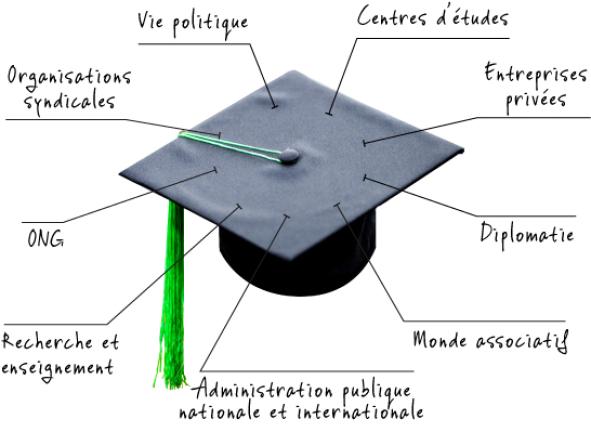
Essential professions for tomorrow's major challenges
Power, Authority, and Decision-Making
As political scientists, you have a deep understanding of the principles that shape society.
As experts in understanding the mechanisms of power and political, economic, and social life, you unravel the secrets and challenges of public policy at the local, regional, national, and international levels.
The history of democracy, liberalism, and nationalism, along with your knowledge of economics, law, history, and philosophy, enable you to take a critical look at today’s society. This unique ability to integrate different perspectives sets you apart and places you among the best-prepared individuals to understand and shape the world in which we live.
Political Life
Graduates actively participate in political life within ministerial offices, political parties, labor unions, and parliamentary caucuses. They follow debates and prepare in-depth reports on specific issues for elected officials.
National and International Public Administration
Regardless of the level of government (federal, community, regional, provincial, or municipal), political scientists are qualified to manage day-to-day operations in all public services (health, interior, finance, education, foreign affairs, etc.).
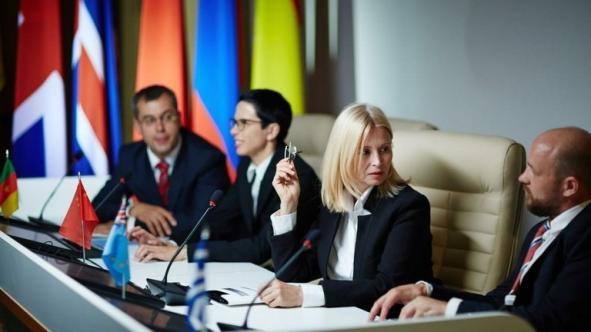
Many graduates dream of working for an international organization (the European Union, NATO, FAO, etc.). National competitive exams and hiring quotas limit employment opportunities in this sector. Nevertheless, most of these institutions offer internships to recent graduates, which can, in some cases, increase their chances of securing a contract position there.
Nonprofit Sector
From neighborhood committees to development aid organizations in the broadest sense, there are many nonprofit organizations where political science graduates can serve the public interest. They hold positions in research, decision-making, or management.
Other Sectors
Political scientists can work in the media or become spokespersons for a political organization—provided, of course, that they demonstrate specific personal skills or even have additional training. Large private companies (banks, consulting firms, etc.) value the international outlook of certain political scientists, whom they entrust with assignments where international connections are now crucial.
Key Players in Society
Able to draw on legal, sociological, political, and economic knowledge to construct a coherent narrative on a given topic, political scientists have a wide range of professional opportunities. When it comes to landing their first job, in addition to proficiency in analytical methods (qualitative and quantitative), language skills and a strong track record of engagement—particularly in the nonprofit sector—will often be decisive factors.
“Architects” of Public Policy
Political science students share a strong sense of the public good, both at the local level and from a global perspective. In fact, to encourage this openness to the world, UNamur offers students in this program the opportunity to participate in an Erasmus exchange beginning in the third semester of their bachelor’s degree.
Bringing about social change requires an understanding of its most intricate workings. Upon completion of their studies, political scientists have a thorough understanding of how Belgian and/or international institutions function, as well as the economics and management of public affairs. They are prepared to develop action plans that are both realistic and mindful of constraints, in response to increasingly complex societal problems.
Studying political science also develops the ability to communicate in French and in a foreign language. Political scientists must be able to explain what they do and rigorously defend the results of their work.