
Lucas Chancel: What kind of ecological transition for what kind of society?
On March 23, Lucas Chancel (Sciences Po Paris) will present his book "Energy and Inequality: A Political History." In collaboration with Librairie Point Virgule.
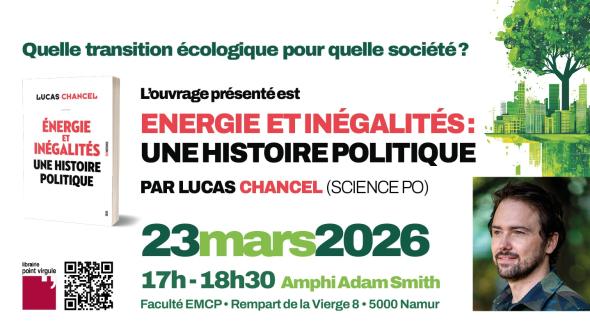
Why is the history of energy so closely linked to that of social inequality? How can we frame debates on energy transition in light of conflicts over wealth distribution?
For thousands of years, the use of energy has shaped human societies, structuring their hierarchies and power relations. Its control is a vehicle for emancipation as much as it is a tool of domination. Ownership of energy resources and infrastructure is a battleground for social, political, and geostrategic struggles. Depending on who owns energy, radically different societal choices can arise.
But how has the link between energy and inequality developed since prehistoric times? By combining the results of research in economic history, archaeology, and climate science, Lucas Chancel seeks to show how, over the long term, the technical and political frameworks that determine energy use are linked to the distribution of wealth among individuals, social groups, and nations.
The history of energy cannot be reduced to its technical dimension, nor to the sum of past political choices. It opens up a diversity of possible futures, where the decoupling of energy consumption, material resources, and prosperity is inseparable from the question of social justice.
This book advocates for an ecological transition based on a collective reappropriation of energy. Drawing on experiences of wealth redistribution from the past century, it outlines an alternative to ecological disaster and extreme inequality through the development of new forms of public and participatory ownership in the 21st century.
Lucas Chancel is a professor at Sciences Po Paris, at the Center for Research on Social Inequality, and co-director of the Laboratory on Global Inequality at the Paris School of Economics. He has taught at Harvard University in the United States.