UNamur's university heritage brings together all the objects, documents and collections linked to teaching and research since the Collège Notre-Dame de la Paix was founded in 1831. It bears witness to the evolution of teaching and scientific knowledge and practices over time. Ancient scientific instruments, historical herbariums, naturalized animals, anatomical collections in fluid, minerals and rocks, zoological specimens... are just a few examples that illustrate the diversity and richness of this heritage. Today, these collections are housed in several departments or faculties and at the Moretus Plantin University Library (BUMP).

The 2025 edition of European Academic Heritage Day, under the theme of "Unexpected Heritage", gave UNamur the opportunity to highlight three amazing objects from its collections: a miniature library kept at the BUMP, an osteological assembly of the inner ear housed in URBC and an anatomical anomaly from the Department of Veterinary Medicine.

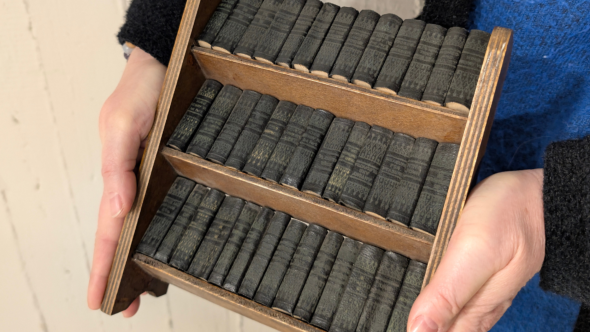
The miniature library is housed on this three-tiered wooden shelf, which houses an iconic work of British literature: the complete edition of Shakespeare, printed in London around 1930 for the Allied Newspapers group. It comprises forty volumes, each measuring between 5 and 5.2 cm in height, with a maximum thickness of 3.5 cm.

Bibliothèque miniature - BUMP

This set, probably designed as a promotional item, was offered as a welcome gift when subscribing to one of the group's many newspapers or magazines. In the world of very small-format books (less than 10 cm), each category has a name: "minuscules" (less than 7.5 cm), "miniatures" (2.5 cm) and "microbes" (1.25 cm). A typographic feat that invites us to rediscover Shakespeare in a Lilliputian version.

This osteological montage illustrates the structure of the human inner ear, composed of two essential elements. The cochlea, first, is a spirally wound tube, similar to a snail shell. The sensory center of hearing, it receives sounds transmitted by the eardrum via the ossicles of the middle ear (hammer, anvil and stirrup) and transforms them into nerve impulses destined for the brain. The semicircular canals, then, constitute the center of balance.

Montage ostéologique qui illustre la structure de l’oreille interne humaine

Orienting in three dimensions, they constantly inform the brain of the body's position in relation to the vertical and horizontal. A failure of this system makes it impossible to stand upright! The renowned Parisian firm Tramond specialized in wax modeling for the production of anatomical models and the preparation of osteological specimens during the second half of the XIXe century. These models were frequently used in science teaching.

This anatomical specimen shows two partially fused bovine twins: they share pelvis, trunk and spine, but possess two heads. This anomaly, known as caudal crucipagia or double Y monster, is a rare form of incomplete gemellity. The term "crucipagia" comes from crux (cross) and pagus (union), while "caudal" indicates that the fusion involves the rear part of the body.

Pièce anatomique qui montre deux jumeaux bovins partiellement fusionnés

The Y shape evokes two divergent heads connected to a common trunk. This malformation stems from a very early defect in embryonic development, at the level of the primitive line, which organizes the formation of the body. Normally single, this line produces a complete individual. If it splits completely, two distinct twins are produced. But when the splitting is incomplete and too close together, the embryos partially fuse, as in this case where the junction extends from the pelvis to the neck.

A heritage to explore...

This selection of pieces, which arouse curiosity and astonishment, provided a brief overview of UNamur's collections on the occasion of this theme day. Many other pieces are still waiting to be inventoried, preserved and promoted within the University. Through their historical, pedagogical and scientific value, these objects are much more than material witnesses: they tell the story of the evolution of our institution's knowledge, practices and learning methods.

In 2019, BUMP's Heritage Unit has been mandated by the UNamur Board of Directors to ensure the inventory, management, conservation and enhancement of university collections. Active collaboration with several departments is already well established.

...and accessible online

NEPTUN is a portal providing free access to several thousand documents held at the BUMP, digitized in high resolution. The Heritage Department is gradually digitizing exceptional documents. Explore this documentary heritage online, find our virtual exhibitions, listen to our podcasts and sound capsules!