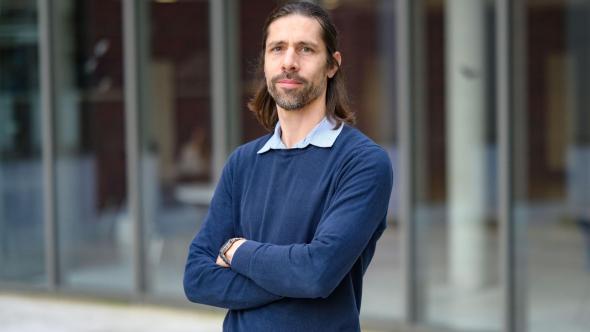
In his work, Alexandre Mauroy develops methods to better understand these dynamical systems. His stint at the University of Santa Barbara in California from 2011 to 2013 introduced him to operator theory, and in particular the Koopman operator, an original method for studying these unsolvable equations : "The idea may seem counter-intuitive, because we transform a finite-dimensional system into an infinite-dimensional one. It is then described by an infinite number of variables, but it becomes linear and can therefore be solved more easily. It's like using a kind of mathematical magic wand", he explains.
Koopman's operator is not new, however: it was first demonstrated in the 1930s before falling into oblivion. It was only revived in the 2000s. "It was the very beginning of the renaissance of this approach, we were pioneers", recalls Alexandre Mauroy. "Today, the Koopman operator has become very trendy in the scientific community."
And for good reason, many applications are possible thanks to this method. Among those studied by Alexandre Mauroy:
- The study of global stability of equilibria.
- The identification of network structure from observed data (e.g. connections between neurons in the brain or interactions between people).
- Control theory, halfway between mathematics and engineering sciences, which aims to impose the behavior of the dynamic system (e.g. car cruise control).
In this last field, Alexandre Mauroy is collaborating with Elio Tuci (Faculty of Computer Science) on the ARC "AUTOMATic" project, which aims to develop an intelligent urban traffic management system, thanks to data collected by drones. This project illustrates the interdisciplinary dimension of the naXys Institute's research and the "applied math" specificity of the teaching at UNamur's Mathematics Department, which is unique in the Wallonia-Brussels Federation.
.