

Image

Département de chimie
La chimie est par excellence la science de la transformation de la matière et se situe de ce fait à la croisée des sciences physiques et mathématiques d'une part, et des sciences de la vie, des sciences de la terre et des sciences des matériaux d'autre part. Des laboratoires de pointe, dirigés par des chercheurs de renommée mondiale, sont dédiés à une vaste gamme de domaines, de la chimie organique à la chimie des matériaux, en passant par la chimie analytique et la chimie théorique.
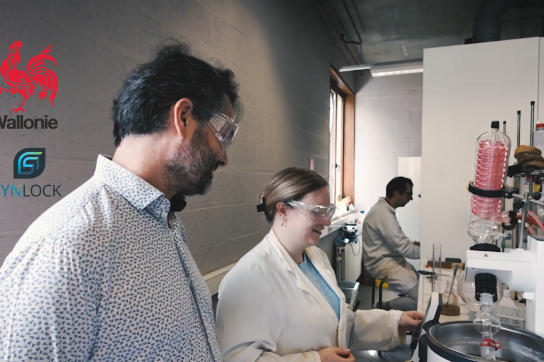
À l’UNamur, une thèse menée par Juliette Liégeois, avec le soutien du SPW Recherche dans le cadre du programme Win4Doc, vise à moderniser la production automatisée de radiotraceurs utilisés notamment pour diagnostiquer certains cancers et d’autres maladies. Baptisé SMART, le projet est développé en collaboration avec Synlock, une entreprise qui conçoit des automates de synthèse destinés aux laboratoires académiques et industriels.
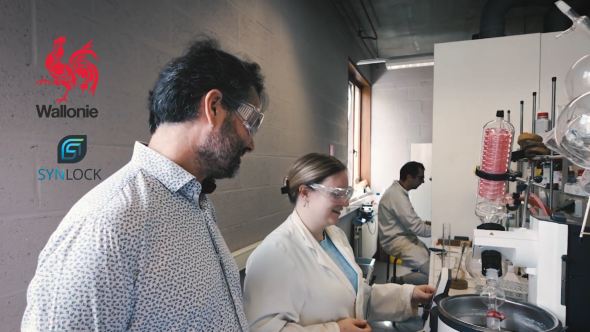
Les radiotraceurs sont de petites molécules radioactives utilisées en imagerie médicale. Une fois injectées dans le corps, elles peuvent se fixer sur certaines cibles caractéristiques d’une maladie et émettre un rayonnement détectable par les appareils d’imagerie. C’est sur ces molécules que travaille Juliette Liégeois, doctorante au laboratoire de Chimie Bioorganique (CBO) de l’UNamur, dans le cadre d’une thèse menée en collaboration avec l’entreprise Synlock. “On peut les comparer à des traceurs GPS. Ils permettent par exemple de localiser précisément une tumeur dans le corps humain et d’aider ensuite l’oncologue à définir une stratégie thérapeutique”, explique-t-elle.
Mais produire ces molécules représente un véritable défi. Radioactives et instables, elles doivent être fabriquées rapidement et dans des conditions permettant de garantir la sécurité des scientifiques. Leur synthèse est donc réalisée à l’aide de machines automatisées capables d’enchaîner les différentes étapes sans intervention humaine directe. Or, une grande partie des automates utilisés actuellement repose encore sur des technologies qui ne permettent pas d’intégrer facilement certaines méthodes de synthèse plus récentes développées dans les laboratoires de recherche.
L’objectif du projet SMART est précisément de combler ce retard, en adaptant des méthodes existantes afin de pouvoir les intégrer dans des systèmes automatisés et de vérifier leur efficacité dans des conditions proches de la production réelle.
Pour y parvenir, Juliette Liégeois travaille sur deux techniques. La biocatalyse utilise des enzymes pour réaliser certaines réactions chimiques dans des conditions plus douces, tandis que la photocatalyse utilise la lumière pour déclencher ces réactions. Deux méthodes souvent utilisées en recherche, mais qui doivent encore être adaptées aux contraintes des machines automatisées.
Le projet teste également le Cheminizer, une technologie développée par Synlock. Ce réacteur tourne pendant la fabrication afin de mieux mélanger les différents éléments et de mieux contrôler les réactions. Son fonctionnement pourrait notamment faciliter l’utilisation de la lumière et des enzymes.
Le projet SMART repose sur la complémentarité entre l’UNamur et Synlock. L’entreprise apporte son expertise dans la conception des machines et des réacteurs, tandis que le laboratoire de Chimie Bioorganique (CBO) de l’UNamur apporte ses connaissances sur les réactions chimiques.

“La valeur ajoutée de la collaboration entre l’entreprise Synlock et le laboratoire CBO est double. Il y a d’abord une synergie vis-à-vis de la ou des technologies développées dans le projet : l’entreprise apporte son savoir-faire dans le domaine des réacteurs, le laboratoire alimente le projet par ses connaissances sur les réactions et les transformations chimiques impactantes pour le projet. L’autre dimension importante est la gestion et l’orientation des décisions stratégiques à prendre en concertation avec les deux partenaires car elles peuvent avoir des incidences économiques directes sur le développement des produits de Synlock.”
Win4Doc est une mesure mise en place par la Wallonie (SPW Recherche) permettant à une entreprise wallonne d'engager un chercheur pour mener une recherche doctorale en collaboration avec une unité de recherche universitaire.


À l’UNamur, une thèse menée par Jozie Tientcheu, avec le soutien du SPW Recherche dans le cadre du programme Win4Doc, explore une nouvelle piste pour accélérer le diagnostic des résistances bactériennes aux antibiotiques. Baptisé STABLE2, le projet est développé en collaboration avec Coris BioConcept, une entreprise wallonne spécialisée dans les tests rapides de diagnostic.

La résistance aux antibiotiques est l’un des grands défis de santé publique. Certaines bactéries produisent des enzymes, appelées bêta-lactamases, capables de rendre inefficaces des antibiotiques très utilisés, comme les bêta-lactamines. Parmi elles, les résistances aux carbapénèmes, souvent réservés aux infections graves, sont particulièrement préoccupantes.
Identifier rapidement ces résistances est essentiel pour adapter le traitement, éviter l’usage inutile d’antibiotiques de dernier recours et limiter la propagation de bactéries résistantes dans les milieux de soins.
L’objectif de STABLE2 est de réduire le délai entre le prélèvement d’un échantillon et l’obtention d’un diagnostic. « Pour y parvenir, le projet combine chimie de synthèse, électrochimie et microbiologie. Il vise à concevoir des molécules analogues aux bêta-lactamines, puis à mesurer leur transformation lorsqu’elles entrent en contact avec les enzymes responsables de certaines résistances », explique la doctorante Jozie Tientcheu.
Cette transformation peut générer un signal électrochimique mesurable. À terme, cette approche pourrait contribuer au développement de tests plus rapides, plus ciblés et mieux adaptés aux besoins des laboratoires et du monde hospitalier.
Le projet s’inscrit dans le développement de la gamme de tests électrochimiques de Coris BioConcept, entreprise située à Gembloux et active depuis 1996 dans le diagnostic rapide des maladies infectieuses. Déjà engagée dans la détection des résistances bactériennes, elle apporte son expertise industrielle et sa connaissance des besoins de terrain.
À l’UNamur, la recherche est menée au sein du laboratoire de Chimie Bioorganique (CBO), qui conçoit et synthétise les molécules nécessaires au développement du test.
« La lutte contre les maladies infectieuses constitue l’axe principal de recherche du CBO. La collaboration avec Coris BioConcept est très intéressante car elle permet de faire un lien direct entre le savoir-faire du laboratoire et des applications accessibles rapidement au milieu médical, et donc au bénéfice du patient. La complémentarité des deux entités est optimale et permet une relation Win-Win et une véritable synergie »
Win4Doc est une mesure mise en place par la Wallonie (SPW Recherche) permettant à une entreprise wallonne d'engager un chercheur pour mener une recherche doctorale en collaboration avec une unité de recherche universitaire.
Créée conjointement par l’Université de Namur et l’UCLouvain, la spin-off Intercept Bio entend franchir une nouvelle étape dans la prévention des infections respiratoires virales. Issue des recherches menées par les équipes du professeur Stéphane Vincent, au Laboratoire de Chimie Bio-Organique de l’UNamur, et du professeur David Alsteens, au Louvain Institute of Biomolecular Science and Technology de l’UCLouvain, et Investigateur au WEL Research Institute, la jeune société développe un spray nasal conçu pour agir dès la porte d’entrée des virus respiratoires : les voies nasales.
L’innovation au cœur d’Intercept Bio repose sur une molécule propriétaire, 9-Ac-SAP, protégée par plusieurs familles de brevets internationaux codétenues par les deux universités. Cette molécule, formulée sous la forme d’un spray nasal, a été pensée pour intercepter les virus avant qu’ils ne puissent s’accrocher aux cellules humaines. Concrètement, elle agit comme un « leurre » moléculaire : au lieu de se fixer à la surface des cellules de l’organisme, le virus rencontre d’abord cette molécule, qui perturbe son adhésion et limite ainsi sa capacité à initier l’infection.

Avec le spray nasal, notre objectif est de proposer une approche simple à utiliser, mais fondée sur une compréhension très fine des premières étapes de l’infection virale. Plutôt que d’attendre que le virus soit installé dans l’organisme, nous cherchons à l’empêcher de franchir cette première barrière en intervenant directement au niveau des voies nasales.
Le Professeur Stéphane Vincent est membre du Laboratoire de Chimie Bio-Organique (CBO) et des Instituts NISM et NARILIS de l’UNamur.
Les virus respiratoires évoluent en permanence. En ciblant une étape fondamentale de leur interaction avec les cellules humaines plutôt qu'une protéine virale spécifique, nous espérons développer une solution capable de conserver son efficacité malgré l'apparition de nouveaux variants ou de nouveaux virus émergents.
Le professeur David Alsteens, du NanoBioPhysics lab et membre du Louvain Institute of Biomolecular Science and Technology de l’UCLouvain et du WEL Research Institute.
Cette approche est particulièrement originale parce qu’elle ne vise pas un seul virus ni une seule souche. Les travaux précliniques menés à l’UNamur et à l’UCLouvain ont montré une activité antivirale contre plusieurs virus respiratoires majeurs, dont le SARS-CoV-2, les virus de la grippe et le virus respiratoire syncytial. En ciblant une étape très précoce et commune du processus infectieux, c’est-à-dire l’attachement du virus à la cellule hôte, la technologie ouvre la voie à une stratégie préventive complémentaire aux vaccins, aux traitements antiviraux existants et aux mesures de protection classiques.
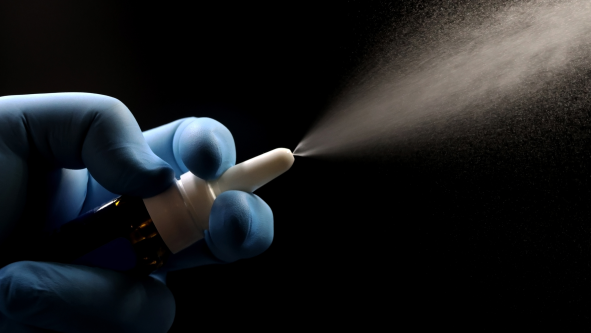
Le premier produit développé par Intercept Bio, prend la forme d’un spray nasal. Ce mode d’administration répond à une logique simple : intervenir localement, là où de nombreux virus respiratoires commencent leur progression dans l’organisme. Facile à utiliser, non invasif et pensé pour un usage préventif, ce spray pourrait représenter une solution particulièrement pertinente pour les personnes les plus à risque de complications, notamment les patients souffrant de pathologies respiratoires chroniques.
« Ce spray pourrait être une alternative au vaccin pour les personnes immunodéprimées. Il permettrait d’empêcher d’attraper des maladies respiratoires, la grippe ou d’autres infections en l’appliquant avant d’entrer dans des lieux confinés, comme les transports en commun. Il pourrait aussi être utilisé par une personne infectée pour limiter les risques de transmission du virus aux personnes qui l’entourent », précise David Alsteens, UCLouvain, WEL Research Institute.
En réduisant le risque d’infection ou d’exacerbation de maladies respiratoires sévères, une solution préventive comme ce spray pourrait contribuer à limiter les complications, les hospitalisations et la pression sur les soins de santé.
En 2020, dès le début de l’épidémie du coronavirus, David Alsteens (UCLouvain, WEL Research Institute), utilise sa plateforme de microscopie à force atomique de pointe, unique en Belgique par ses capacités d'étude des interactions entre pathogènes et cellules, pour voir comment le covid s’attache à nos cellules. Très vite, l’équipe UCLouvain-WEL Research Institute découvre l’importance de certains acides sialiques à la surface de nos cellules pour permettre au virus de s’y attacher. Les acides sialiques, des résidus de sucre, sont comme des petits verrous où le virus vient se fixer grâce à ses protéines de surface avant d’entrer dans la cellule hôte.
Pour tenter de bloquer cette interaction, et donc l’infection des cellules par le virus, David Alsteens se tourne vers le professeur Stéphane Vincent du Laboratoire de Chimie Bio-Organique de l’UNamur, spécialisé en chimie organique, en glycosciences, en biocatalyse et en enzymologie mécanistique. Son équipe conçoit et synthétise des molécules complexes capables d’interagir avec des cibles biologiques, notamment dans des contextes liés aux infections. Ce dernier produit alors une molécule flanquée d’acides sialiques, la fameuse molécule leurre, qui sature le virus et l’empêchent de se lier aux cellules de son hôte. S’ensuivent des tests sur des souris qui se sont avérés efficaces dans 80 % des cas. Dans le cadre d’Intercept Bio, cet apport a été déterminant pour imaginer, produire et optimiser les molécules à la base de la plateforme technologique.
Intercept Bio illustre également la force de la collaboration interuniversitaire. Le projet est né de la complémentarité entre deux expertises scientifiques de haut niveau : d’une part, la capacité de l’UNamur à concevoir et synthétiser des molécules innovantes inspirées des glycosciences ; d’autre part, l’expertise de l’UCLouvain- WEL Research Institutepour observer, mesurer et comprendre, à l’échelle nanométrique, les interactions entre virus, molécules et cellules. Cette collaboration a permis de passer d’une intuition scientifique à une technologie protégée, validée en préclinique et aujourd’hui portée vers un développement industriel.
La création d’Intercept Bio s’inscrit dans une démarche de valorisation portée conjointement par l’UNamur et l’UCLouvain, avec le soutien du WEL Research Institute, d’UNamur Venture et de la Sopartec, membre du Louvain-Transfer, l’organisme de valorisation de la recherche de l’UCLouvain. Ces structures ont accompagné la maturation du projet, sa structuration, son financement initial et sa gouvernance, aux côtés des chercheurs fondateurs et de l’équipe de management, permettant ainsi de passer d’une recherche fondamentale à une application concrète pour la société. Serge Pampfer, figure expérimentée de l’écosystème biotech belge, accompagne la nouvelle structure en tant qu’administrateur délégué.
Les travaux de recherche et les financements qui ont permis la conception de cette solution, ainsi que le dépôt des brevets associés, ont bénéficié du soutien de plusieurs dispositifs et programmes de financement : les deux bourses ERC, le soutien du WEL Research Institute et de la Fondation Louvain, obtenus par David Alsteens, UCLouvain ; mais aussi le programme EOS (interuniversitaire), le FNRS et le réseau ITN Marie Curie, qui a permis le financement d’un doctorat dans l’équipe Stéphane Vincent. L’ITN, financé dans le cadre du programme FP7 Marie Curie Doctoral Network, a notamment permis de construire la méthodologie initiale développée sur Ebola, qui a contribué aux avancées scientifiques à l’origine de cette technologie. La société aura pour mission de poursuivre les étapes de développement préclinique et clinique, de mobiliser les financements nécessaires aux prochaines phases réglementaires et de préparer, à terme, la mise sur le marché de solutions innovantes destinées à la prévention des infections respiratoires virales. Au-delà de ce premier produit, Intercept Bio ambitionne de développer progressivement un portefeuille de produits fondés sur la même plateforme technologique.
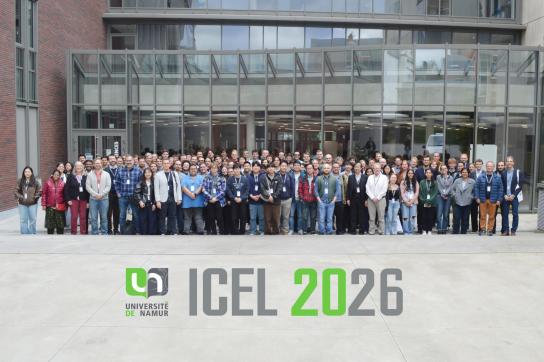
Reconnue comme une conférence de recherche de premier plan dans le domaine de l'électroluminescence organique et des dispositifs émetteurs, les conférences ICEL se tiennent généralement tous les deux ans, depuis leur création à Fukuoka, au Japon, en 1997, par le professeur Tetsuo Tsutsui. Retour sur l’ICEL2026, 15e conférence du nom, à l’UNamur.
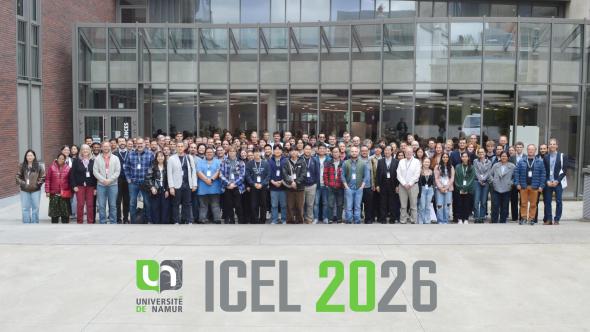
En mai dernier, l'International Conference on Electroluminescence and Optoelectronic Devices (ICEL 2026), organisée à l’Université de Namur par le Professeur Yoann Olivier, avec le soutien duet le Professeur Benoît Champagne, a offert une excellente occasion d'échanges intellectuels et sociaux aux chercheurs du monde entier impliqués dans la recherche, le développement et la fabrication de matériaux émetteurs de lumière d’échanger sur leurs récentes avancées.
Cette 15e édition a proposé des conférences plénières aux 125 participants, qu’ils soient chercheurs renommés ou émergents. Un programme dense sur 5 jours, avec 5 exposés de « keynote speakers » internationaux renommés, 20 exposés de conférenciers invités et une trentaine de communications orales sélectionnées par le comité organisateur, ainsi que deux sessions posters réunissant plus de 50 présentations.
Les participants ont également pu profiter de moments de rencontre et de discussions dans les différentes activités du programme social qui mettait la Ville de Namur, ses lieux emblématiques ainsi que ses commerces à l’honneur : visite des souterrains de la Citadelle, balade historique et/ou gourmande au cœur du piétonnier, visite du Musée Félicien Rops et des caves Grafé-Lecocq, dîner des conférenciers invités au restaurant « Le Balthazar » et dîner de conférence au restaurant « Le Panorama ».
Un accent particulier a été mis sur la participation active de jeunes chercheurs motivés. Un large éventail de sujets a été exploré, offrant une perspective complète sur les avancées contemporaines dans le domaine des matériaux, de la physique fondamentale et de leurs applications dans les dispositifs et applications de pointe.
« Un IMMENSE merci – ce fut une conférence vraiment excellente – une science de haut niveau et une merveilleuse ambiance accueillante – exactement comme devraient l’être les conférences ! » – Sir Richard Friend, Université de Cambridge, Royaume-Uni
« Je tiens à vous féliciter pour cette excellente conférence. J'ai beaucoup apprécié son format (pas trop grand), le fait qu'il s'agisse d'une session unique, son prix abordable, le cadre agréable, ainsi que les nombreuses occasions de discuter avec les autres participants autour d'un café, d'un déjeuner ou d'un rafraîchissement pendant les sessions de posters. Le niveau scientifique était excellent (ce à quoi je m'attendais pleinement de votre part en tant qu'organisateurs) et le programme offrait une belle diversité. Les activités sociales, le dîner avec les conférenciers invités et le spectaculaire dîner de la conférence ont tous contribué à rendre cette semaine merveilleuse. Ce fut une semaine extraordinaire. » – Prof. Ifor Samuel, Université de St Andrews, Royaume-Uni
« Ce fut un réel plaisir d’assister à la conférence ICEL. On se sentait vraiment comme en famille et l’ambiance était si chaleureuse qu’elle a complètement compensé le temps froid et ma grippe. Excellente organisation et timing parfait ! », Prof. Illia Serdiuk, Université de Gdansk, Pologne
« Encore un grand merci pour l’effort d’organisation, la conférence s’est déroulée sans le moindre accroc ! » – Prof. Barry Rand, Université de Princeton, États-Unis
Le Professeur Barry Rand a d’ailleurs pris la relève, puisqu’il organisera la 16ème édition de la conférence à la prestigieuse Université de Princeton, USA en 2028.
Le comité organisateur tient à remercier ses sponsors et partenaires pour leur soutien : Universal Display Corporation, Angstrom Engineering, The Royal Society of Chemistry (RSC), Chemistry Europe, l’Université de Namur, le Namur Institute of Structured Matter (NISM), le Namur Research College (NARC), le C.G.B. (Comité de Gestion du Bulletin) - C.B.B. (Comité van Beheer van het Bulletin), l’Office du Tourisme de la Ville de Namur et les écoles doctorales thématiques CHIM, MAIN et METAMORPHOSE du F.R.S.-FNRS.
Atomistic modeling of the nanomechanical properties of organic semiconductors for flexible electronics
This thesis presents a multiscale investigation of the nanomechanical properties and deformation mechanisms of organic semiconductors, which are best known for their optoelectronic properties. It examines their mechanical behavior in the context of increasing structural complexity, from individual molecular interactions to crystalline and polymeric materials. Computational results are systematically compared with available experimental measurements. The molecular dynamics approaches used throughout this work are introduced and applied to different topics of current interest in the field.
In this thesis, the following topics were investigated: (i) the force-induced dissociation and conformational unfolding pathways of individual π–π interactions in a perylene derivative dimers, (ii) the anisotropic elastic properties of high-mobility DNTT molecular crystals and the influence of alkyl-chain functionalization on their mechanical rigidity and (iii) the impact of microstructure, ranging from crystalline to amorphous phases, as well as F4TCNQ doping on the nanomechanical properties of PBTTT. In all applications reported above, the computational results are confronted with experimental data across these different structural scales to assess the predictive capabilities of the modelling approaches and identify the molecular and structural factors that govern the mechanical response of organic semiconductors. Finally, the conclusions are presented alongside perspectives to achieve a better understanding of, and ultimately the rational design of, mechanically tunable organic semiconductors for use in flexible electronics.
After a successful 1st edition that notably gathered figures renowned for discovering and conceptualising intrinsically disordered proteins – Drs. Vladimir N. Uversky, Peter Tompa, and Sonia Longhi – we are pleased to announce that the 2nd edition of the One-Day Symposium on Protein Disorder, Interactions, and Dynamics (PDID 2026) will be held on Friday the 18th of December 2026 at the University of Namur (UNamur), Namur, Belgium.
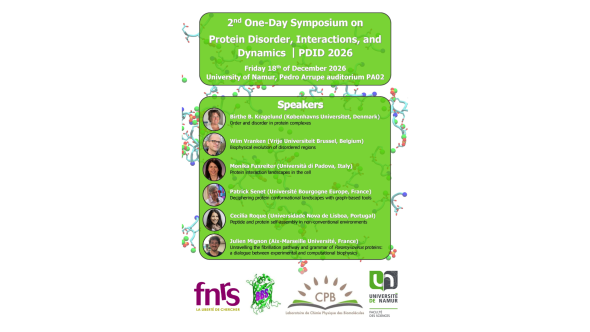
Organised every two years by the Belgian Biophysical Society (BBS) and the Laboratoire de Chimie Physique des Biomolécules (CPB), the PDID symposium is a human-sized and convivial event for exchanging new ideas and meeting leading experts in the field in the typical Belgian city of Namur, the capital of Wallonia located at the confluence of the rivers Meuse and Sambre.
We are welcoming people from any scientific background who are especially interested in diving into the world of biomolecules dynamics as well as exploring their unique behaviours, comprising structural transition, interaction network, protein-ligand interaction, self-assembly, amyloid fibrillation, condensation, phase separation and transition. Through the lens of biophysics, biochemistry, bioinformatics, and molecular biology, the program aims at covering both experimental and computational approaches for the characterisation of such intricate and elusive systems in health-related, biotechnological, and biomaterial contexts.
