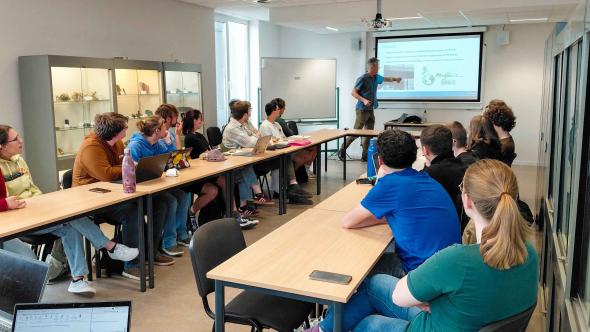
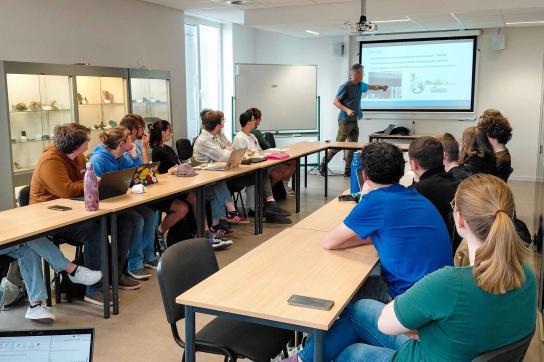
Exploring the Earth and its past to prepare for a sustainable future.

Geologists interrogate rocks and landscapes to reveal the dynamic processes that shape our natural environment. Why is the Earth unique in our solar system? How did life develop here? How diverse are the rocks and minerals that make it up? Where can we find the metals we need for technological and sustainable development? How can we manage, protect and clean up our soil and groundwater? From the field to the laboratory, geology provides answers to these varied questions through an interdisciplinary approach combining exact and natural sciences.

Find out more about the Geology Department

SVG

Geology studies

See content
SVG

Geological research

See content
SVG

Service to society

See content
SVG

Contact

See content
SVG

Alumni

See content

Nowadays, the geologist plays an essential role in the energy transition. They identify and enable the extraction of metals and other resources crucial to the establishment of sustainable energies. Thanks to their understanding of the interactions between the subsoil and the environment, they contribute to land-use planning and the siting of new infrastructures and buildings.

In the age of space exploration, geologists also compare the Earth with the other planets in our solar system to better understand the specific features of our "living" planet. These current themes are at the heart of our research activities and continue to diversify the opportunities for our graduates.

The spectacular rocks sculpted by the Meuse and its tributaries in the Namur region have captivated European geologists for over two centuries. They illustrate major geological processes and trace the evolution of our region over hundreds of millions of years. They are also home to numerous quarries that continue to fuel our local industry and economy.

parc_sambre_meuse

Spotlight

News

Colourful speleothems: treasures hidden deep within the earth

Geology

Well hidden from passersby, caves nevertheless conceal particularly aesthetic secrets. For the past four years, Martin Vlieghe has been pursuing a PhD in geology at UNamur.  He is exploring the origin of the surprisingly varied colours of certain concretions nestled in the heart of Belgian and French caves. Together with Prof. Johan Yans and Gaëtan Rochez, he samples, observes, and analyses these magnificent objects with the aim of uncovering the mysteries they conceal.
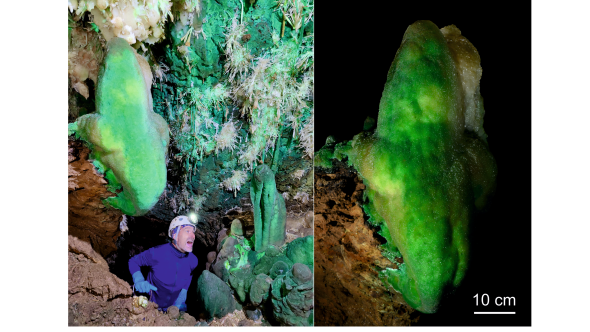
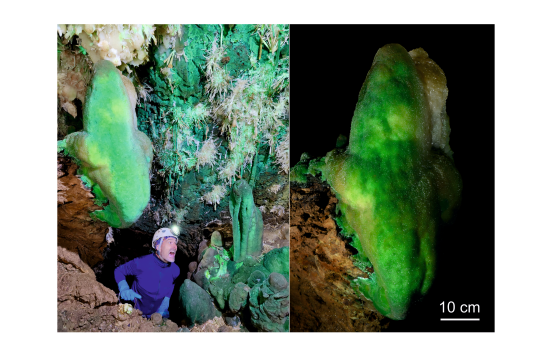
Spéléothèmes verts dans l’Aven du Mont Marcou (Hérault, France) © Stéphane Pire, Gaëtan Rochez (UNamur)

Photo: Green speleothems in the Aven du Mont Marcou (Hérault, France) © Stéphane Pire, Gaëtan Rochez (UNamur)

Speleothems, for instance stalactites and stalagmites, are commonly composed of calcite or aragonite (CaCO3). This mineral compound comes directly from the rock in which the cave was formed and naturally has a white to brownish colour. However, speleothems can sometimes exhibit unique and unusual colours. From yellow to black, blue, red, green, and even purple, there is something for everyone! 

Such a diversity of colours reflects the many possible causes: mineralogical, chemical, biological, or even physical. A speleothem, like any natural formation, is never perfectly pure. Their deposition process, through the precipitation of calcium carbonate dissolved in water, is necessarily accompanied by the deposition of numerous impurities carried along with the water circulating underground. Even if these impurities are sometimes too low in concentration or simply uncoloured, they can still have a visible impact on the colour. 

OK, but what is the point?

The formation of speleothems is very often linked to impurities dissolved in groundwater. Therefore, studying coloured speleothems provides valuable information about potential contamination of surface water with heavy metals or other harmful organic compounds, which in some cases may be consumed by residents. It is therefore a simple and direct way to identify areas with potentially contaminated water and to determine whether this contamination poses an environmental or health risk.

This is the objective of Martin Vlieghe's thesis: to apply a range of cutting-edge analytical techniques to samples of these speleothems to determine these causes and propose an explanation for the origin of the colouring elements. 

Here are a few examples.

Green from the Aven du Marcou: the influence of nickel

An initial project explored the green speleothems of the Aven du Marcou (see photo above). Located in the Hérault department of France, this chasm is well known in the area for its series of impressive shafts, the largest of which is over 100 meters deep. It also has a tiny chamber hidden at the top of a steep wall, which houses an impressive concentration of deep green speleothems. After all the effort of descending and climbing ropes to progress through this very vertical cave, what a wonderful reward to discover this true underground gem! Once the initial wonder has passed, it's time to get to work!  We observe, describe, interpret, and collect a few green fragments from the ground, while respecting the integrity of the site as much as possible. Back in Belgium, it's time to move on to the analyses.

Careful observation of the recovered fragments quickly reveals the presence of green minerals in the outer part of the speleothems, which are easily associated with the green colour observed. These minerals, which are deposited in platelets parallel to the white aragonite (CaCO₃), turn out to be nepouite crystals, a nickel phyllosilicate ((Ni,Mg)SiO(OH)) usually found in marine volcanic rocks.

Photo : Vue au microscope électronique à balayage mettant en avant les dépôts de népouite sur les cristaux d’aragonite.
Picture: Scanning electron microscope view highlighting nepouite deposits on aragonite crystals.

The discovery is all the more surprising given that there are no nickel deposits in the vicinity of the cave! Further study of the composition of the nepouite reveals that they contain a high concentration of zinc, which is also very unusual and suggests that they are in fact quite different from those commonly mined in volcanic deposits. Finally, this mystery was solved by a thorough examination of the rock outcrops in the immediate vicinity of the cave. Just above the cave are siliceous deposits particularly rich in pyrite, an iron sulphide commonly found in this type of settingst. Analysis of these sulphides reveals high concentrations of nickel, which is also found in the natural water source closest to the cave. 

The result of this "investigation" and final explanation: nepouite was able to settle underground through the dissolution of various chemical elements contained in the pyrite of the overlying rocks, which were transported into the cave by surface water and were able to crystallize on site. 

Malaval blues: when metals interact

The Malaval cave is very different from the Aven du Marcou. Located in Lozère (France), it extends largely along a high underground river that winds beneath the Cévennes massif. At the bend of a meander, one can find magnificent blue speleothems. 

As in the Aven du Marcou, the coloured speleothems are found only in two specific locations in the cave and nowhere else, suggesting that the origin of the chromophore elements is probably very localized.
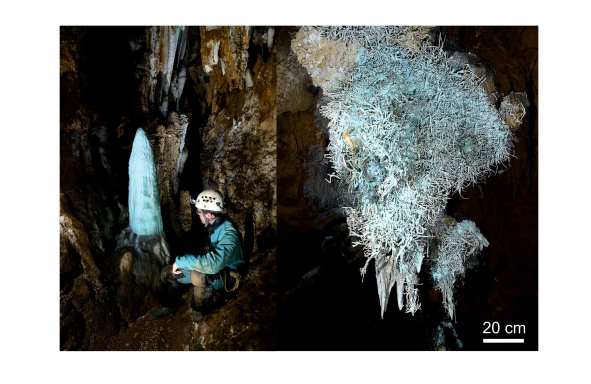
Gauche : Stalagmite bleue de la Grotte de Malaval. Droite : Bouquet d’aragonite bleue de la Grotte de Malaval © Gaëtan Rochez (UNamur)

Photos - Left: Blue stalagmite in Malaval Cave. Right: Cluster of blue aragonites in Malaval Cave © Gaëtan Rochez (UNamur)

Once again, a few fragments were collected, including a large bluish stalactite found broken on the cave floor. A series of microscopic observations and mineralogical and geochemical analyses were carried out. The first striking finding was that several blue fragments contained no minerals other than aragonite, suggesting that, unlike the green ones from Marcou, it was the aragonite itself that was coloured by the presence of metallic elements. After examining the analyses, three of these elements stood out: copper, commonly cited as the cause of blue colouring in aragonite, as well as zinc and lead. 

While copper appears to be the main cause of the blue colouration, zinc and lead also play a role here. 

Zinc is largely present in the form of deep blue amorphous phases, which are only found in some of the blue fragments studied. The presence of these phases, linked to the oxidation of nearby zinc-rich deposits, generates variations in the blue colour at the microscopic level, as revealed by optical microspectrophotometry.

Prises de vue de spéléothèmes bleus de Malaval au microscope électronique à balayage montrant les phases riches en Zn. Gauche : Vue en électrons rétrodiffusés. Droite : Cartographie élémentaire.
Scanning electron microscope images of blue speleothems from Malaval showing Zn-rich phases. Left: Backscattered electron image. Right: Elemental mapping.

Lead also has a marked colouring power, producing green to blue hues, but statistical analysis of coloured and uncoloured areas shows that these colours only appear in the absence of zinc, which seems to inhibit lead-induced colouring. This study clearly demonstrates that, even if a problem seems easy to explain at first glance, it can sometimes hide unexpected subtleties that need to be explored in greater depth in order to uncover all its secrets. 

Gypsum from the Cigalère: the underground rainbow

The Cigalère Cave is one of a kind. Not only does it contain impressive quantities of gypsum, a calcium sulphate found in certain caves, but this gypsum also displays a wide variety of colours rarely seen in nature. Because of this rarity, the cave is particularly well protected, to the point that we were not allowed to collect any fragments from inside it. 

This study was therefore the ideal opportunity to test the Geology Department's new acquisition: a portable X-ray fluorescence spectrometer (pXRF), which allows rapid, in situ, and above all completely non-destructive analysis of coloured speleothems.
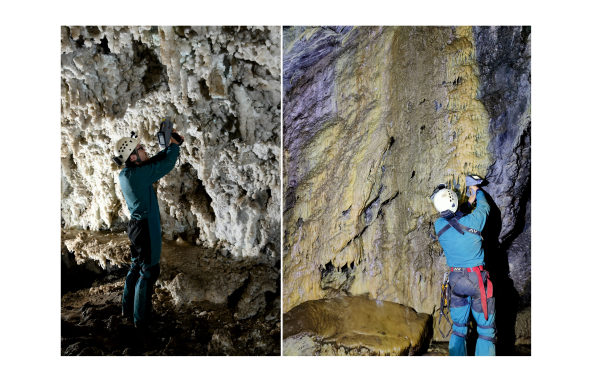
Analyse pXRF d’un coeur de stalactite bleu (gauche) et d’une coulée jaune (droite) dans la Grotte de la Cigalère © Stéphane Pire (UNamur)

Photos - pXRF analysis of a blue stalactite core (left) and a yellow flowstone (right) in the Cigalère Cave © Stéphane Pire (UNamur)

A total of five sites of interest were selected in the Cigalère for the diversity of colours found there. The pXRF revealed the presence of several metals. 

At Cascade Noire, for example, a high concentration of iron in the form of oxides and sulphates was detected, which are responsible for the black and orange colouring of the gypsum, respectively.

Modèle 3D de la Cascade Noire. Les cercles représentent l’intensité du pic pXRF du fer, montrant une plus forte concentration dans la partie noire (oxydes de fer), et une plus faible dans la partie orangée (sulfates de fer).
Picture: 3D model of the Cascade Noire. The circles represent the intensity of the pXRF peak for iron, showing a higher concentration in the black part (iron oxides) and a lower concentration in the orange part (iron sulfates).

Black is also found in the Chapelle de Donnea, but contrary to what one might think, no iron has been detected. Here, it is manganese in the form of oxides that is responsible for the colouration. This observation is interesting because it clearly demonstrates that black colouration in gypsum, two phenomena that appear similar at first glance, can have very different causes, hence the importance of being able to carry out analyses directly in the field. 

A little further downstream, blue dominates along the main gallery, and analyses have shown strong similarities with the blue speleothems of Malaval, with a marked influence of copper and potentially zinc. 

All this highlights that, despite certain limitations of the device, this type of non-destructive analysis method is a very valuable tool for studying rare, fragile, precious, or protected objects, of which the Cigalère cave is an excellent example! 

The research team

Martin Vlieghe's doctoral thesis on "The origin(s) of colored speleothems in caves," supervised by Professor Johan Yans and in collaboration with Gaëtan Rochez, began in February 2022. All three researchers are members of the Faculty of Sciences, Department of Geology at UNamur and the ILEE Research Institute. 

ILEE (Institute of Life, Earth and Environment) is directly involved in issues related to the study and preservation of the environment, to which this subject is directly linked. 

The various analyses were carried out with the support of UNamur's technological platforms:

Some analyses were carried out in partnership with KUL, MRScNB and UMontpellier, and access to the caves was provided by the Association Mont Marcou, the Malaval Association and the Association de Recherche souterraine du Haut Lez.

This thesis was originally funded by the ILEE institute and institutional funds from UNamur, and by an Aspirant F.R.S. - FNRS grant (FC 50205) since October 2023.

It is also closely linked to the new research partnership supported by the RELIEF network (Réseau d’Échanges et de Liaisons entre Institutions d’Enseignement supérieur Francophones), the ILEE research institute at UNamur, and EDYTEM (Environnements, Dynamiques et Territoires de Montagne, Université Savoie Mont Blanc).  Mobility programs between these entities will strengthen a common research area: the study of the critical zone, the most superficial zone of the Earth, where rocks, water, air, and living organisms interact. The perspective is to develop other transdisciplinary research areas and potential teaching projects in the field of environmental sciences and sustainable development.

Being curious about the Earth and the natural world: a key to meeting tomorrow's challenges!

Studying geology means developing a solid foundation in physics, chemistry, and biology in order to understand the Earth, from its internal dynamics to surface processes and their interactions with our environment and human activities. 

Thanks to their interdisciplinary training, geologists are ideally positioned to perform a variety of roles that require a rigorous scientific approach to solving complex problems (research and development, project management, consulting, and education).
What are the advantages of studying at UNamur? 

  • Practical training and numerous field activities
  • Strong scientific foundations
  • Immersion in geology from block 1
  • The possibility of ERASMUS from block 3 onwards
  • Close contact with teachers

The advantages of studying in Namur

  • A practical training and lots of field activities
  • Strong scientific foundations
  • Immersion in geology from the 1st year
  • ERASMUS possible from the 3rd year onwards
  • Close contact with teachers

Climate disruption: fossils tell us about the past to better understand the future

Geology
Sustainable

Today, our planet is undergoing major climatic changes. Particularly in the face of rising temperatures, it is not easy to predict how flora and fauna will react and adapt in disturbed ecosystems. International research, in which Professor Johan Yans' team (Department of Geology and ILEE Institute) is taking part, has found some answers in fossils, which have been the memory of Darwinian evolution for millions of years. Explanations.

Johan Yans et Jean-Yves Storme sur le site de fouilles à Albas (France) (c) Gaëtan Rochez - UNamur

Photo: Excavation site at Albas, Massif des Corbières (France) © Gaëtan Rochez (UNamur)

Current predictions for biodiversity evolution in the face of climate change are based on models and scenarios derived from multidisciplinary studies. An article has just been published in the prestigious journal PNAS (Proceedings of the National Academy of Sciences), feeding into these scenarios. The researchers' original idea? To envisage an analogy between the biodiversity of the past and that of the future.

To understand, we need to go back 56 million years, to the transition between the Paleocene and the Eocene, a period characterized by intense global warming (named Paleocene-Eocene Thermal Maximum - or PETM). Paleoclimatologists consider this period to be a geological analogue of today's warming in terms of its amplitude (an increase of 5 to 8°C) and cause (a massive release of CO₂ into the atmosphere, similar to what we experience today).

At this time, global warming generated major disturbances on fauna. This change in climate, although 10 to 100 times slower than the one we experience today, coincided with the appearance of "modern" placental mammals (of which humans are a part), but also artiodactyls (ruminants, goats...), perissodactyls (horses, rhinoceroses...), bats, rodents and so on. Intense and rapid climatic disturbances generate major stresses on ecosystems: organisms try to adapt, some disappearing because they are unable to cope with these intense environmental changes, while others develop or evolve. This scenario was already well known...

But a few thousand years before PETM, another warming episode, named Pre-Onset Event (or POE), is recorded. It is less intense (+2°C) than the PETM, and more similar to current climate disturbances, leading researchers to investigate its impacts on faunas.
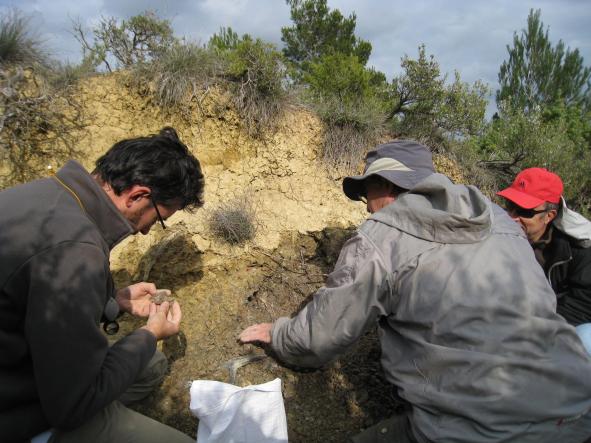
Johan Yans à Albas

Photo: In search of fossils by fellow paleontologists from the University of Montpellier © ISEM

Fossils speak

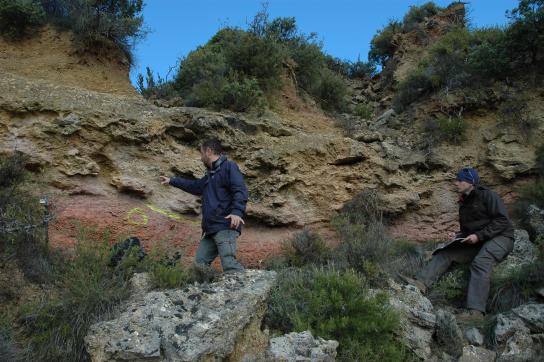
Field research has been carried out in the Massif des Corbières, southern France: the geological layers representative of this period are numerous and thick. Thanks to carbon isotope geochemistry, Namur researchers have been able to date these layers with great precision, making it possible to detail the evolution of fossils over time.

The fossils thus discovered have delivered their memory. And this calls into question previously established scenarios on two key aspects:
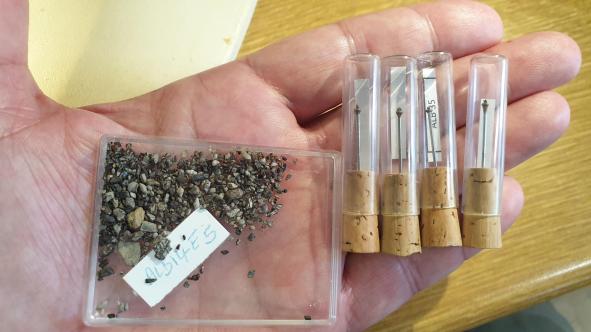
  • Species evolved rapidly as early as the EOP, a climatic event similar to today's disturbances.
  • While researchers thought that European faunas were composed of species endemic to Europe, they discovered that these archaic animals also rubbed shoulders with more modern species, such as marsupials or rodents, having probably migrated from North America during the EOP.
Echantillons de fossiles prélevés en cours de fouilles, Albas, France

Photo: Mammal fossils discovered at Albas preserved in small glass tubes. These are the tiny teeth of a small "archaic" mammal called Paschatherium. Rodolphe Tabuce

So, during the EOP, species migrated from one continent to another... But how is this possible? It was thought that, at the time, the European continent was relatively isolated from the others by shallow seas. In reality, as a result of global warming, vast expanses of forest covered the high latitudes (present-day northern Greenland, Scandinavia and the Bering Strait in Siberia), serving as "natural land bridges" for forest fauna! Climatic disturbances therefore modified the flora, which in turn served as a passage between continents for "modern" faunas, also in the midst of upheaval.

The climatic disturbances of the POE, similar to those recorded today, therefore drastically influenced the faunas, notably by facilitating intercontinental migrations.

The impact of these decisive events during the EOP offers new avenues for reflection and study on the future of biodiversity in the context of current and future global warming.

The project team

"EDENs: Life during past super-warm climate events: Evolutionary Dynamics of Early EoceNe mammals from Southwestern France" is a multidisciplinary and international project in which Johan Yans, Jean-Yves Storme and Gaëtan Rochez (Department of Geology and ILEE Institute at UNamur) have been involved for the past 3 years. This research brings together the expertise of various partners:

  • L'Institut des Sciences de l'Evolution de Montpellier (ISEM), Rodolphe Tabuce and Fabrice Lihoreau,
  • Géosciences Montpellier, Flavia Girard and Gregory Ballas.

It is funded by the Agence Nationale de la Recherche (ANR-France). Its mission is to support and promote the development of fundamental and finalized research in all disciplines, and to strengthen the dialogue between science and society.

Sustainable development at UNamur

The university, in its missions, must be exemplary in terms of Sustainable Development in line with the United Nations Sustainable Development Goals (SDGs).

Objectifs du développement durable

In terms of training, in addition to courses incorporating the SDOs, the University of Namur offers the University Certificate of Further Training in Sustainable Development. Aimed at members of organizations, administrations, companies, schools, etc. concerned or simply interested in the implications and challenges of sustainable development, it aims to offer information that is as thoughtful and diversified as possible, in order to help each participant better position, in his or her professional context, the issues linked to sustainable development that concern him or her more directly.

In terms of research, researchers work through 11 interdisciplinary research institutes. Johan Yans' team is active within the Institute ILEE - Institute of Life, Earth and Environment - and this research is a focus of activities devoted to Sustainable Development at UNamur.
A furnace to reproduce magmatic processes in Mars rocks

Geology
UNIVERSEH

Max Collinet, professor of geology at the Faculty of Science and researcher at the Institute of Life, Earth and Environment (ILEE), has just been awarded equipment funding (EQP) from the F.R.S - FNRS following calls whose results were published in December 2024.
Photo de Max Collinet, logo FNRS et ILEE

The rocks that make up a planet's crust have a wide variety of chemical and mineralogical compositions. For the most part, these rocks originate from the slow cooling of magmas produced by the melting of other rocks located deeper down (the so-called mantle).

Between their source and the surface, magmas undergo continuous transformations, as crystals form and separate, progressively modifying their composition. It is theoretically possible to use surface rocks to infer the composition of planetary interiors. However, this requires a detailed understanding of magmatic processes, which can be partially reproduced in the laboratory.

The funding obtained will be used to acquire a furnace capable of reaching temperatures of up to 1600°C, in order to study the chemical equilibria between magmas and the various crystals that form in them.

Lame mince de météorite martienne (shergottite)
Thin blade of Martian meteorite (shergottite): olivine basalt (large, colored crystals), a rock formed by the crystallization of magma originating in the mantle on the surface of Mars, then ejected by an impact.

Two objectives

The first objective is to constrain the magmatic processes behind rocks over 3.5 billion years old, analyzed by the Perseverance rover on Mars. This should make it possible to identify the nature of the mantle rocks at depth, but also to better understand how the Martian crust, as a whole, was formed.

The second objective is to study even older magmatic processes, active over 4.5 billion years ago, at a time when planets were still forming and had not yet reached their final size. At that time, the solar system was populated by miniature planets known as planetesimals, the vast majority of which were incorporated into the growing planets. Some fragments of these planetesimals survived to form what are known today as asteroids.

Image
Photo de Max Collinet

We can also study the meteorites from these planetesimals and reproduce the magmatic processes that gave rise to them, in order to understand why the planets of the solar system are covered with rocks of such varied compositions.

Max Collinet Professor of Geology, Faculty of Science and ILEE Institute

Max Collinet - Mini CV

Max Collinet joined the University of Namur in September 2023. He brings unique expertise in magmatic petrology and planetary geology. Having explored Martian rocks through the study of meteorites, he also examined asteroid meteorites at MIT Boston. At UNamur, his ambition is to develop an experimental petrology laboratory and collaborate with physicists.

Photos de Max Collinet

Committed to the UNIVERSEH program, Max Collinet has positioned himself as a key figure in the geological and space fields.

To find out more, read our previous article: Understanding Mars rocks that have fallen to Earth: portrait of a geologist with his head in the stars

ILEE - Institute of Life, Earth and Environment

The Institut de la Vie, de la Terre et de l'Environnement at the University of Namur brings together a team of experts from diverse backgrounds and disciplines to work collaboratively using innovative technologies and rigorous scientific methods to make significant contributions to the field of environmental sciences. Researchers collaborate in interdisciplinary research around 5 research areas.

Logo institut de recherche ilee

FNRS, the freedom to search

Every year, the F.R.S.-FNRS launches calls for proposals to fund fundamental research. It has set up a range of tools enabling it to offer scientific and technical staff, equipment and operating resources to researchers, who are the bearers of a project of excellence.

Logo FNRS

Space, between dream and strategic challenge

Space
Institution
SDG#12 - Responsible consumption and production
SDG#13 - Measures to combat climate change
SDG#17 - Partnerships to achieve the goals

Space has become a major economic and strategic issue. As a member of the European UNIVERSEH Alliance, UNamur explores this space theme in its various departments, from physics to geology, via mathematics, computer science or philosophy. Without forgetting to address the general public, who still dream of the stars...

le-spatial-a-l-unamur

All it takes is one night under the stars to plunge us back into the endless questions of childhood: are we alone in the Universe? Can we go back in time? Does space have a limit? And what lies beyond that limit? "Today, we know that the stars around us are spread out over a very large space, and that we are part of the suburbs of one galaxy among many others", explains Eve-Aline Dubois, a mathematician by training and researcher in the Department of Science, Philosophy and Society at UNamur. "But this is a recent realization, marking the beginnings of cosmology as a science, dating back more or less to the 1920s." Because it considers the Universe as a whole, cosmology actually operates a "huge zoom-out" from conventional astronomy. "On the scale of cosmology, a galaxy is a point", sums up the researcher.

Cosmology, a recent science

While working on the history of cosmology, Eve-Aline Dubois was challenged by the fact that many theories relating to space were motivated by positions that had nothing to do with science, but were rather metaphysical or philosophical."For example, Einstein was convinced that the Universe had to be static, which is why he put into his equations what would make the Universe static," she illustrates.

eve-aline-dubois
Eve-Aline Dubois

An observation that led her to take an interest in the notion of infinity in the late Middle Ages and early Renaissance. "At the time, infinity was considered an attribute of God: so it was more of a theological question, before the debate shifted to more scientific and philosophical considerations. And it wasn't until the late 19th and early 20th centuries that the notion of infinity was properly mathematized." An infinity that can be envisaged in both its temporal and spatial dimensions. "Can we go back to infinity in the past, and does the Universe have an infinite future? With the Big Bang, this theory falls apart, since there would be a beginning... But also: does the Universe have a boundary, or is it like the surface of a sphere which, if traversed, would give the impression of never reaching the end?"

Space as a resource

If space is of interest to the philosophy of science, it is also at the heart of very real economic and geopolitical issues. Using applied mathematics, Jérôme Daquin, a lecturer in the Department of Mathematics at UNamur, is seeking to gain a better understanding of how satellites and space debris in the Earth's vicinity behave. "Ultimately, the aim is to be able to guide political or legislative decisions to preserve space, which is increasingly seen as a resource, on a par with other natural resources," he explains. Today, space has never been so densely populated with satellites, sometimes sent up in squadrons, notably for the needs of new technologies and high-speed Internet. But at the same time, the space environment is cluttered with several million objects that have become useless and out of control. "This space debris has various sources", Jérôme Daquin details.

"They can come from rocket launches, collisions, explosions of eroded material, deliberate destruction by missile fire.... They also pose risks of various kinds, either in orbit or on the ground. Voices from the community are also being raised to warn that, at the rate things are going and without major changes, we will no longer be able to access and use this space resource."

jerome-daquin
Jérôme Daquin

Thanks to the theory of dynamic systems and the field known as "complexity", Jérôme Daquin is therefore trying to understand how space objects behave on large time scales, in order to propose perennial scenarios. "These scenarios make it possible, for example, to envisage placing a satellite in such and such an orbit that we know will not deform over time." Because today the issue of space debris has become central not only for certain private operators, but also for public authorities and in particular for the defense sector. "Space has always been a place of strategic influence", recalls Jérôme Daquin. "For the armed forces, having a good knowledge of it is always very interesting." Today, moreover, there is a synergy between academic and private players concerning the production of data relating to the space environment. "Fifteen years ago, this didn't exist, but today, more and more companies are producing their own cataloging."

Digital twins

If space is an essential resource for the new technologies sector, computer science and artificial intelligence (AI) in turn enable us to better understand the enigmas it still harbors. For example, the team led by Benoît Frenay, a professor at UNamur's Faculty of Computer Science, is collaborating on the VAMOS project, which is studying the atmosphere of Venus.

"We help scientists to analyze the data collected thanks to probes sent into space, but also to complete these data when they are missing." The contribution of AI to the space field doesn't stop there, either. "We can also help scientists model space phenomena, such as extrasolar planets, solar flares"details Benoît Frenay.

benoit-frenay
Benoît Frenay

"This allows us to work not directly on a system of distant planets, for example, but on its "digital twin", which we will have built from data. While it's impossible to modify a star and its planets, it is possible in computer science! It's quite possible to modify a digital solar system and observe, for example, what would happen if one of the planets were a little bigger... Finally, we can help the missions themselves, by embedding AI techniques in the probe."

As a geologist specializing in the study of magmas at UNamur, Max Collinet also collaborates on a number of space missions. "Magmas are obviously linked to volcanology, but on a larger scale, they also inform as to the formation of rocks on Earth, but also on other planets. The question is also how these magmas may have influenced the composition of these planets' atmospheres."

max-collinet
Max Collinet

By helping to analyze the physical and mineralogical composition of rocks on the surface of Mars or Venus, geology is thus able to better understand the conditions necessary for the appearance of life and why, Max Collinet points out, this life has instead developed on Earth, "our favorite planet"

UNIVERSEH Alliance

At the end of 2022, UNamur joined the European Alliance UNIVERSEH (European Space University for Earth and Humanity) focused on the theme of space, with the aim of addressing societal and environmental challenges relating to European space policy. This Alliance is part of the European Alliances initiative launched in 2017 by Emmanuel Macron. "A European Alliance is a network of universities that come together voluntarily with the aim of building an international campus and thus facilitating the development of integrated international pathways accessible to different learner profiles, explains Isabella Fontana, Director of International Relations at UNamur."This implies a great openness for students, who can choose innovative pathways recognized at European level, but also for teachers, who can collaborate in a context conducive to cross-border, transdisciplinary interactions and in dialogue with regional ecosystems."

Networking

Alliances can be either transversal or thematic, as is the case with the UNIVERSEH alliance. "The case of Belgium is rather particular since all the universities were already part of an alliance in 2022, with the exception of UNamur. There was therefore a particular strategic challenge for our university to join an alliance in its turn," continues Isabella Fontana. By joining the six other alliance partners - including the University of Toulouse, a European leader in the space field - UNamur can now lay claim to new opportunities in terms of international collaborations, teaching and research. "One of UNamur's strengths in relation to space is the scientific mediation and education component", details Isabella Fontana."Having said that, the aim of the Alliance is above all to be able to work in a network, to fuel the process of raising awareness of the importance of the network especially in the field of education and more generally in economic development. At UNamur, for example, we have devoted part of the budget to stays for members of the academic and scientific staff who wish to develop collaborations particularly at teaching level with partner universities, collaborations which, of course, have the potential to have spin-offs on research too."

UNIVERSEH Annual General Meeting at UNamur

From November 18 to 20, the University of Namur had the honor of hosting scientists, academics, students and university staff from all over Europe for the UNIVERSEH alliance's "General meeting".

Image
Soirée networking au Théâtre (c)Christophe Danaux

"UNamur joined the Alliance relatively recently. Organizing and hosting the general meeting was a way of showing and demonstrating our investment in this project. It was also an opportunity to showcase Namur and its ecosystem", says Annick Castiaux, Rector of UNamur. The main aim of the general meeting was to bring together all the partners and people involved in the project to discuss progress and difficulties, but also to build solid, supportive teams and encourage team spirit. Work meetings, thematic workshops and collective exchange moments took place throughout the three days.

.

More about UNIVERSEH

Space is still the stuff of dreams

A complex field involving both the "hard" sciences and the humanities, particularly the philosophy of science, space is also very present in literature and film. This makes it a "perfect theme for popularization", according to Maxime Dussong, communications and events manager at Confluent des Savoirs, UNamur's research popularization service."In culture, space is everywhere. It's an interesting gateway, even if we also have to break down stereotypes. And remind people that space isn't just about astronauts...". This is notably the aim of the Printemps des Sciences, an initiative of the Wallonia-Brussels Federation in which UNamur is actively involved. "Through this event, we are reminding people that the theme of space can be found in all STEM (science, technology, engineering, and mathematics) professions. On this occasion, we also organize visits to UNamur's Antoine Thomas Astronomical Observatory, which are always a huge success. They enable the public to discover the various instruments used there, but also, weather permitting, to observe the sky..."

A dedicated event, the Space week organized at UNamur (the last edition was held in October 2024) meanwhile enables schools and the general public to rub shoulders very directly with the thrill of space through meeting astronauts. "Again this year, we were lucky enough to have the participation of Dirk Frimout, who everyone knows, even children in fifth grade...", recounts Maxime Dussong. The event also features themed workshops, on constellations for example, an opportunity to "make the link between legends and science"and to"remind the youngest of the distinction between science and belief"illustrates Maxime Dussong.

Finally, UNamur is collaborating on various space-related art projects, such as "Stellar Scape", an exhibition at the Pavillon - located on the Esplanade de la Citadelle in Namur - which brings together works designed by artists and researchers until January 2025. "This is a fine example of collaboration, enabling people who are not very inclined towards scientific themes to become interested in them via art... and vice versa! ". We should also mention the existence at UNamur of Kap to UNIVERSEH, a kot-à-projet on the theme of space, which brings together students from all backgrounds: scientists, historians, philosophers... A transdisciplinary and cosmic experience!

This article is taken from the "Issues" section of Omalius magazine #35 (December 2024).

Visuel de Omalius #35 - décembre 2024

Colourful speleothems: treasures hidden deep within the earth

Geology

Well hidden from passersby, caves nevertheless conceal particularly aesthetic secrets. For the past four years, Martin Vlieghe has been pursuing a PhD in geology at UNamur.  He is exploring the origin of the surprisingly varied colours of certain concretions nestled in the heart of Belgian and French caves. Together with Prof. Johan Yans and Gaëtan Rochez, he samples, observes, and analyses these magnificent objects with the aim of uncovering the mysteries they conceal.

Spéléothèmes verts dans l’Aven du Mont Marcou (Hérault, France) © Stéphane Pire, Gaëtan Rochez (UNamur)

Photo: Green speleothems in the Aven du Mont Marcou (Hérault, France) © Stéphane Pire, Gaëtan Rochez (UNamur)

Speleothems, for instance stalactites and stalagmites, are commonly composed of calcite or aragonite (CaCO3). This mineral compound comes directly from the rock in which the cave was formed and naturally has a white to brownish colour. However, speleothems can sometimes exhibit unique and unusual colours. From yellow to black, blue, red, green, and even purple, there is something for everyone! 

Such a diversity of colours reflects the many possible causes: mineralogical, chemical, biological, or even physical. A speleothem, like any natural formation, is never perfectly pure. Their deposition process, through the precipitation of calcium carbonate dissolved in water, is necessarily accompanied by the deposition of numerous impurities carried along with the water circulating underground. Even if these impurities are sometimes too low in concentration or simply uncoloured, they can still have a visible impact on the colour. 

OK, but what is the point?

The formation of speleothems is very often linked to impurities dissolved in groundwater. Therefore, studying coloured speleothems provides valuable information about potential contamination of surface water with heavy metals or other harmful organic compounds, which in some cases may be consumed by residents. It is therefore a simple and direct way to identify areas with potentially contaminated water and to determine whether this contamination poses an environmental or health risk.

This is the objective of Martin Vlieghe's thesis: to apply a range of cutting-edge analytical techniques to samples of these speleothems to determine these causes and propose an explanation for the origin of the colouring elements. 

Here are a few examples.

Green from the Aven du Marcou: the influence of nickel

An initial project explored the green speleothems of the Aven du Marcou (see photo above). Located in the Hérault department of France, this chasm is well known in the area for its series of impressive shafts, the largest of which is over 100 meters deep. It also has a tiny chamber hidden at the top of a steep wall, which houses an impressive concentration of deep green speleothems. After all the effort of descending and climbing ropes to progress through this very vertical cave, what a wonderful reward to discover this true underground gem! Once the initial wonder has passed, it's time to get to work!  We observe, describe, interpret, and collect a few green fragments from the ground, while respecting the integrity of the site as much as possible. Back in Belgium, it's time to move on to the analyses.

Careful observation of the recovered fragments quickly reveals the presence of green minerals in the outer part of the speleothems, which are easily associated with the green colour observed. These minerals, which are deposited in platelets parallel to the white aragonite (CaCO₃), turn out to be nepouite crystals, a nickel phyllosilicate ((Ni,Mg)SiO(OH)) usually found in marine volcanic rocks.

Photo : Vue au microscope électronique à balayage mettant en avant les dépôts de népouite sur les cristaux d’aragonite.
Picture: Scanning electron microscope view highlighting nepouite deposits on aragonite crystals.

The discovery is all the more surprising given that there are no nickel deposits in the vicinity of the cave! Further study of the composition of the nepouite reveals that they contain a high concentration of zinc, which is also very unusual and suggests that they are in fact quite different from those commonly mined in volcanic deposits. Finally, this mystery was solved by a thorough examination of the rock outcrops in the immediate vicinity of the cave. Just above the cave are siliceous deposits particularly rich in pyrite, an iron sulphide commonly found in this type of settingst. Analysis of these sulphides reveals high concentrations of nickel, which is also found in the natural water source closest to the cave. 

The result of this "investigation" and final explanation: nepouite was able to settle underground through the dissolution of various chemical elements contained in the pyrite of the overlying rocks, which were transported into the cave by surface water and were able to crystallize on site. 

Malaval blues: when metals interact

The Malaval cave is very different from the Aven du Marcou. Located in Lozère (France), it extends largely along a high underground river that winds beneath the Cévennes massif. At the bend of a meander, one can find magnificent blue speleothems. 

As in the Aven du Marcou, the coloured speleothems are found only in two specific locations in the cave and nowhere else, suggesting that the origin of the chromophore elements is probably very localized.

Gauche : Stalagmite bleue de la Grotte de Malaval. Droite : Bouquet d’aragonite bleue de la Grotte de Malaval © Gaëtan Rochez (UNamur)

Photos - Left: Blue stalagmite in Malaval Cave. Right: Cluster of blue aragonites in Malaval Cave © Gaëtan Rochez (UNamur)

Once again, a few fragments were collected, including a large bluish stalactite found broken on the cave floor. A series of microscopic observations and mineralogical and geochemical analyses were carried out. The first striking finding was that several blue fragments contained no minerals other than aragonite, suggesting that, unlike the green ones from Marcou, it was the aragonite itself that was coloured by the presence of metallic elements. After examining the analyses, three of these elements stood out: copper, commonly cited as the cause of blue colouring in aragonite, as well as zinc and lead. 

While copper appears to be the main cause of the blue colouration, zinc and lead also play a role here. 

Zinc is largely present in the form of deep blue amorphous phases, which are only found in some of the blue fragments studied. The presence of these phases, linked to the oxidation of nearby zinc-rich deposits, generates variations in the blue colour at the microscopic level, as revealed by optical microspectrophotometry.

Prises de vue de spéléothèmes bleus de Malaval au microscope électronique à balayage montrant les phases riches en Zn. Gauche : Vue en électrons rétrodiffusés. Droite : Cartographie élémentaire.
Scanning electron microscope images of blue speleothems from Malaval showing Zn-rich phases. Left: Backscattered electron image. Right: Elemental mapping.

Lead also has a marked colouring power, producing green to blue hues, but statistical analysis of coloured and uncoloured areas shows that these colours only appear in the absence of zinc, which seems to inhibit lead-induced colouring. This study clearly demonstrates that, even if a problem seems easy to explain at first glance, it can sometimes hide unexpected subtleties that need to be explored in greater depth in order to uncover all its secrets. 

Gypsum from the Cigalère: the underground rainbow

The Cigalère Cave is one of a kind. Not only does it contain impressive quantities of gypsum, a calcium sulphate found in certain caves, but this gypsum also displays a wide variety of colours rarely seen in nature. Because of this rarity, the cave is particularly well protected, to the point that we were not allowed to collect any fragments from inside it. 

This study was therefore the ideal opportunity to test the Geology Department's new acquisition: a portable X-ray fluorescence spectrometer (pXRF), which allows rapid, in situ, and above all completely non-destructive analysis of coloured speleothems.

Analyse pXRF d’un coeur de stalactite bleu (gauche) et d’une coulée jaune (droite) dans la Grotte de la Cigalère © Stéphane Pire (UNamur)

Photos - pXRF analysis of a blue stalactite core (left) and a yellow flowstone (right) in the Cigalère Cave © Stéphane Pire (UNamur)

A total of five sites of interest were selected in the Cigalère for the diversity of colours found there. The pXRF revealed the presence of several metals. 

At Cascade Noire, for example, a high concentration of iron in the form of oxides and sulphates was detected, which are responsible for the black and orange colouring of the gypsum, respectively.

Modèle 3D de la Cascade Noire. Les cercles représentent l’intensité du pic pXRF du fer, montrant une plus forte concentration dans la partie noire (oxydes de fer), et une plus faible dans la partie orangée (sulfates de fer).
Picture: 3D model of the Cascade Noire. The circles represent the intensity of the pXRF peak for iron, showing a higher concentration in the black part (iron oxides) and a lower concentration in the orange part (iron sulfates).

Black is also found in the Chapelle de Donnea, but contrary to what one might think, no iron has been detected. Here, it is manganese in the form of oxides that is responsible for the colouration. This observation is interesting because it clearly demonstrates that black colouration in gypsum, two phenomena that appear similar at first glance, can have very different causes, hence the importance of being able to carry out analyses directly in the field. 

A little further downstream, blue dominates along the main gallery, and analyses have shown strong similarities with the blue speleothems of Malaval, with a marked influence of copper and potentially zinc. 

All this highlights that, despite certain limitations of the device, this type of non-destructive analysis method is a very valuable tool for studying rare, fragile, precious, or protected objects, of which the Cigalère cave is an excellent example! 

The research team

Martin Vlieghe's doctoral thesis on "The origin(s) of colored speleothems in caves," supervised by Professor Johan Yans and in collaboration with Gaëtan Rochez, began in February 2022. All three researchers are members of the Faculty of Sciences, Department of Geology at UNamur and the ILEE Research Institute. 

ILEE (Institute of Life, Earth and Environment) is directly involved in issues related to the study and preservation of the environment, to which this subject is directly linked. 

The various analyses were carried out with the support of UNamur's technological platforms:

Some analyses were carried out in partnership with KUL, MRScNB and UMontpellier, and access to the caves was provided by the Association Mont Marcou, the Malaval Association and the Association de Recherche souterraine du Haut Lez.

This thesis was originally funded by the ILEE institute and institutional funds from UNamur, and by an Aspirant F.R.S. - FNRS grant (FC 50205) since October 2023.

It is also closely linked to the new research partnership supported by the RELIEF network (Réseau d’Échanges et de Liaisons entre Institutions d’Enseignement supérieur Francophones), the ILEE research institute at UNamur, and EDYTEM (Environnements, Dynamiques et Territoires de Montagne, Université Savoie Mont Blanc).  Mobility programs between these entities will strengthen a common research area: the study of the critical zone, the most superficial zone of the Earth, where rocks, water, air, and living organisms interact. The perspective is to develop other transdisciplinary research areas and potential teaching projects in the field of environmental sciences and sustainable development.

Being curious about the Earth and the natural world: a key to meeting tomorrow's challenges!

Studying geology means developing a solid foundation in physics, chemistry, and biology in order to understand the Earth, from its internal dynamics to surface processes and their interactions with our environment and human activities. 

Thanks to their interdisciplinary training, geologists are ideally positioned to perform a variety of roles that require a rigorous scientific approach to solving complex problems (research and development, project management, consulting, and education).

What are the advantages of studying at UNamur? 

  • Practical training and numerous field activities
  • Strong scientific foundations
  • Immersion in geology from block 1
  • The possibility of ERASMUS from block 3 onwards
  • Close contact with teachers

The advantages of studying in Namur

  • A practical training and lots of field activities
  • Strong scientific foundations
  • Immersion in geology from the 1st year
  • ERASMUS possible from the 3rd year onwards
  • Close contact with teachers

Climate disruption: fossils tell us about the past to better understand the future

Geology
Sustainable

Today, our planet is undergoing major climatic changes. Particularly in the face of rising temperatures, it is not easy to predict how flora and fauna will react and adapt in disturbed ecosystems. International research, in which Professor Johan Yans' team (Department of Geology and ILEE Institute) is taking part, has found some answers in fossils, which have been the memory of Darwinian evolution for millions of years. Explanations.

Johan Yans et Jean-Yves Storme sur le site de fouilles à Albas (France) (c) Gaëtan Rochez - UNamur

Photo: Excavation site at Albas, Massif des Corbières (France) © Gaëtan Rochez (UNamur)

Current predictions for biodiversity evolution in the face of climate change are based on models and scenarios derived from multidisciplinary studies. An article has just been published in the prestigious journal PNAS (Proceedings of the National Academy of Sciences), feeding into these scenarios. The researchers' original idea? To envisage an analogy between the biodiversity of the past and that of the future.

To understand, we need to go back 56 million years, to the transition between the Paleocene and the Eocene, a period characterized by intense global warming (named Paleocene-Eocene Thermal Maximum - or PETM). Paleoclimatologists consider this period to be a geological analogue of today's warming in terms of its amplitude (an increase of 5 to 8°C) and cause (a massive release of CO₂ into the atmosphere, similar to what we experience today).

At this time, global warming generated major disturbances on fauna. This change in climate, although 10 to 100 times slower than the one we experience today, coincided with the appearance of "modern" placental mammals (of which humans are a part), but also artiodactyls (ruminants, goats...), perissodactyls (horses, rhinoceroses...), bats, rodents and so on. Intense and rapid climatic disturbances generate major stresses on ecosystems: organisms try to adapt, some disappearing because they are unable to cope with these intense environmental changes, while others develop or evolve. This scenario was already well known...

But a few thousand years before PETM, another warming episode, named Pre-Onset Event (or POE), is recorded. It is less intense (+2°C) than the PETM, and more similar to current climate disturbances, leading researchers to investigate its impacts on faunas.

Johan Yans à Albas

Photo: In search of fossils by fellow paleontologists from the University of Montpellier © ISEM

Fossils speak

Field research has been carried out in the Massif des Corbières, southern France: the geological layers representative of this period are numerous and thick. Thanks to carbon isotope geochemistry, Namur researchers have been able to date these layers with great precision, making it possible to detail the evolution of fossils over time.

The fossils thus discovered have delivered their memory. And this calls into question previously established scenarios on two key aspects:

  • Species evolved rapidly as early as the EOP, a climatic event similar to today's disturbances.
  • While researchers thought that European faunas were composed of species endemic to Europe, they discovered that these archaic animals also rubbed shoulders with more modern species, such as marsupials or rodents, having probably migrated from North America during the EOP.
Echantillons de fossiles prélevés en cours de fouilles, Albas, France

Photo: Mammal fossils discovered at Albas preserved in small glass tubes. These are the tiny teeth of a small "archaic" mammal called Paschatherium. Rodolphe Tabuce

So, during the EOP, species migrated from one continent to another... But how is this possible? It was thought that, at the time, the European continent was relatively isolated from the others by shallow seas. In reality, as a result of global warming, vast expanses of forest covered the high latitudes (present-day northern Greenland, Scandinavia and the Bering Strait in Siberia), serving as "natural land bridges" for forest fauna! Climatic disturbances therefore modified the flora, which in turn served as a passage between continents for "modern" faunas, also in the midst of upheaval.

The climatic disturbances of the POE, similar to those recorded today, therefore drastically influenced the faunas, notably by facilitating intercontinental migrations.

The impact of these decisive events during the EOP offers new avenues for reflection and study on the future of biodiversity in the context of current and future global warming.

The project team

"EDENs: Life during past super-warm climate events: Evolutionary Dynamics of Early EoceNe mammals from Southwestern France" is a multidisciplinary and international project in which Johan Yans, Jean-Yves Storme and Gaëtan Rochez (Department of Geology and ILEE Institute at UNamur) have been involved for the past 3 years. This research brings together the expertise of various partners:

  • L'Institut des Sciences de l'Evolution de Montpellier (ISEM), Rodolphe Tabuce and Fabrice Lihoreau,
  • Géosciences Montpellier, Flavia Girard and Gregory Ballas.

It is funded by the Agence Nationale de la Recherche (ANR-France). Its mission is to support and promote the development of fundamental and finalized research in all disciplines, and to strengthen the dialogue between science and society.

Sustainable development at UNamur

The university, in its missions, must be exemplary in terms of Sustainable Development in line with the United Nations Sustainable Development Goals (SDGs).

Objectifs du développement durable

In terms of training, in addition to courses incorporating the SDOs, the University of Namur offers the University Certificate of Further Training in Sustainable Development. Aimed at members of organizations, administrations, companies, schools, etc. concerned or simply interested in the implications and challenges of sustainable development, it aims to offer information that is as thoughtful and diversified as possible, in order to help each participant better position, in his or her professional context, the issues linked to sustainable development that concern him or her more directly.

In terms of research, researchers work through 11 interdisciplinary research institutes. Johan Yans' team is active within the Institute ILEE - Institute of Life, Earth and Environment - and this research is a focus of activities devoted to Sustainable Development at UNamur.

A furnace to reproduce magmatic processes in Mars rocks

Geology
UNIVERSEH

Max Collinet, professor of geology at the Faculty of Science and researcher at the Institute of Life, Earth and Environment (ILEE), has just been awarded equipment funding (EQP) from the F.R.S - FNRS following calls whose results were published in December 2024.

Photo de Max Collinet, logo FNRS et ILEE

The rocks that make up a planet's crust have a wide variety of chemical and mineralogical compositions. For the most part, these rocks originate from the slow cooling of magmas produced by the melting of other rocks located deeper down (the so-called mantle).

Between their source and the surface, magmas undergo continuous transformations, as crystals form and separate, progressively modifying their composition. It is theoretically possible to use surface rocks to infer the composition of planetary interiors. However, this requires a detailed understanding of magmatic processes, which can be partially reproduced in the laboratory.

The funding obtained will be used to acquire a furnace capable of reaching temperatures of up to 1600°C, in order to study the chemical equilibria between magmas and the various crystals that form in them.

Lame mince de météorite martienne (shergottite)
Thin blade of Martian meteorite (shergottite): olivine basalt (large, colored crystals), a rock formed by the crystallization of magma originating in the mantle on the surface of Mars, then ejected by an impact.

Two objectives

The first objective is to constrain the magmatic processes behind rocks over 3.5 billion years old, analyzed by the Perseverance rover on Mars. This should make it possible to identify the nature of the mantle rocks at depth, but also to better understand how the Martian crust, as a whole, was formed.

The second objective is to study even older magmatic processes, active over 4.5 billion years ago, at a time when planets were still forming and had not yet reached their final size. At that time, the solar system was populated by miniature planets known as planetesimals, the vast majority of which were incorporated into the growing planets. Some fragments of these planetesimals survived to form what are known today as asteroids.

Image
Photo de Max Collinet

We can also study the meteorites from these planetesimals and reproduce the magmatic processes that gave rise to them, in order to understand why the planets of the solar system are covered with rocks of such varied compositions.

Max Collinet Professor of Geology, Faculty of Science and ILEE Institute

Max Collinet - Mini CV

Max Collinet joined the University of Namur in September 2023. He brings unique expertise in magmatic petrology and planetary geology. Having explored Martian rocks through the study of meteorites, he also examined asteroid meteorites at MIT Boston. At UNamur, his ambition is to develop an experimental petrology laboratory and collaborate with physicists.

Photos de Max Collinet

Committed to the UNIVERSEH program, Max Collinet has positioned himself as a key figure in the geological and space fields.

To find out more, read our previous article: Understanding Mars rocks that have fallen to Earth: portrait of a geologist with his head in the stars

ILEE - Institute of Life, Earth and Environment

The Institut de la Vie, de la Terre et de l'Environnement at the University of Namur brings together a team of experts from diverse backgrounds and disciplines to work collaboratively using innovative technologies and rigorous scientific methods to make significant contributions to the field of environmental sciences. Researchers collaborate in interdisciplinary research around 5 research areas.

Logo institut de recherche ilee

FNRS, the freedom to search

Every year, the F.R.S.-FNRS launches calls for proposals to fund fundamental research. It has set up a range of tools enabling it to offer scientific and technical staff, equipment and operating resources to researchers, who are the bearers of a project of excellence.

Logo FNRS

Space, between dream and strategic challenge

Space
Institution
SDG#12 - Responsible consumption and production
SDG#13 - Measures to combat climate change
SDG#17 - Partnerships to achieve the goals

Space has become a major economic and strategic issue. As a member of the European UNIVERSEH Alliance, UNamur explores this space theme in its various departments, from physics to geology, via mathematics, computer science or philosophy. Without forgetting to address the general public, who still dream of the stars...

le-spatial-a-l-unamur

All it takes is one night under the stars to plunge us back into the endless questions of childhood: are we alone in the Universe? Can we go back in time? Does space have a limit? And what lies beyond that limit? "Today, we know that the stars around us are spread out over a very large space, and that we are part of the suburbs of one galaxy among many others", explains Eve-Aline Dubois, a mathematician by training and researcher in the Department of Science, Philosophy and Society at UNamur. "But this is a recent realization, marking the beginnings of cosmology as a science, dating back more or less to the 1920s." Because it considers the Universe as a whole, cosmology actually operates a "huge zoom-out" from conventional astronomy. "On the scale of cosmology, a galaxy is a point", sums up the researcher.

Cosmology, a recent science

While working on the history of cosmology, Eve-Aline Dubois was challenged by the fact that many theories relating to space were motivated by positions that had nothing to do with science, but were rather metaphysical or philosophical."For example, Einstein was convinced that the Universe had to be static, which is why he put into his equations what would make the Universe static," she illustrates.

eve-aline-dubois
Eve-Aline Dubois

An observation that led her to take an interest in the notion of infinity in the late Middle Ages and early Renaissance. "At the time, infinity was considered an attribute of God: so it was more of a theological question, before the debate shifted to more scientific and philosophical considerations. And it wasn't until the late 19th and early 20th centuries that the notion of infinity was properly mathematized." An infinity that can be envisaged in both its temporal and spatial dimensions. "Can we go back to infinity in the past, and does the Universe have an infinite future? With the Big Bang, this theory falls apart, since there would be a beginning... But also: does the Universe have a boundary, or is it like the surface of a sphere which, if traversed, would give the impression of never reaching the end?"

Space as a resource

If space is of interest to the philosophy of science, it is also at the heart of very real economic and geopolitical issues. Using applied mathematics, Jérôme Daquin, a lecturer in the Department of Mathematics at UNamur, is seeking to gain a better understanding of how satellites and space debris in the Earth's vicinity behave. "Ultimately, the aim is to be able to guide political or legislative decisions to preserve space, which is increasingly seen as a resource, on a par with other natural resources," he explains. Today, space has never been so densely populated with satellites, sometimes sent up in squadrons, notably for the needs of new technologies and high-speed Internet. But at the same time, the space environment is cluttered with several million objects that have become useless and out of control. "This space debris has various sources", Jérôme Daquin details.

"They can come from rocket launches, collisions, explosions of eroded material, deliberate destruction by missile fire.... They also pose risks of various kinds, either in orbit or on the ground. Voices from the community are also being raised to warn that, at the rate things are going and without major changes, we will no longer be able to access and use this space resource."

jerome-daquin
Jérôme Daquin

Thanks to the theory of dynamic systems and the field known as "complexity", Jérôme Daquin is therefore trying to understand how space objects behave on large time scales, in order to propose perennial scenarios. "These scenarios make it possible, for example, to envisage placing a satellite in such and such an orbit that we know will not deform over time." Because today the issue of space debris has become central not only for certain private operators, but also for public authorities and in particular for the defense sector. "Space has always been a place of strategic influence", recalls Jérôme Daquin. "For the armed forces, having a good knowledge of it is always very interesting." Today, moreover, there is a synergy between academic and private players concerning the production of data relating to the space environment. "Fifteen years ago, this didn't exist, but today, more and more companies are producing their own cataloging."

Digital twins

If space is an essential resource for the new technologies sector, computer science and artificial intelligence (AI) in turn enable us to better understand the enigmas it still harbors. For example, the team led by Benoît Frenay, a professor at UNamur's Faculty of Computer Science, is collaborating on the VAMOS project, which is studying the atmosphere of Venus.

"We help scientists to analyze the data collected thanks to probes sent into space, but also to complete these data when they are missing." The contribution of AI to the space field doesn't stop there, either. "We can also help scientists model space phenomena, such as extrasolar planets, solar flares"details Benoît Frenay.

benoit-frenay
Benoît Frenay

"This allows us to work not directly on a system of distant planets, for example, but on its "digital twin", which we will have built from data. While it's impossible to modify a star and its planets, it is possible in computer science! It's quite possible to modify a digital solar system and observe, for example, what would happen if one of the planets were a little bigger... Finally, we can help the missions themselves, by embedding AI techniques in the probe."

As a geologist specializing in the study of magmas at UNamur, Max Collinet also collaborates on a number of space missions. "Magmas are obviously linked to volcanology, but on a larger scale, they also inform as to the formation of rocks on Earth, but also on other planets. The question is also how these magmas may have influenced the composition of these planets' atmospheres."

max-collinet
Max Collinet

By helping to analyze the physical and mineralogical composition of rocks on the surface of Mars or Venus, geology is thus able to better understand the conditions necessary for the appearance of life and why, Max Collinet points out, this life has instead developed on Earth, "our favorite planet"

UNIVERSEH Alliance

At the end of 2022, UNamur joined the European Alliance UNIVERSEH (European Space University for Earth and Humanity) focused on the theme of space, with the aim of addressing societal and environmental challenges relating to European space policy. This Alliance is part of the European Alliances initiative launched in 2017 by Emmanuel Macron. "A European Alliance is a network of universities that come together voluntarily with the aim of building an international campus and thus facilitating the development of integrated international pathways accessible to different learner profiles, explains Isabella Fontana, Director of International Relations at UNamur."This implies a great openness for students, who can choose innovative pathways recognized at European level, but also for teachers, who can collaborate in a context conducive to cross-border, transdisciplinary interactions and in dialogue with regional ecosystems."

Networking

Alliances can be either transversal or thematic, as is the case with the UNIVERSEH alliance. "The case of Belgium is rather particular since all the universities were already part of an alliance in 2022, with the exception of UNamur. There was therefore a particular strategic challenge for our university to join an alliance in its turn," continues Isabella Fontana. By joining the six other alliance partners - including the University of Toulouse, a European leader in the space field - UNamur can now lay claim to new opportunities in terms of international collaborations, teaching and research. "One of UNamur's strengths in relation to space is the scientific mediation and education component", details Isabella Fontana."Having said that, the aim of the Alliance is above all to be able to work in a network, to fuel the process of raising awareness of the importance of the network especially in the field of education and more generally in economic development. At UNamur, for example, we have devoted part of the budget to stays for members of the academic and scientific staff who wish to develop collaborations particularly at teaching level with partner universities, collaborations which, of course, have the potential to have spin-offs on research too."

UNIVERSEH Annual General Meeting at UNamur

From November 18 to 20, the University of Namur had the honor of hosting scientists, academics, students and university staff from all over Europe for the UNIVERSEH alliance's "General meeting".

Image
Soirée networking au Théâtre (c)Christophe Danaux

"UNamur joined the Alliance relatively recently. Organizing and hosting the general meeting was a way of showing and demonstrating our investment in this project. It was also an opportunity to showcase Namur and its ecosystem", says Annick Castiaux, Rector of UNamur. The main aim of the general meeting was to bring together all the partners and people involved in the project to discuss progress and difficulties, but also to build solid, supportive teams and encourage team spirit. Work meetings, thematic workshops and collective exchange moments took place throughout the three days.

.

More about UNIVERSEH

Space is still the stuff of dreams

A complex field involving both the "hard" sciences and the humanities, particularly the philosophy of science, space is also very present in literature and film. This makes it a "perfect theme for popularization", according to Maxime Dussong, communications and events manager at Confluent des Savoirs, UNamur's research popularization service."In culture, space is everywhere. It's an interesting gateway, even if we also have to break down stereotypes. And remind people that space isn't just about astronauts...". This is notably the aim of the Printemps des Sciences, an initiative of the Wallonia-Brussels Federation in which UNamur is actively involved. "Through this event, we are reminding people that the theme of space can be found in all STEM (science, technology, engineering, and mathematics) professions. On this occasion, we also organize visits to UNamur's Antoine Thomas Astronomical Observatory, which are always a huge success. They enable the public to discover the various instruments used there, but also, weather permitting, to observe the sky..."

A dedicated event, the Space week organized at UNamur (the last edition was held in October 2024) meanwhile enables schools and the general public to rub shoulders very directly with the thrill of space through meeting astronauts. "Again this year, we were lucky enough to have the participation of Dirk Frimout, who everyone knows, even children in fifth grade...", recounts Maxime Dussong. The event also features themed workshops, on constellations for example, an opportunity to "make the link between legends and science"and to"remind the youngest of the distinction between science and belief"illustrates Maxime Dussong.

Finally, UNamur is collaborating on various space-related art projects, such as "Stellar Scape", an exhibition at the Pavillon - located on the Esplanade de la Citadelle in Namur - which brings together works designed by artists and researchers until January 2025. "This is a fine example of collaboration, enabling people who are not very inclined towards scientific themes to become interested in them via art... and vice versa! ". We should also mention the existence at UNamur of Kap to UNIVERSEH, a kot-à-projet on the theme of space, which brings together students from all backgrounds: scientists, historians, philosophers... A transdisciplinary and cosmic experience!

This article is taken from the "Issues" section of Omalius magazine #35 (December 2024).

Visuel de Omalius #35 - décembre 2024
All news

Agenda

All events