The Synthesis, Irradiation, and Analysis of Materials (SIAM) platform relies on its ability to use and combine different spectroscopies (XPS, ToF-SIMS, and IBA) to characterize materials. 

These techniques enable a comprehensive evaluation of almost all types of samples, such as metals, welds, glass, polymers, powders, liquids, in vivo biological materials, etc.

One of SIAM's main strengths is its unique expertise in various spectroscopy techniques (high and low energies) that can be coupled with nuclear analysis. This is made possible by state-of-the-art equipment, a philosophy of constant development, and a highly qualified team.

SIAM has several facilities for the functionalization of materials and/or the synthesis of thin films using plasma treatments.

The experience gained through several projects funded by the European Commission and regional authorities qualifies the SIAM platform for the analysis of complex samples such as nanoparticles in complex matrices (food, culture media, cells from in vitro experiments, and organs from in vivo experiments).

Logoe de la plateforme technologique SIAM
Image
Un chercheur faisant des réglages sur une ligne de l'accélérateur ALTAIS de la plateforme SIAM
See content
Image
Gros plan sur und es équipements de la plateforme SIAM
See content

Spotlight

News

Producing "green" hydrogen from water from the Meuse River? It's now possible!

Chemistry
Materials, energy and environment
SDG#7 - Clean and affordable energy

At UNamur, research is not confined to laboratories. From physics to political science, robotics, biodiversity, law, AI, and health, researchers collaborate daily with numerous stakeholders in society. The goal? Transform ideas into concrete solutions to address current challenges. 
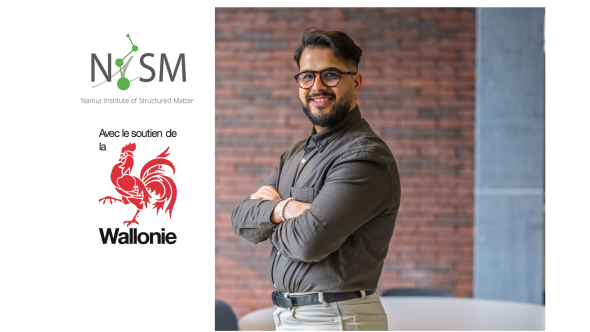
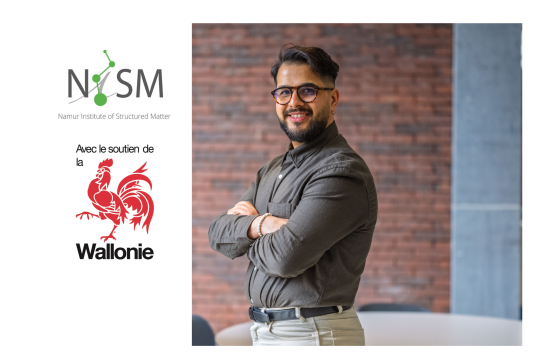
Photo du Dr. Laroussi Chaabane avec les logos de l'Institut NISM et de la Région wallonne

Focus #2 | What if our rivers became a source of clean energy for the future?

An international team of chemistry researchers, led by Dr. Laroussi Chaabane and Prof. Bao-Lian Su, has just demonstrated that it is possible to produce "green" hydrogen using natural water and sunlight. These findings have been published in the prestigious Chemical Engineering Journal.

When sunlight becomes a source of clean energy

Faced with climate change, pollution, and energy shortages, the search for alternatives to fossil fuels has become a global priority in order to achieve carbon neutrality by 2050. Among the solutions being considered, green hydrogen appears to be a particularly promising energy carrier: it has a high energy density and can be produced without greenhouse gas emissions. Today, most of the world's hydrogen (around 87 million tons produced in 2020) is obtained through costly and polluting electrochemical processes, mainly used by the chemical industry or fuel cells. Hence the major interest in more sustainable methods.

Water photocatalysis: the "Holy Grail" of chemistry

Producing hydrogen and oxygen directly from water using light, a process known as photocatalysis of water, is often referred to as the "Holy Grail of chemistry" because it is so complex to master. At the University of Namur, researchers at the Laboratory of Inorganic Materials Chemistry (CMI), part of the Nanomaterials Chemistry Unit (UCNANO) and the Namur Institute of Structured Matter (NISM), have taken a decisive step forward. They have demonstrated that it is possible to use natural water, and no longer just ultrapure water, to produce green hydrogen under the action of sunlight.

Image
Dr. Laroussi Chaabane

The core of the process is based on an innovative photocatalyst, which acts as a kind of "chemical pair of scissors" capable of splitting water molecules into hydrogen and oxygen—an area in which the CMI laboratory has recognized expertise.

Dr. Laroussi Chaabane Researcher in the Department of Chemistry, CMI Laboratory, and member of the NISM Institute

A 3D photocatalyst based on graphene and gold

The new material developed is a three-dimensional (3D) photocatalyst based on titanium oxide, graphene, and gold nanoparticles. This 3D architecture allows for better light absorption and more efficient generation of free electrons, which are essential for triggering the water dissociation reaction. One of the main challenges lies in the use of natural water, which contains minerals, salts, and organic compounds that can disrupt the process. To address this challenge, the researchers tested their device with water from several Belgian rivers: the Meuse, the Sambre, the Scheldt, and the Yser.
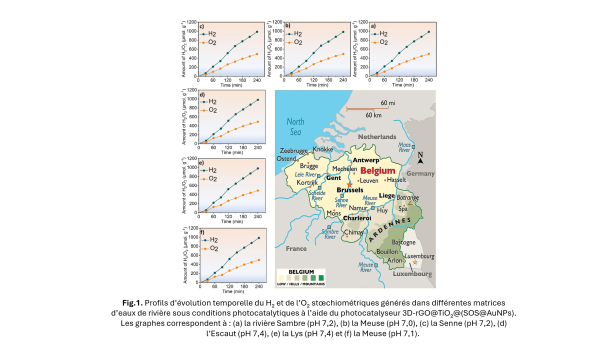
Laroussi Chaaban - Profils d’évolution temporelle du H₂ et de l’O₂ stœchiométriques générés dans différentes matrices d’eaux de rivière sous conditions photocatalytiques à l’aide du photocatalyseur 3D-rGO@TiO₂@(SOS@AuNPs). Les graphes correspondent à : (a) la rivière Sambre (pH 7,2), (b) la Meuse (pH 7,0), (c) la Senne (pH 7,2), (d) l’Escaut (pH 7,4), (e) la Lys (pH 7,4) et (f) la Meuse (pH 7,1).

A remarkable result and a first in Belgium!

The performance achieved is almost equivalent to that measured with pure water.  

This is a first in Belgium, opening up concrete prospects for the sustainable use of local natural resources!

The full article, "Synergistic four physical phenomena in a 3D photocatalyst for unprecedented overall water splitting," is available in open access.

International recognition

This scientific breakthrough also earned Dr. Laroussi Chaabane the award for best poster at the 4th International Colloids Conference (San Sebastián, Spain, July 2025), highlighting the impact and originality of this work.

An international research team
  • University of Namur, Faculty of Sciences, UCNANO, Laboratory of Inorganic Materials Chemistry (CMI) and Namur Institute of Structured Matter (NISM), Belgium | Principal Investigator (PI) | Professor Bao Lian SU; Postdoctoral Researcher | Dr. Laroussi Chaabane
  • Institute of Organic Chemistry, Phytochemistry Center, Academy of Sciences, Bulgaria
  • Department of Organic Chemistry (MSc), Loyola Academy, India
  • Free University of Brussels (ULB) and Flanders Make, Department of Applied Physics and Photonics, Brussels Photonics, Belgium
  • University of Quebec in Montreal (UQAM), Department of Chemistry, Montreal, Quebec, Canada
  • National Institute for Scientific Research - Energy Materials Telecommunications Center (INRS-EMT), Varennes, Quebec, Canada
  • Wuhan University of Technology, National Laboratory for Advanced Technologies in Materials Synthesis and Processing, China

What next?

At this stage, the study constitutes proof of concept demonstrating the feasibility of the process. It illustrates the excellence of chemical engineering and nanomaterials research at UNamur, as well as its potential for sustainable energy applications. A new study is underway to evaluate the performance of the process with seawater, a key step towards large-scale green hydrogen production.

State-of-the-art equipment

The analyses carried out were made possible thanks to the equipment available at UNamur's Physico-Chemical Characterization (PC²), Electron Microscopy, and Material Synthesis, Irradiation, and Analysis (SIAM) technology platforms. UNamur's technology platforms house state-of-the-art equipment and are accessible to the scientific community as well as to industries and companies. 

The authors would like to thank the Wallonia Public Service (SPW) for its ongoing commitment to scientific research and innovation in Wallonia, enabling UNamur to develop technological solutions with a significant societal and environmental impact.

From fundamental to applied research, UNamur demonstrates every day that research is a driver of transformation. Thanks to the commitment of its researchers, the support of its partners from all walks of life, funders, industrial partners, and a solid ecosystem of valorization, UNamur actively participates in shaping a society that is open to the world, more innovative, more responsible, and more sustainable.

To go further

This article complements our publication "Research and innovation: major assets for the industrial sector" taken from the Issues section of Omalius magazine #39 (December 2025).
Colourful speleothems: treasures hidden deep within the earth

Geology

Well hidden from passersby, caves nevertheless conceal particularly aesthetic secrets. For the past four years, Martin Vlieghe has been pursuing a PhD in geology at UNamur.  He is exploring the origin of the surprisingly varied colours of certain concretions nestled in the heart of Belgian and French caves. Together with Prof. Johan Yans and Gaëtan Rochez, he samples, observes, and analyses these magnificent objects with the aim of uncovering the mysteries they conceal.
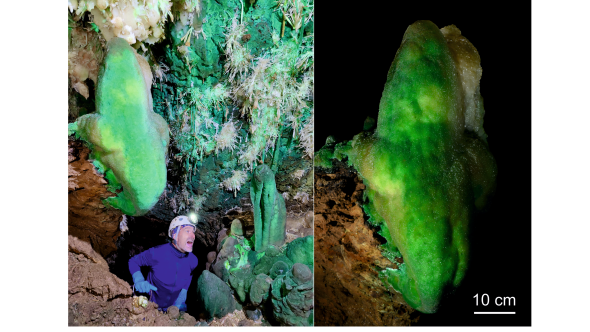
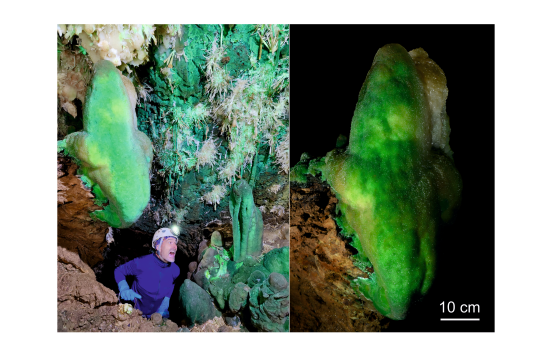
Spéléothèmes verts dans l’Aven du Mont Marcou (Hérault, France) © Stéphane Pire, Gaëtan Rochez (UNamur)

Photo: Green speleothems in the Aven du Mont Marcou (Hérault, France) © Stéphane Pire, Gaëtan Rochez (UNamur)

Speleothems, for instance stalactites and stalagmites, are commonly composed of calcite or aragonite (CaCO3). This mineral compound comes directly from the rock in which the cave was formed and naturally has a white to brownish colour. However, speleothems can sometimes exhibit unique and unusual colours. From yellow to black, blue, red, green, and even purple, there is something for everyone! 

Such a diversity of colours reflects the many possible causes: mineralogical, chemical, biological, or even physical. A speleothem, like any natural formation, is never perfectly pure. Their deposition process, through the precipitation of calcium carbonate dissolved in water, is necessarily accompanied by the deposition of numerous impurities carried along with the water circulating underground. Even if these impurities are sometimes too low in concentration or simply uncoloured, they can still have a visible impact on the colour. 

OK, but what is the point?

The formation of speleothems is very often linked to impurities dissolved in groundwater. Therefore, studying coloured speleothems provides valuable information about potential contamination of surface water with heavy metals or other harmful organic compounds, which in some cases may be consumed by residents. It is therefore a simple and direct way to identify areas with potentially contaminated water and to determine whether this contamination poses an environmental or health risk.

This is the objective of Martin Vlieghe's thesis: to apply a range of cutting-edge analytical techniques to samples of these speleothems to determine these causes and propose an explanation for the origin of the colouring elements. 

Here are a few examples.

Green from the Aven du Marcou: the influence of nickel

An initial project explored the green speleothems of the Aven du Marcou (see photo above). Located in the Hérault department of France, this chasm is well known in the area for its series of impressive shafts, the largest of which is over 100 meters deep. It also has a tiny chamber hidden at the top of a steep wall, which houses an impressive concentration of deep green speleothems. After all the effort of descending and climbing ropes to progress through this very vertical cave, what a wonderful reward to discover this true underground gem! Once the initial wonder has passed, it's time to get to work!  We observe, describe, interpret, and collect a few green fragments from the ground, while respecting the integrity of the site as much as possible. Back in Belgium, it's time to move on to the analyses.

Careful observation of the recovered fragments quickly reveals the presence of green minerals in the outer part of the speleothems, which are easily associated with the green colour observed. These minerals, which are deposited in platelets parallel to the white aragonite (CaCO₃), turn out to be nepouite crystals, a nickel phyllosilicate ((Ni,Mg)SiO(OH)) usually found in marine volcanic rocks.

Photo : Vue au microscope électronique à balayage mettant en avant les dépôts de népouite sur les cristaux d’aragonite.
Picture: Scanning electron microscope view highlighting nepouite deposits on aragonite crystals.

The discovery is all the more surprising given that there are no nickel deposits in the vicinity of the cave! Further study of the composition of the nepouite reveals that they contain a high concentration of zinc, which is also very unusual and suggests that they are in fact quite different from those commonly mined in volcanic deposits. Finally, this mystery was solved by a thorough examination of the rock outcrops in the immediate vicinity of the cave. Just above the cave are siliceous deposits particularly rich in pyrite, an iron sulphide commonly found in this type of settingst. Analysis of these sulphides reveals high concentrations of nickel, which is also found in the natural water source closest to the cave. 

The result of this "investigation" and final explanation: nepouite was able to settle underground through the dissolution of various chemical elements contained in the pyrite of the overlying rocks, which were transported into the cave by surface water and were able to crystallize on site. 

Malaval blues: when metals interact

The Malaval cave is very different from the Aven du Marcou. Located in Lozère (France), it extends largely along a high underground river that winds beneath the Cévennes massif. At the bend of a meander, one can find magnificent blue speleothems. 

As in the Aven du Marcou, the coloured speleothems are found only in two specific locations in the cave and nowhere else, suggesting that the origin of the chromophore elements is probably very localized.
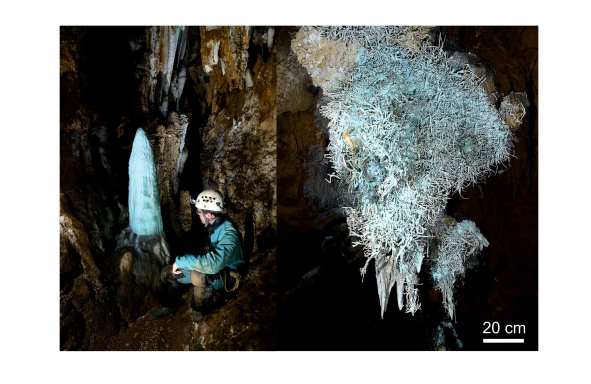
Gauche : Stalagmite bleue de la Grotte de Malaval. Droite : Bouquet d’aragonite bleue de la Grotte de Malaval © Gaëtan Rochez (UNamur)

Photos - Left: Blue stalagmite in Malaval Cave. Right: Cluster of blue aragonites in Malaval Cave © Gaëtan Rochez (UNamur)

Once again, a few fragments were collected, including a large bluish stalactite found broken on the cave floor. A series of microscopic observations and mineralogical and geochemical analyses were carried out. The first striking finding was that several blue fragments contained no minerals other than aragonite, suggesting that, unlike the green ones from Marcou, it was the aragonite itself that was coloured by the presence of metallic elements. After examining the analyses, three of these elements stood out: copper, commonly cited as the cause of blue colouring in aragonite, as well as zinc and lead. 

While copper appears to be the main cause of the blue colouration, zinc and lead also play a role here. 

Zinc is largely present in the form of deep blue amorphous phases, which are only found in some of the blue fragments studied. The presence of these phases, linked to the oxidation of nearby zinc-rich deposits, generates variations in the blue colour at the microscopic level, as revealed by optical microspectrophotometry.

Prises de vue de spéléothèmes bleus de Malaval au microscope électronique à balayage montrant les phases riches en Zn. Gauche : Vue en électrons rétrodiffusés. Droite : Cartographie élémentaire.
Scanning electron microscope images of blue speleothems from Malaval showing Zn-rich phases. Left: Backscattered electron image. Right: Elemental mapping.

Lead also has a marked colouring power, producing green to blue hues, but statistical analysis of coloured and uncoloured areas shows that these colours only appear in the absence of zinc, which seems to inhibit lead-induced colouring. This study clearly demonstrates that, even if a problem seems easy to explain at first glance, it can sometimes hide unexpected subtleties that need to be explored in greater depth in order to uncover all its secrets. 

Gypsum from the Cigalère: the underground rainbow

The Cigalère Cave is one of a kind. Not only does it contain impressive quantities of gypsum, a calcium sulphate found in certain caves, but this gypsum also displays a wide variety of colours rarely seen in nature. Because of this rarity, the cave is particularly well protected, to the point that we were not allowed to collect any fragments from inside it. 

This study was therefore the ideal opportunity to test the Geology Department's new acquisition: a portable X-ray fluorescence spectrometer (pXRF), which allows rapid, in situ, and above all completely non-destructive analysis of coloured speleothems.
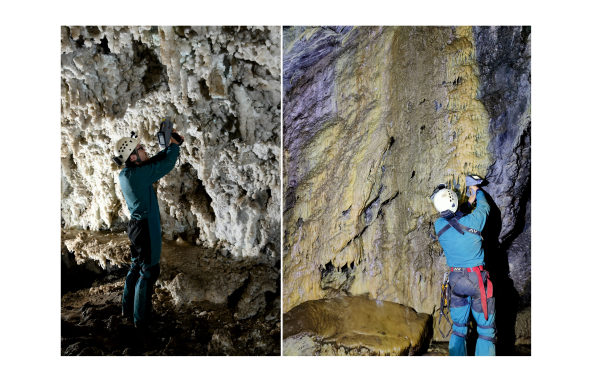
Analyse pXRF d’un coeur de stalactite bleu (gauche) et d’une coulée jaune (droite) dans la Grotte de la Cigalère © Stéphane Pire (UNamur)

Photos - pXRF analysis of a blue stalactite core (left) and a yellow flowstone (right) in the Cigalère Cave © Stéphane Pire (UNamur)

A total of five sites of interest were selected in the Cigalère for the diversity of colours found there. The pXRF revealed the presence of several metals. 

At Cascade Noire, for example, a high concentration of iron in the form of oxides and sulphates was detected, which are responsible for the black and orange colouring of the gypsum, respectively.

Modèle 3D de la Cascade Noire. Les cercles représentent l’intensité du pic pXRF du fer, montrant une plus forte concentration dans la partie noire (oxydes de fer), et une plus faible dans la partie orangée (sulfates de fer).
Picture: 3D model of the Cascade Noire. The circles represent the intensity of the pXRF peak for iron, showing a higher concentration in the black part (iron oxides) and a lower concentration in the orange part (iron sulfates).

Black is also found in the Chapelle de Donnea, but contrary to what one might think, no iron has been detected. Here, it is manganese in the form of oxides that is responsible for the colouration. This observation is interesting because it clearly demonstrates that black colouration in gypsum, two phenomena that appear similar at first glance, can have very different causes, hence the importance of being able to carry out analyses directly in the field. 

A little further downstream, blue dominates along the main gallery, and analyses have shown strong similarities with the blue speleothems of Malaval, with a marked influence of copper and potentially zinc. 

All this highlights that, despite certain limitations of the device, this type of non-destructive analysis method is a very valuable tool for studying rare, fragile, precious, or protected objects, of which the Cigalère cave is an excellent example! 

The research team

Martin Vlieghe's doctoral thesis on "The origin(s) of colored speleothems in caves," supervised by Professor Johan Yans and in collaboration with Gaëtan Rochez, began in February 2022. All three researchers are members of the Faculty of Sciences, Department of Geology at UNamur and the ILEE Research Institute. 

ILEE (Institute of Life, Earth and Environment) is directly involved in issues related to the study and preservation of the environment, to which this subject is directly linked. 

The various analyses were carried out with the support of UNamur's technological platforms:

Some analyses were carried out in partnership with KUL, MRScNB and UMontpellier, and access to the caves was provided by the Association Mont Marcou, the Malaval Association and the Association de Recherche souterraine du Haut Lez.

This thesis was originally funded by the ILEE institute and institutional funds from UNamur, and by an Aspirant F.R.S. - FNRS grant (FC 50205) since October 2023.

It is also closely linked to the new research partnership supported by the RELIEF network (Réseau d’Échanges et de Liaisons entre Institutions d’Enseignement supérieur Francophones), the ILEE research institute at UNamur, and EDYTEM (Environnements, Dynamiques et Territoires de Montagne, Université Savoie Mont Blanc).  Mobility programs between these entities will strengthen a common research area: the study of the critical zone, the most superficial zone of the Earth, where rocks, water, air, and living organisms interact. The perspective is to develop other transdisciplinary research areas and potential teaching projects in the field of environmental sciences and sustainable development.

Being curious about the Earth and the natural world: a key to meeting tomorrow's challenges!

Studying geology means developing a solid foundation in physics, chemistry, and biology in order to understand the Earth, from its internal dynamics to surface processes and their interactions with our environment and human activities. 

Thanks to their interdisciplinary training, geologists are ideally positioned to perform a variety of roles that require a rigorous scientific approach to solving complex problems (research and development, project management, consulting, and education).

What are the advantages of studying at UNamur? 

  • Practical training and numerous field activities
  • Strong scientific foundations
  • Immersion in geology from block 1
  • The possibility of ERASMUS from block 3 onwards
  • Close contact with teachers

The advantages of studying in Namur

  • A practical training and lots of field activities
  • Strong scientific foundations
  • Immersion in geology from the 1st year
  • ERASMUS possible from the 3rd year onwards
  • Close contact with teachers

35 years between two accelerators - Serge Mathot's journey, or the art of welding history to physics

Alumni
Physics and astronomy
Heritage, culture and society
Materials, energy and environment

One foot in the past, the other in the future. From Etruscan granulation to PIXE analysis, Serge Mathot has built a unique career, between scientific heritage and particle accelerators. Portrait of a passionate alumnus at the crossroads of disciplines.

Photo de Serge Mathot (CERN) lors de sa visite à l'UNamur en mai 2025

What prompted you to undertake your studies and then your doctorate in physics?

I was fascinated by the research field of one of my professors, Guy Demortier. He was working on the characterization of antique jewelry. He had found a way to differentiate by PIXE (Proton Induced X-ray Emission) analysis between antique and modern brazes that contained Cadmium, the presence of this element in antique jewelry being controversial at the time. He was interested in ancient soldering methods in general, and the granulation technique in particular. He studied them at the Laboratoire d'Analyses par Réaction Nucléaires (LARN). Brazing is an assembly operation involving the fusion of a filler metal (e.g. copper- or silver-based) without melting the base metal. This phenomenon allows a liquid metal to penetrate first by capillary action and then by diffusion at the interface of the metals to be joined, making the junction permanent after solidification. Among the jewels of antiquity, we find brazes made with incredible precision, the ancient techniques are fascinating.

Studying antique jewelry? Not what you'd expect in physics.

In fact, this was one of Namur's fields of research at the time: heritage sciences. Professor Demortier was conducting studies on a variety of jewels, but those made by the Etruscans using the so-called granulation technique, which first appeared in Eturia in the 8th century BC, are particularly incredible. It consists of depositing hundreds of tiny gold granules, up to two-tenths of a millimeter in diameter, on the surface to be decorated, and then soldering them onto the jewel without altering its fineness. So I also trained in brazing techniques and physical metallurgy.

The characterization of jewelry using LARN's particle accelerator, which enables non-destructive analysis, yields valuable information for heritage science.

This is, moreover, a current area of collaboration between the Department of Physics and the Department of History at UNamur (NDLR: notably through the ARC Phoenix project).

Statuette en Or (Egypte), env. 2000 ans av.J.C, analysée au LARN (1990)
Gold statuette (Egypt), circa 2000 BC, analyzed at LARN (1990)

How did that help you land a job at CERN?

I applied for a position as a physicist at CERN in the field of vacuum and thin films, but was invited for the position of head of the vacuum brazing department. This department is very important for CERN as it studies methods for assembling particularly delicate and precise parts for accelerators. It also manufactures prototypes and often one-off parts. Broadly speaking, vacuum brazing is the same technique as the one we study at Namur, except that it is carried out in a vacuum chamber. This means no oxidation, perfect wetting of the brazing alloys on the parts to be assembled, and very precise temperature control to obtain very precise assemblies (we're talking microns!). I'd never heard of vacuum brazing, but my experience of Etruscan brazing, metallurgy and my background in applied physics as taught at Namur were of particular interest to the selection committee. They hired me right away!

Le parcours de Serge Mathot

Tell us about CERN and the projects that keep you busy.

CERN is primarily known for hosting particle accelerators, including the famous LHC (Large Hadron Collider), a 27 km circumference accelerator buried some 100 m underground, which accelerates particles to 99.9999991% of the speed of light! CERN's research focuses on technology and innovation in many fields: nuclear physics, cosmic rays and cloud formation, antimatter research, the search for rare phenomena (such as the Higgs boson) and a contribution to neutrino research. It is also the birthplace of the World Wide Web (WWW). There are also projects in healthcare, medicine and partnerships with industry.

Nuclear physics at CERN is very different from what we do at UNamur with the ALTAÏS accelerator. But my training in applied physics (namuroise) has enabled me to integrate seamlessly into various research projects.

Plateforme technologique SIAM - Accélérateur ALTAïS IBMM
ALTAÏS accelerator (Synthesis, Irradiation and Analysis of Materials technology platform - SIAM)

For my part, in addition to developing vacuum brazing methods, a field in which I've worked for over 20 years, I've worked a lot in parallel for the CLOUD experiment. For over 10 years, and until recently, I was its Technical Coordinator. CLOUD is a small but fascinating experiment at CERN which studies cloud formation and uses a particle beam to reproduce atomic bombardment in the laboratory in the manner of galactic radiation in our atmosphere. Using an ultra-clean 26 m³ cloud chamber, precise gas injection systems, electric fields, UV light systems and multiple detectors, we reproduce and study the Earth's atmosphere to understand whether galactic rays can indeed influence climate. This experiment calls on various fields of applied physics, and my background at UNamur has helped me once again.

I was also responsible for CERN's MACHINA project -Movable Accelerator for Cultural Heritage In situ Non-destructive Analysis - carried out in collaboration with the Istituto Nazionale di Fisica Nucleare (INFN), Florence section - Italy. Together, we have created the first portable proton accelerator for in-situ, non-destructive analysis in heritage science. MACHINA is soon to be used at the OPD (Opificio delle Pietre Dure), one of the oldest and most prestigious art restoration centers, also in Florence. The accelerator is also destined to travel to other museums or restoration centers.

Currently, I'm in charge of the ELISA (Experimental LInac for Surface Analysis) project. With ELISA, we're running a real proton accelerator for the first time in a place open to the public: the Science Gateway (SGW), CERN's new permanent exhibition center

L'accélérateur ELISA du CERN
ELISA accelerator (CERN)

ELISA uses the same accelerator cavity as MACHINA. The public can observe a proton beam extracted just a few centimetres from their eyes. Demonstrations are organized to show various physical phenomena, such as light production in gases or beam deflection with dipoles or quadrupoles, for example. The PIXE analysis method is also presented. ELISA is also a high-performance accelerator that we use for research projects in the field of heritage and others such as thin films, which are used extensively at CERN. The special feature is that the scientists who come to work with us do so in front of the public!

Do you have a story to tell?

I remember that in 1989, I finished typing my report for my IRSIA fellowship in the middle of the night, the day before the deadline. It had to be in by midnight the next day. There were very few computers back then, so I typed my report at the last minute on one of the secretaries' Macs. One false move and pow! all my data was gone - big panic! The next day, the secretary helped me restore my file, we printed out the document and I dropped it straight into the mailbox in Brussels, where I arrived after 11pm, in extremis, because at midnight, someone had come to close the mailbox. Fortunately, technology has come a long way since then...

Image
Photo de Serge Mathot

And I can't resist sharing two images 35 years apart!

To the left, a Gold statuette (Egypt), c. 2000 BC, analyzed at LARN - UNamur (photo 1990) and to the right, a copy (in Brass) of the Dame de Brassempouy, analyzed with ELISA - CERN (2025).

The "photographer" is the same, so we've come full circle...

Serge Mathot Serge Mathot, Referent Applied Physicist (CERN)
A gauche, Statuette en Or (Egypte), env. 2000 ans av.J.C, analysée au LARN (photo 1990) – A droite, copie (en Laiton) de la Dame de Brassempouy, analysée avec ELISA (2025)

The proximity between teaching and research inspires and questions. This enables graduate students to move into multiple areas of working life.

Come and study in Namur!

Serge Mathot (May 2025) - Interview by Karin Derochette

Further information

CERN - the science portal

Le Portail de la Science du CERN

This article is taken from the "Alumni" section of Omalius magazine #38 (September 2025).

cover-omalius-septembre-2025

The Department of Physics welcomes a delegation from CERN

Alumni
Materials, energy and environment
Heritage, culture and society
Physics and astronomy
Life and health sciences
UNIVERSEH

In May 2025, the Department of Physics welcomed two special visitors: Serge Mathot and François Briard from Namur, both alumni of UNamur and members of CERN. Several activities were on the program, ranging from a visit to the particle accelerator, to science popularization and thematic seminars, particularly in heritage sciences. The aim? To identify areas or activities in which UNamur and CERN could strengthen their collaboration.

Photo de groupe

In the picture, from left to right: (top) Pierre Louette, Director of the Physics Department; François Briard, Head of the Science Portal Group (CERN); Julien Colaux, IBA specialist, physics researcher; Boris Hespeels, biology researcher; Alexandre Mayer, physics researcher; Anne-Catherine Heuskin, physics and biophysics researcher. (bottom) André Füzfa, astrophysicist and mathematics researcher; Serge Mathot, Applied Physicist (CERN) and Michaël Lobet, physics researcher.

The love affair between CERN and UNamur goes back a long way. CERN's accelerator complex and experimental program are very different and much larger than those of UNamur's Physics Department, but the fields in which the two institutions work have much in common.

In addition, both guests have a personal history with UNamur. The Physics Department was pleased to welcome Serge Mathot, Referent Applied Physicist (CERN) and alumni of the UNamur Physics Department (1992), as well as François Briard, Group Leader Science Portal (CERN), and alumni of the UNamur Faculty of Computer Science (1994).

The activities began with a meeting between the guests, Rector Annick Castiaux, Vice-Rector for Research Carine Michiels, Physics Department Director Pierre Louette and several other members of the Physics and Biology Department. After a general presentation of the University, the participants pointed out the missions shared by both institutions: research and the transfer of technology and knowledge, service to society, scientific popularization and education and training.

.

Focus on meetings

Physics lunch - CERN presentation

The physics lunch is the monthly meeting between students and members of the physics department and a professional, alumni or not, coming to explain his or her background and what he or she does on a daily basis as a physicist.

During this meeting, attended by around 80 people, François Briard and Serge Mathot presented CERN, the world's largest laboratory for particle physics. CERN's mission is to understand the most elementary particles and the laws of our universe.

At the end of the seminar, the students came away with stars in their eyes. Indeed, opportunities for internships or even first jobs at CERN are possible for physicists but also in many other fields.

Photo de groupe
Image
Photo de Serge Mathot

Your physics training at UNamur is your best ticket to a job at CERN. It's more than just a degree in particle physics!

Serge mathot Referent Applied Physicist (CERN) and alumni of the UNamur Physics Department (1992)

Some internship programs at CERN are particularly well suited to the needs of young Belgian students.

The vast majority of physicists working with CERN (over 13,000) are in fact sent to CERN for varying periods of time by their employing national research institutes. CERN offers an exceptional opportunity to develop international experience under excellent conditions, in an environment that is unique in the world! What an inspiration for our young students!

Visit of the ALTAÏS and SIAM facilities

Capable of generating ion beams consisting of any stable element with energies of up to 16 Mega electron-Volt (MeV), the ALTAÏS particle accelerator is used in various fields of fundamental and applied research, notably through industrial partnerships. CERN's largest current linear accelerator can produce particle beams of up to 160 MeV.

ALTAIS - L'accélérateur de particules du LARN (UNamur)

Meeting with members of the ARC PHOENIX project, complemented by a heritage science seminar given by Serge Mathot.

The projet d'Action Recherche Concertée (ARC) PHOENIX aims to renew our understanding of medieval parchments and ancient coins. Artificial intelligence will be exploited to analyze the data generated by material characterization.

This joint study between the Department of Physics and the Namur Institute of Structured Matter (NISM) and the Department of History and the Institut Patrimoines, Transmissions, Héritages (PaTHs) will address questions relating to the production chain and use of these objects and materials in past societies.

At the same time, Serge Mathot presented a seminar in heritage science attended by some 50 people. In particular, he presented his research and the brand-new ELISA accelerator: a miniaturized gas pedal capable of delivering a 2 MeV proton beam used to perform real measurements at the Science Portal.

Meeting on science popularization

Having the opportunity to exchange views with François Briard, Group Leader of the CERN Science Portal is a rare opportunity. Comparing outreach activities has opened up new avenues, discovering and sharing approaches, assessing what works and what doesn't, depending on the target audience. A highly satisfying enrichment for the members present from Confluent des Savoirs (CDS), the University of Namur's research outreach and dissemination service.

Image
François Briard - Chef de projet Portail de la science

The CERN Science Portal is a place where you can explore CERN and science through authentic and innovative experiences: immersive multimedia exhibitions, hands-on lab workshops, science shows, events combining science and culture, prototyping workshops on the theme of innovation, tours of CERN sites, all accompanied by CERN staff.

François Briard Group Leader, CERN Science Portal

BD Physix - Energy

Teachers André Füzfa and Michaël Lobet were able to present the comic strip project created with author Jean-Marc Dubois.

The theme? Energy!

What could be more natural than to talk about it with François Briard, chief popularizer at CERN, who is interested in this popularization project in a medium accessible to people aged 7 to 77!

Image illustrative - vue de la cathédrale saitn aubain

Meeting on the theme of biophysics

Professor Anne-Catherine Heuskin and Dr. Boris Hespeels are currently working on the BEBLOB project, a Belspo project with ESA support, as part of the UNIVERSEH (European Space University for Earth and Humanity) alliance. They are particularly interested in its astonishing ability to withstand high doses of radiation.

Anne-Catherine Heuskin also works in radiobiology. Particles are used to irradiate cancerous cells in order to destroy their genetic material and prevent them from proliferating: this is the basis of radiotherapy and proton therapy.

Meeting with FaSEF regarding teacher training opportunities.

The meeting confirmed the willingness of FaSEF and UNamur to get involved in coordinating the Belgian National Teacher Programme in French-speaking Belgium, which CERN intends to relaunch in 2026. Consideration was also given to other avenues for teacher training, such as CERN's forthcoming involvement in the "Salle des Pros", the training venue for the various players involved in teacher training at UNamur.

.

A visit to TRAKK

The TRAKK is Namur's creative hub supported by 3 complementary partners in the field: BEP, KIKK, and UNamur. In addition to the venue, François Briard was able to visit the ProtoLab , which bridges the gap between ideas and industry by being a decentralized research and development hub accessible to SMEs and project leaders by offering advanced support in prototyping products or services.

Guests at CERN

François Briard - CERN Science Portal Group Leader, UNamur alumni 1994

Specialities:

  • Information systems, administrative applications and databases (Oracle)
  • Communications for the general public
  • Visitor reception logistics
  • Event organization for up to 80,000 participants.
Photo de François Briard, Chef de groupe Portail de la science du CERN, alumni UNamur 1994

Graduating in law and information technology management (DGTIC) in 1994 after his bachelor's and master's degrees in computer science in 1993, François Briard works at CERN, the European Organization for Nuclear Research in Geneva, the world's largest particle physics laboratory.

During his school career, which was 100% at UNamur, he was vice-president of the Régionale namuroise and student delegate during his years as a candidate in economic and social sciences, computer science option.

Thanks to the multidisciplinary training provided at UNamur, he was able to seize several opportunities to redirect his career at CERN, where he was an information systems engineer from 1994 and then, from 2014, redirected his career until he became Group Leader of the Science Portal, which is CERN's general public communications center.

Serge Mathot - Referent Applied Physicist at CERN, UNamur alumni 1992

His specialties

  • Ion Beam Analysis (IBA)
  • Metallurgy, vacuum brazing
  • Radio-Frequency Quadrupole (RFQ) linacs, ion sources
Photo de Serge Mathot, Referent Applied Physicist au CERN, alumni UNamur 1992

Serge Mathot obtained his doctorate in applied sciences from UNamur in 1992, following his bachelor's degree in physical sciences in 1985.

He then carried out a post-doctorate at the Joint Research Center (EU science hub) in Geel, which aims to bring together multidisciplinary skills to develop new measurement methods and tools such as reference materials.

He perfected his expertise in physical metallurgy before joining CERN in 1995 as a Referent Applied Physicist. He has worked on numerous research projects (CLOUD, MACHINA, ELISA...) and developed numerous parts for the manufacture of CERN's gas pedals.

It's a great pleasure to meet him.

CERN

CERN, the European Organization for Nuclear Research, is one of the world's largest and most prestigious scientific laboratories. Its vocation is fundamental physics, the discovery of the constituents and laws of the Universe. It uses highly complex scientific instruments to probe the ultimate constituents of matter: the fundamental particles. By studying what happens when these particles collide, physicists understand the laws of Nature.

The instruments used at CERN are particle gas pedals and detectors. Gas pedals carry beams of particles at high energies to collide with other beams or fixed targets. Detectors observe and record the results of these collisions.

Founded in 1954, CERN is located on either side of the French-Swiss border, near Geneva. It was one of the first organizations on a European scale and today has 25 member states, including Belgium.

Physics programs at UNamur

From the infinitely small to the infinitely large, from elementary particles to galaxies, are you thirsty to understand the whys and wherefores of the natural phenomena you observe? Physics answers all your questions.

Producing "green" hydrogen from water from the Meuse River? It's now possible!

Chemistry
Materials, energy and environment
SDG#7 - Clean and affordable energy

At UNamur, research is not confined to laboratories. From physics to political science, robotics, biodiversity, law, AI, and health, researchers collaborate daily with numerous stakeholders in society. The goal? Transform ideas into concrete solutions to address current challenges. 

Photo du Dr. Laroussi Chaabane avec les logos de l'Institut NISM et de la Région wallonne

Focus #2 | What if our rivers became a source of clean energy for the future?

An international team of chemistry researchers, led by Dr. Laroussi Chaabane and Prof. Bao-Lian Su, has just demonstrated that it is possible to produce "green" hydrogen using natural water and sunlight. These findings have been published in the prestigious Chemical Engineering Journal.

When sunlight becomes a source of clean energy

Faced with climate change, pollution, and energy shortages, the search for alternatives to fossil fuels has become a global priority in order to achieve carbon neutrality by 2050. Among the solutions being considered, green hydrogen appears to be a particularly promising energy carrier: it has a high energy density and can be produced without greenhouse gas emissions. Today, most of the world's hydrogen (around 87 million tons produced in 2020) is obtained through costly and polluting electrochemical processes, mainly used by the chemical industry or fuel cells. Hence the major interest in more sustainable methods.

Water photocatalysis: the "Holy Grail" of chemistry

Producing hydrogen and oxygen directly from water using light, a process known as photocatalysis of water, is often referred to as the "Holy Grail of chemistry" because it is so complex to master. At the University of Namur, researchers at the Laboratory of Inorganic Materials Chemistry (CMI), part of the Nanomaterials Chemistry Unit (UCNANO) and the Namur Institute of Structured Matter (NISM), have taken a decisive step forward. They have demonstrated that it is possible to use natural water, and no longer just ultrapure water, to produce green hydrogen under the action of sunlight.

Image
Dr. Laroussi Chaabane

The core of the process is based on an innovative photocatalyst, which acts as a kind of "chemical pair of scissors" capable of splitting water molecules into hydrogen and oxygen—an area in which the CMI laboratory has recognized expertise.

Dr. Laroussi Chaabane Researcher in the Department of Chemistry, CMI Laboratory, and member of the NISM Institute

A 3D photocatalyst based on graphene and gold

The new material developed is a three-dimensional (3D) photocatalyst based on titanium oxide, graphene, and gold nanoparticles. This 3D architecture allows for better light absorption and more efficient generation of free electrons, which are essential for triggering the water dissociation reaction. One of the main challenges lies in the use of natural water, which contains minerals, salts, and organic compounds that can disrupt the process. To address this challenge, the researchers tested their device with water from several Belgian rivers: the Meuse, the Sambre, the Scheldt, and the Yser.

Laroussi Chaaban - Profils d’évolution temporelle du H₂ et de l’O₂ stœchiométriques générés dans différentes matrices d’eaux de rivière sous conditions photocatalytiques à l’aide du photocatalyseur 3D-rGO@TiO₂@(SOS@AuNPs). Les graphes correspondent à : (a) la rivière Sambre (pH 7,2), (b) la Meuse (pH 7,0), (c) la Senne (pH 7,2), (d) l’Escaut (pH 7,4), (e) la Lys (pH 7,4) et (f) la Meuse (pH 7,1).

A remarkable result and a first in Belgium!

The performance achieved is almost equivalent to that measured with pure water.  

This is a first in Belgium, opening up concrete prospects for the sustainable use of local natural resources!

The full article, "Synergistic four physical phenomena in a 3D photocatalyst for unprecedented overall water splitting," is available in open access.

International recognition

This scientific breakthrough also earned Dr. Laroussi Chaabane the award for best poster at the 4th International Colloids Conference (San Sebastián, Spain, July 2025), highlighting the impact and originality of this work.

An international research team
  • University of Namur, Faculty of Sciences, UCNANO, Laboratory of Inorganic Materials Chemistry (CMI) and Namur Institute of Structured Matter (NISM), Belgium | Principal Investigator (PI) | Professor Bao Lian SU; Postdoctoral Researcher | Dr. Laroussi Chaabane
  • Institute of Organic Chemistry, Phytochemistry Center, Academy of Sciences, Bulgaria
  • Department of Organic Chemistry (MSc), Loyola Academy, India
  • Free University of Brussels (ULB) and Flanders Make, Department of Applied Physics and Photonics, Brussels Photonics, Belgium
  • University of Quebec in Montreal (UQAM), Department of Chemistry, Montreal, Quebec, Canada
  • National Institute for Scientific Research - Energy Materials Telecommunications Center (INRS-EMT), Varennes, Quebec, Canada
  • Wuhan University of Technology, National Laboratory for Advanced Technologies in Materials Synthesis and Processing, China

What next?

At this stage, the study constitutes proof of concept demonstrating the feasibility of the process. It illustrates the excellence of chemical engineering and nanomaterials research at UNamur, as well as its potential for sustainable energy applications. A new study is underway to evaluate the performance of the process with seawater, a key step towards large-scale green hydrogen production.

State-of-the-art equipment

The analyses carried out were made possible thanks to the equipment available at UNamur's Physico-Chemical Characterization (PC²), Electron Microscopy, and Material Synthesis, Irradiation, and Analysis (SIAM) technology platforms. UNamur's technology platforms house state-of-the-art equipment and are accessible to the scientific community as well as to industries and companies. 

The authors would like to thank the Wallonia Public Service (SPW) for its ongoing commitment to scientific research and innovation in Wallonia, enabling UNamur to develop technological solutions with a significant societal and environmental impact.

From fundamental to applied research, UNamur demonstrates every day that research is a driver of transformation. Thanks to the commitment of its researchers, the support of its partners from all walks of life, funders, industrial partners, and a solid ecosystem of valorization, UNamur actively participates in shaping a society that is open to the world, more innovative, more responsible, and more sustainable.

To go further

This article complements our publication "Research and innovation: major assets for the industrial sector" taken from the Issues section of Omalius magazine #39 (December 2025).

Colourful speleothems: treasures hidden deep within the earth

Geology

Well hidden from passersby, caves nevertheless conceal particularly aesthetic secrets. For the past four years, Martin Vlieghe has been pursuing a PhD in geology at UNamur.  He is exploring the origin of the surprisingly varied colours of certain concretions nestled in the heart of Belgian and French caves. Together with Prof. Johan Yans and Gaëtan Rochez, he samples, observes, and analyses these magnificent objects with the aim of uncovering the mysteries they conceal.

Spéléothèmes verts dans l’Aven du Mont Marcou (Hérault, France) © Stéphane Pire, Gaëtan Rochez (UNamur)

Photo: Green speleothems in the Aven du Mont Marcou (Hérault, France) © Stéphane Pire, Gaëtan Rochez (UNamur)

Speleothems, for instance stalactites and stalagmites, are commonly composed of calcite or aragonite (CaCO3). This mineral compound comes directly from the rock in which the cave was formed and naturally has a white to brownish colour. However, speleothems can sometimes exhibit unique and unusual colours. From yellow to black, blue, red, green, and even purple, there is something for everyone! 

Such a diversity of colours reflects the many possible causes: mineralogical, chemical, biological, or even physical. A speleothem, like any natural formation, is never perfectly pure. Their deposition process, through the precipitation of calcium carbonate dissolved in water, is necessarily accompanied by the deposition of numerous impurities carried along with the water circulating underground. Even if these impurities are sometimes too low in concentration or simply uncoloured, they can still have a visible impact on the colour. 

OK, but what is the point?

The formation of speleothems is very often linked to impurities dissolved in groundwater. Therefore, studying coloured speleothems provides valuable information about potential contamination of surface water with heavy metals or other harmful organic compounds, which in some cases may be consumed by residents. It is therefore a simple and direct way to identify areas with potentially contaminated water and to determine whether this contamination poses an environmental or health risk.

This is the objective of Martin Vlieghe's thesis: to apply a range of cutting-edge analytical techniques to samples of these speleothems to determine these causes and propose an explanation for the origin of the colouring elements. 

Here are a few examples.

Green from the Aven du Marcou: the influence of nickel

An initial project explored the green speleothems of the Aven du Marcou (see photo above). Located in the Hérault department of France, this chasm is well known in the area for its series of impressive shafts, the largest of which is over 100 meters deep. It also has a tiny chamber hidden at the top of a steep wall, which houses an impressive concentration of deep green speleothems. After all the effort of descending and climbing ropes to progress through this very vertical cave, what a wonderful reward to discover this true underground gem! Once the initial wonder has passed, it's time to get to work!  We observe, describe, interpret, and collect a few green fragments from the ground, while respecting the integrity of the site as much as possible. Back in Belgium, it's time to move on to the analyses.

Careful observation of the recovered fragments quickly reveals the presence of green minerals in the outer part of the speleothems, which are easily associated with the green colour observed. These minerals, which are deposited in platelets parallel to the white aragonite (CaCO₃), turn out to be nepouite crystals, a nickel phyllosilicate ((Ni,Mg)SiO(OH)) usually found in marine volcanic rocks.

Photo : Vue au microscope électronique à balayage mettant en avant les dépôts de népouite sur les cristaux d’aragonite.
Picture: Scanning electron microscope view highlighting nepouite deposits on aragonite crystals.

The discovery is all the more surprising given that there are no nickel deposits in the vicinity of the cave! Further study of the composition of the nepouite reveals that they contain a high concentration of zinc, which is also very unusual and suggests that they are in fact quite different from those commonly mined in volcanic deposits. Finally, this mystery was solved by a thorough examination of the rock outcrops in the immediate vicinity of the cave. Just above the cave are siliceous deposits particularly rich in pyrite, an iron sulphide commonly found in this type of settingst. Analysis of these sulphides reveals high concentrations of nickel, which is also found in the natural water source closest to the cave. 

The result of this "investigation" and final explanation: nepouite was able to settle underground through the dissolution of various chemical elements contained in the pyrite of the overlying rocks, which were transported into the cave by surface water and were able to crystallize on site. 

Malaval blues: when metals interact

The Malaval cave is very different from the Aven du Marcou. Located in Lozère (France), it extends largely along a high underground river that winds beneath the Cévennes massif. At the bend of a meander, one can find magnificent blue speleothems. 

As in the Aven du Marcou, the coloured speleothems are found only in two specific locations in the cave and nowhere else, suggesting that the origin of the chromophore elements is probably very localized.

Gauche : Stalagmite bleue de la Grotte de Malaval. Droite : Bouquet d’aragonite bleue de la Grotte de Malaval © Gaëtan Rochez (UNamur)

Photos - Left: Blue stalagmite in Malaval Cave. Right: Cluster of blue aragonites in Malaval Cave © Gaëtan Rochez (UNamur)

Once again, a few fragments were collected, including a large bluish stalactite found broken on the cave floor. A series of microscopic observations and mineralogical and geochemical analyses were carried out. The first striking finding was that several blue fragments contained no minerals other than aragonite, suggesting that, unlike the green ones from Marcou, it was the aragonite itself that was coloured by the presence of metallic elements. After examining the analyses, three of these elements stood out: copper, commonly cited as the cause of blue colouring in aragonite, as well as zinc and lead. 

While copper appears to be the main cause of the blue colouration, zinc and lead also play a role here. 

Zinc is largely present in the form of deep blue amorphous phases, which are only found in some of the blue fragments studied. The presence of these phases, linked to the oxidation of nearby zinc-rich deposits, generates variations in the blue colour at the microscopic level, as revealed by optical microspectrophotometry.

Prises de vue de spéléothèmes bleus de Malaval au microscope électronique à balayage montrant les phases riches en Zn. Gauche : Vue en électrons rétrodiffusés. Droite : Cartographie élémentaire.
Scanning electron microscope images of blue speleothems from Malaval showing Zn-rich phases. Left: Backscattered electron image. Right: Elemental mapping.

Lead also has a marked colouring power, producing green to blue hues, but statistical analysis of coloured and uncoloured areas shows that these colours only appear in the absence of zinc, which seems to inhibit lead-induced colouring. This study clearly demonstrates that, even if a problem seems easy to explain at first glance, it can sometimes hide unexpected subtleties that need to be explored in greater depth in order to uncover all its secrets. 

Gypsum from the Cigalère: the underground rainbow

The Cigalère Cave is one of a kind. Not only does it contain impressive quantities of gypsum, a calcium sulphate found in certain caves, but this gypsum also displays a wide variety of colours rarely seen in nature. Because of this rarity, the cave is particularly well protected, to the point that we were not allowed to collect any fragments from inside it. 

This study was therefore the ideal opportunity to test the Geology Department's new acquisition: a portable X-ray fluorescence spectrometer (pXRF), which allows rapid, in situ, and above all completely non-destructive analysis of coloured speleothems.

Analyse pXRF d’un coeur de stalactite bleu (gauche) et d’une coulée jaune (droite) dans la Grotte de la Cigalère © Stéphane Pire (UNamur)

Photos - pXRF analysis of a blue stalactite core (left) and a yellow flowstone (right) in the Cigalère Cave © Stéphane Pire (UNamur)

A total of five sites of interest were selected in the Cigalère for the diversity of colours found there. The pXRF revealed the presence of several metals. 

At Cascade Noire, for example, a high concentration of iron in the form of oxides and sulphates was detected, which are responsible for the black and orange colouring of the gypsum, respectively.

Modèle 3D de la Cascade Noire. Les cercles représentent l’intensité du pic pXRF du fer, montrant une plus forte concentration dans la partie noire (oxydes de fer), et une plus faible dans la partie orangée (sulfates de fer).
Picture: 3D model of the Cascade Noire. The circles represent the intensity of the pXRF peak for iron, showing a higher concentration in the black part (iron oxides) and a lower concentration in the orange part (iron sulfates).

Black is also found in the Chapelle de Donnea, but contrary to what one might think, no iron has been detected. Here, it is manganese in the form of oxides that is responsible for the colouration. This observation is interesting because it clearly demonstrates that black colouration in gypsum, two phenomena that appear similar at first glance, can have very different causes, hence the importance of being able to carry out analyses directly in the field. 

A little further downstream, blue dominates along the main gallery, and analyses have shown strong similarities with the blue speleothems of Malaval, with a marked influence of copper and potentially zinc. 

All this highlights that, despite certain limitations of the device, this type of non-destructive analysis method is a very valuable tool for studying rare, fragile, precious, or protected objects, of which the Cigalère cave is an excellent example! 

The research team

Martin Vlieghe's doctoral thesis on "The origin(s) of colored speleothems in caves," supervised by Professor Johan Yans and in collaboration with Gaëtan Rochez, began in February 2022. All three researchers are members of the Faculty of Sciences, Department of Geology at UNamur and the ILEE Research Institute. 

ILEE (Institute of Life, Earth and Environment) is directly involved in issues related to the study and preservation of the environment, to which this subject is directly linked. 

The various analyses were carried out with the support of UNamur's technological platforms:

Some analyses were carried out in partnership with KUL, MRScNB and UMontpellier, and access to the caves was provided by the Association Mont Marcou, the Malaval Association and the Association de Recherche souterraine du Haut Lez.

This thesis was originally funded by the ILEE institute and institutional funds from UNamur, and by an Aspirant F.R.S. - FNRS grant (FC 50205) since October 2023.

It is also closely linked to the new research partnership supported by the RELIEF network (Réseau d’Échanges et de Liaisons entre Institutions d’Enseignement supérieur Francophones), the ILEE research institute at UNamur, and EDYTEM (Environnements, Dynamiques et Territoires de Montagne, Université Savoie Mont Blanc).  Mobility programs between these entities will strengthen a common research area: the study of the critical zone, the most superficial zone of the Earth, where rocks, water, air, and living organisms interact. The perspective is to develop other transdisciplinary research areas and potential teaching projects in the field of environmental sciences and sustainable development.

Being curious about the Earth and the natural world: a key to meeting tomorrow's challenges!

Studying geology means developing a solid foundation in physics, chemistry, and biology in order to understand the Earth, from its internal dynamics to surface processes and their interactions with our environment and human activities. 

Thanks to their interdisciplinary training, geologists are ideally positioned to perform a variety of roles that require a rigorous scientific approach to solving complex problems (research and development, project management, consulting, and education).

What are the advantages of studying at UNamur? 

  • Practical training and numerous field activities
  • Strong scientific foundations
  • Immersion in geology from block 1
  • The possibility of ERASMUS from block 3 onwards
  • Close contact with teachers

The advantages of studying in Namur

  • A practical training and lots of field activities
  • Strong scientific foundations
  • Immersion in geology from the 1st year
  • ERASMUS possible from the 3rd year onwards
  • Close contact with teachers

35 years between two accelerators - Serge Mathot's journey, or the art of welding history to physics

Alumni
Physics and astronomy
Heritage, culture and society
Materials, energy and environment

One foot in the past, the other in the future. From Etruscan granulation to PIXE analysis, Serge Mathot has built a unique career, between scientific heritage and particle accelerators. Portrait of a passionate alumnus at the crossroads of disciplines.

Photo de Serge Mathot (CERN) lors de sa visite à l'UNamur en mai 2025

What prompted you to undertake your studies and then your doctorate in physics?

I was fascinated by the research field of one of my professors, Guy Demortier. He was working on the characterization of antique jewelry. He had found a way to differentiate by PIXE (Proton Induced X-ray Emission) analysis between antique and modern brazes that contained Cadmium, the presence of this element in antique jewelry being controversial at the time. He was interested in ancient soldering methods in general, and the granulation technique in particular. He studied them at the Laboratoire d'Analyses par Réaction Nucléaires (LARN). Brazing is an assembly operation involving the fusion of a filler metal (e.g. copper- or silver-based) without melting the base metal. This phenomenon allows a liquid metal to penetrate first by capillary action and then by diffusion at the interface of the metals to be joined, making the junction permanent after solidification. Among the jewels of antiquity, we find brazes made with incredible precision, the ancient techniques are fascinating.

Studying antique jewelry? Not what you'd expect in physics.

In fact, this was one of Namur's fields of research at the time: heritage sciences. Professor Demortier was conducting studies on a variety of jewels, but those made by the Etruscans using the so-called granulation technique, which first appeared in Eturia in the 8th century BC, are particularly incredible. It consists of depositing hundreds of tiny gold granules, up to two-tenths of a millimeter in diameter, on the surface to be decorated, and then soldering them onto the jewel without altering its fineness. So I also trained in brazing techniques and physical metallurgy.

The characterization of jewelry using LARN's particle accelerator, which enables non-destructive analysis, yields valuable information for heritage science.

This is, moreover, a current area of collaboration between the Department of Physics and the Department of History at UNamur (NDLR: notably through the ARC Phoenix project).

Statuette en Or (Egypte), env. 2000 ans av.J.C, analysée au LARN (1990)
Gold statuette (Egypt), circa 2000 BC, analyzed at LARN (1990)

How did that help you land a job at CERN?

I applied for a position as a physicist at CERN in the field of vacuum and thin films, but was invited for the position of head of the vacuum brazing department. This department is very important for CERN as it studies methods for assembling particularly delicate and precise parts for accelerators. It also manufactures prototypes and often one-off parts. Broadly speaking, vacuum brazing is the same technique as the one we study at Namur, except that it is carried out in a vacuum chamber. This means no oxidation, perfect wetting of the brazing alloys on the parts to be assembled, and very precise temperature control to obtain very precise assemblies (we're talking microns!). I'd never heard of vacuum brazing, but my experience of Etruscan brazing, metallurgy and my background in applied physics as taught at Namur were of particular interest to the selection committee. They hired me right away!

Le parcours de Serge Mathot

Tell us about CERN and the projects that keep you busy.

CERN is primarily known for hosting particle accelerators, including the famous LHC (Large Hadron Collider), a 27 km circumference accelerator buried some 100 m underground, which accelerates particles to 99.9999991% of the speed of light! CERN's research focuses on technology and innovation in many fields: nuclear physics, cosmic rays and cloud formation, antimatter research, the search for rare phenomena (such as the Higgs boson) and a contribution to neutrino research. It is also the birthplace of the World Wide Web (WWW). There are also projects in healthcare, medicine and partnerships with industry.

Nuclear physics at CERN is very different from what we do at UNamur with the ALTAÏS accelerator. But my training in applied physics (namuroise) has enabled me to integrate seamlessly into various research projects.

Plateforme technologique SIAM - Accélérateur ALTAïS IBMM
ALTAÏS accelerator (Synthesis, Irradiation and Analysis of Materials technology platform - SIAM)

For my part, in addition to developing vacuum brazing methods, a field in which I've worked for over 20 years, I've worked a lot in parallel for the CLOUD experiment. For over 10 years, and until recently, I was its Technical Coordinator. CLOUD is a small but fascinating experiment at CERN which studies cloud formation and uses a particle beam to reproduce atomic bombardment in the laboratory in the manner of galactic radiation in our atmosphere. Using an ultra-clean 26 m³ cloud chamber, precise gas injection systems, electric fields, UV light systems and multiple detectors, we reproduce and study the Earth's atmosphere to understand whether galactic rays can indeed influence climate. This experiment calls on various fields of applied physics, and my background at UNamur has helped me once again.

I was also responsible for CERN's MACHINA project -Movable Accelerator for Cultural Heritage In situ Non-destructive Analysis - carried out in collaboration with the Istituto Nazionale di Fisica Nucleare (INFN), Florence section - Italy. Together, we have created the first portable proton accelerator for in-situ, non-destructive analysis in heritage science. MACHINA is soon to be used at the OPD (Opificio delle Pietre Dure), one of the oldest and most prestigious art restoration centers, also in Florence. The accelerator is also destined to travel to other museums or restoration centers.

Currently, I'm in charge of the ELISA (Experimental LInac for Surface Analysis) project. With ELISA, we're running a real proton accelerator for the first time in a place open to the public: the Science Gateway (SGW), CERN's new permanent exhibition center

L'accélérateur ELISA du CERN
ELISA accelerator (CERN)

ELISA uses the same accelerator cavity as MACHINA. The public can observe a proton beam extracted just a few centimetres from their eyes. Demonstrations are organized to show various physical phenomena, such as light production in gases or beam deflection with dipoles or quadrupoles, for example. The PIXE analysis method is also presented. ELISA is also a high-performance accelerator that we use for research projects in the field of heritage and others such as thin films, which are used extensively at CERN. The special feature is that the scientists who come to work with us do so in front of the public!

Do you have a story to tell?

I remember that in 1989, I finished typing my report for my IRSIA fellowship in the middle of the night, the day before the deadline. It had to be in by midnight the next day. There were very few computers back then, so I typed my report at the last minute on one of the secretaries' Macs. One false move and pow! all my data was gone - big panic! The next day, the secretary helped me restore my file, we printed out the document and I dropped it straight into the mailbox in Brussels, where I arrived after 11pm, in extremis, because at midnight, someone had come to close the mailbox. Fortunately, technology has come a long way since then...

Image
Photo de Serge Mathot

And I can't resist sharing two images 35 years apart!

To the left, a Gold statuette (Egypt), c. 2000 BC, analyzed at LARN - UNamur (photo 1990) and to the right, a copy (in Brass) of the Dame de Brassempouy, analyzed with ELISA - CERN (2025).

The "photographer" is the same, so we've come full circle...

Serge Mathot Serge Mathot, Referent Applied Physicist (CERN)
A gauche, Statuette en Or (Egypte), env. 2000 ans av.J.C, analysée au LARN (photo 1990) – A droite, copie (en Laiton) de la Dame de Brassempouy, analysée avec ELISA (2025)

The proximity between teaching and research inspires and questions. This enables graduate students to move into multiple areas of working life.

Come and study in Namur!

Serge Mathot (May 2025) - Interview by Karin Derochette

Further information

CERN - the science portal

Le Portail de la Science du CERN

This article is taken from the "Alumni" section of Omalius magazine #38 (September 2025).

cover-omalius-septembre-2025

The Department of Physics welcomes a delegation from CERN

Alumni
Materials, energy and environment
Heritage, culture and society
Physics and astronomy
Life and health sciences
UNIVERSEH

In May 2025, the Department of Physics welcomed two special visitors: Serge Mathot and François Briard from Namur, both alumni of UNamur and members of CERN. Several activities were on the program, ranging from a visit to the particle accelerator, to science popularization and thematic seminars, particularly in heritage sciences. The aim? To identify areas or activities in which UNamur and CERN could strengthen their collaboration.

Photo de groupe

In the picture, from left to right: (top) Pierre Louette, Director of the Physics Department; François Briard, Head of the Science Portal Group (CERN); Julien Colaux, IBA specialist, physics researcher; Boris Hespeels, biology researcher; Alexandre Mayer, physics researcher; Anne-Catherine Heuskin, physics and biophysics researcher. (bottom) André Füzfa, astrophysicist and mathematics researcher; Serge Mathot, Applied Physicist (CERN) and Michaël Lobet, physics researcher.

The love affair between CERN and UNamur goes back a long way. CERN's accelerator complex and experimental program are very different and much larger than those of UNamur's Physics Department, but the fields in which the two institutions work have much in common.

In addition, both guests have a personal history with UNamur. The Physics Department was pleased to welcome Serge Mathot, Referent Applied Physicist (CERN) and alumni of the UNamur Physics Department (1992), as well as François Briard, Group Leader Science Portal (CERN), and alumni of the UNamur Faculty of Computer Science (1994).

The activities began with a meeting between the guests, Rector Annick Castiaux, Vice-Rector for Research Carine Michiels, Physics Department Director Pierre Louette and several other members of the Physics and Biology Department. After a general presentation of the University, the participants pointed out the missions shared by both institutions: research and the transfer of technology and knowledge, service to society, scientific popularization and education and training.

.

Focus on meetings

Physics lunch - CERN presentation

The physics lunch is the monthly meeting between students and members of the physics department and a professional, alumni or not, coming to explain his or her background and what he or she does on a daily basis as a physicist.

During this meeting, attended by around 80 people, François Briard and Serge Mathot presented CERN, the world's largest laboratory for particle physics. CERN's mission is to understand the most elementary particles and the laws of our universe.

At the end of the seminar, the students came away with stars in their eyes. Indeed, opportunities for internships or even first jobs at CERN are possible for physicists but also in many other fields.

Photo de groupe
Image
Photo de Serge Mathot

Your physics training at UNamur is your best ticket to a job at CERN. It's more than just a degree in particle physics!

Serge mathot Referent Applied Physicist (CERN) and alumni of the UNamur Physics Department (1992)

Some internship programs at CERN are particularly well suited to the needs of young Belgian students.

The vast majority of physicists working with CERN (over 13,000) are in fact sent to CERN for varying periods of time by their employing national research institutes. CERN offers an exceptional opportunity to develop international experience under excellent conditions, in an environment that is unique in the world! What an inspiration for our young students!

Visit of the ALTAÏS and SIAM facilities

Capable of generating ion beams consisting of any stable element with energies of up to 16 Mega electron-Volt (MeV), the ALTAÏS particle accelerator is used in various fields of fundamental and applied research, notably through industrial partnerships. CERN's largest current linear accelerator can produce particle beams of up to 160 MeV.

ALTAIS - L'accélérateur de particules du LARN (UNamur)

Meeting with members of the ARC PHOENIX project, complemented by a heritage science seminar given by Serge Mathot.

The projet d'Action Recherche Concertée (ARC) PHOENIX aims to renew our understanding of medieval parchments and ancient coins. Artificial intelligence will be exploited to analyze the data generated by material characterization.

This joint study between the Department of Physics and the Namur Institute of Structured Matter (NISM) and the Department of History and the Institut Patrimoines, Transmissions, Héritages (PaTHs) will address questions relating to the production chain and use of these objects and materials in past societies.

At the same time, Serge Mathot presented a seminar in heritage science attended by some 50 people. In particular, he presented his research and the brand-new ELISA accelerator: a miniaturized gas pedal capable of delivering a 2 MeV proton beam used to perform real measurements at the Science Portal.

Meeting on science popularization

Having the opportunity to exchange views with François Briard, Group Leader of the CERN Science Portal is a rare opportunity. Comparing outreach activities has opened up new avenues, discovering and sharing approaches, assessing what works and what doesn't, depending on the target audience. A highly satisfying enrichment for the members present from Confluent des Savoirs (CDS), the University of Namur's research outreach and dissemination service.

Image
François Briard - Chef de projet Portail de la science

The CERN Science Portal is a place where you can explore CERN and science through authentic and innovative experiences: immersive multimedia exhibitions, hands-on lab workshops, science shows, events combining science and culture, prototyping workshops on the theme of innovation, tours of CERN sites, all accompanied by CERN staff.

François Briard Group Leader, CERN Science Portal

BD Physix - Energy

Teachers André Füzfa and Michaël Lobet were able to present the comic strip project created with author Jean-Marc Dubois.

The theme? Energy!

What could be more natural than to talk about it with François Briard, chief popularizer at CERN, who is interested in this popularization project in a medium accessible to people aged 7 to 77!

Image illustrative - vue de la cathédrale saitn aubain

Meeting on the theme of biophysics

Professor Anne-Catherine Heuskin and Dr. Boris Hespeels are currently working on the BEBLOB project, a Belspo project with ESA support, as part of the UNIVERSEH (European Space University for Earth and Humanity) alliance. They are particularly interested in its astonishing ability to withstand high doses of radiation.

Anne-Catherine Heuskin also works in radiobiology. Particles are used to irradiate cancerous cells in order to destroy their genetic material and prevent them from proliferating: this is the basis of radiotherapy and proton therapy.

Meeting with FaSEF regarding teacher training opportunities.

The meeting confirmed the willingness of FaSEF and UNamur to get involved in coordinating the Belgian National Teacher Programme in French-speaking Belgium, which CERN intends to relaunch in 2026. Consideration was also given to other avenues for teacher training, such as CERN's forthcoming involvement in the "Salle des Pros", the training venue for the various players involved in teacher training at UNamur.

.

A visit to TRAKK

The TRAKK is Namur's creative hub supported by 3 complementary partners in the field: BEP, KIKK, and UNamur. In addition to the venue, François Briard was able to visit the ProtoLab , which bridges the gap between ideas and industry by being a decentralized research and development hub accessible to SMEs and project leaders by offering advanced support in prototyping products or services.

Guests at CERN

François Briard - CERN Science Portal Group Leader, UNamur alumni 1994

Specialities:

  • Information systems, administrative applications and databases (Oracle)
  • Communications for the general public
  • Visitor reception logistics
  • Event organization for up to 80,000 participants.
Photo de François Briard, Chef de groupe Portail de la science du CERN, alumni UNamur 1994

Graduating in law and information technology management (DGTIC) in 1994 after his bachelor's and master's degrees in computer science in 1993, François Briard works at CERN, the European Organization for Nuclear Research in Geneva, the world's largest particle physics laboratory.

During his school career, which was 100% at UNamur, he was vice-president of the Régionale namuroise and student delegate during his years as a candidate in economic and social sciences, computer science option.

Thanks to the multidisciplinary training provided at UNamur, he was able to seize several opportunities to redirect his career at CERN, where he was an information systems engineer from 1994 and then, from 2014, redirected his career until he became Group Leader of the Science Portal, which is CERN's general public communications center.

Serge Mathot - Referent Applied Physicist at CERN, UNamur alumni 1992

His specialties

  • Ion Beam Analysis (IBA)
  • Metallurgy, vacuum brazing
  • Radio-Frequency Quadrupole (RFQ) linacs, ion sources
Photo de Serge Mathot, Referent Applied Physicist au CERN, alumni UNamur 1992

Serge Mathot obtained his doctorate in applied sciences from UNamur in 1992, following his bachelor's degree in physical sciences in 1985.

He then carried out a post-doctorate at the Joint Research Center (EU science hub) in Geel, which aims to bring together multidisciplinary skills to develop new measurement methods and tools such as reference materials.

He perfected his expertise in physical metallurgy before joining CERN in 1995 as a Referent Applied Physicist. He has worked on numerous research projects (CLOUD, MACHINA, ELISA...) and developed numerous parts for the manufacture of CERN's gas pedals.

It's a great pleasure to meet him.

CERN

CERN, the European Organization for Nuclear Research, is one of the world's largest and most prestigious scientific laboratories. Its vocation is fundamental physics, the discovery of the constituents and laws of the Universe. It uses highly complex scientific instruments to probe the ultimate constituents of matter: the fundamental particles. By studying what happens when these particles collide, physicists understand the laws of Nature.

The instruments used at CERN are particle gas pedals and detectors. Gas pedals carry beams of particles at high energies to collide with other beams or fixed targets. Detectors observe and record the results of these collisions.

Founded in 1954, CERN is located on either side of the French-Swiss border, near Geneva. It was one of the first organizations on a European scale and today has 25 member states, including Belgium.

Physics programs at UNamur

From the infinitely small to the infinitely large, from elementary particles to galaxies, are you thirsty to understand the whys and wherefores of the natural phenomena you observe? Physics answers all your questions.

All news

Agenda

  • 08
  • 11

IBAF Conference 2026

Congress / Colloquium / Conference

IBAF Conference 2026

Sustainable
Physics
Materials, energy, and environment
Heritage, culture, and societies
8
13:00 - 11
15:00
Université de Namur - rue de Bruxelles, 61 - 5000 Namur
Contact person :  Colaux Julien

Sixteen years after hosting the 2010 edition, UNamur is delighted to revive this scientific tradition and welcome the 11th edition of the Rencontres Ion Beam Applications Francophones (IBAF). This edition will be organized by scientists from the UNamur Physics Department who are active in the fields of materials science, biophysics, and interdisciplinary applications of ion beams.

Logo de la conférence IBAF 2026 (UNamur, 8-11 septembre 2026)

The IBAF Meetings have been organized since 2003, every two years since 2008, by the Ion Beams Division of the French Vacuum Society (SFV), the oldest national vacuum society in the world, which celebrated its 80th anniversary in 2025.

As in previous editions, IBAF 2026 will offer a rich and varied program with guest lectures, oral and poster presentations, and technical sessions. All this will be complemented by an industrial presence to promote exchanges between research and innovation. 

The conference will cover a wide range of topics, from ion beam instruments and techniques to the physics of ion-matter interactions, including the analysis and modification of materials, applications in the life sciences, earth and environmental sciences, and heritage sciences.

All events

The SIAM team

The SIAM team consists of experts in the various technologies used, supported by an engineer, a technician, and administrative support.

The projects

Current projects are accessible via the University of Namur's research portal.  

Among the projects already completed, it is worth noting the expertise of the SIAM platform in nanomaterials with projects funded by the European Commission under the H2020 (FP7) program on nanomaterials: 
More explanations in a video

Logoe de la plateforme technologique SIAM

SIAM is part of NFFA.eu, a pan-European consortium of 24 international partners, including 13 nanofabrication facilities and LSF located in the same place. More than 180 techniques are currently available to users in the field of nanoscience and nanotechnology.

Logo NFFA.eu

Contact | Technology platforms

Synthesis, Irradiation, and Analysis of Materials (SIAM)