Département de mathématique

This award was established at the initiative of Frank Callier, professor emeritus in the Department of Mathematics at UNamur, to recognize excellence in a Master’s thesis (120 credits) in Applied Mathematics at the University of Namur.
It recognizes the quality of research in mathematics and its applications that stands out in particular for its originality, the depth and rigor of its analysis, the significance of the results obtained, and their applicability or publishability. Particular importance is placed on the candidates’ personalities, their maturity, their charisma, their personal commitment to scientific work, and their ability to present results clearly and appropriately to a non-specialist audience.
2026 Award Winner - "Scientific Excellence" Category - Merlin Michalski
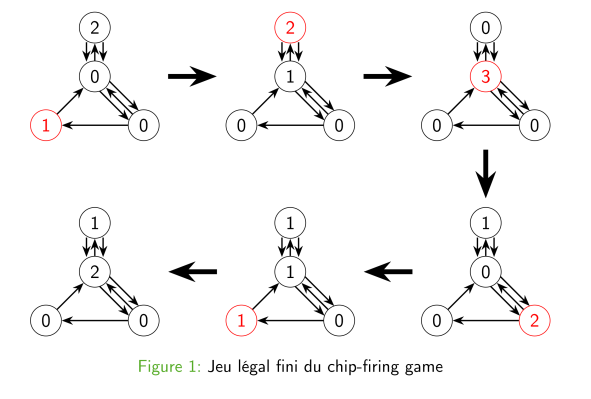
- Title: A Study of the Stabilization of the Chip-Firing Game on Directed Graphs
- Advisor: Christophe Dubussy
Abstract
The Chip-firing game is a dynamic graph game invented around 1983 and originally studied by Anders Björner, László Lóvasz, and Peter Shor. In this game, a certain number of chips are distributed across a directed graph to form an initial configuration. A legal game based on this initial configuration is then a sequence of configurations such that each configuration is obtained from the previous one by activating a vertex, which then distributes its tokens to its neighbors along the outgoing edges. This legal game may, after a certain number of steps, reach a stable configuration, where no vertex has enough tokens to be activated. We then refer to it as a finite legal game in this case, and an infinite legal game otherwise. The category of graphs studied is the most general one, meaning that we work with directed multigraphs with loops that are not necessarily strongly (or weakly) connected. In 1992, Björner and Lóvasz introduced the concept of the instability minimum, which is defined as the minimum number of tokens that can be distributed to generate an infinite legal game.
In the literature, lower and upper bounds on this instability minimum for strongly connected, loop-free graphs have been proposed, along with a proof that it equals the feedback number for strongly connected, loop-free Eulerian graphs. In this thesis, we generalize this latter result to the class of all strongly connected graphs and thus also present an alternative approach to obtaining the aforementioned results. We also provide a characterization of this minimum instability via a new concept called the primitive feedback number. The fundamental idea explored is to analyze the information associated with a sequence of activated vertices—given in reverse order of activation—in order to determine the sequences requiring the minimum number of tokens.
We then show that it is possible to compute the instability minimum of any graph from the instability minimum of its well-connected components (which are strongly connected). We continue with a generalization of the Chip-firing game, in which the activation condition for each vertex is defined by a number that may be greater than its out-degree, and show that this generalization reduces to the Chip-firing game in the context of studying the minimum instability. Finally, we explore the implementation of heuristics for estimating the minimum instability.
2026 Winner - "Science Communication" Category - - Tristan de Cnyf
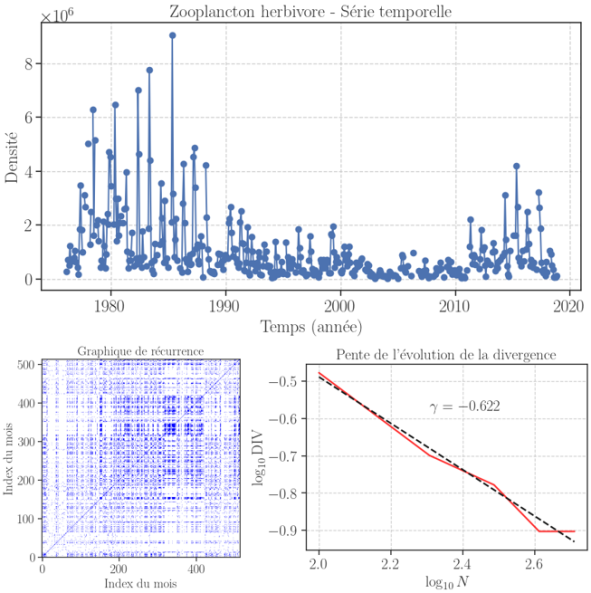
- Title: Formalization of a Chaos Indicator Based on Recurrence Plots. Applications to Plankton Time Series
- Advisor: Jérôme Daquin
- Co-advisor: Alexandre Mauroy
Abstract
From the motion of satellites around Earth to fluctuations in plankton populations, chaos appears to manifest itself at all scales in nature. Such phenomena have been studied for decades using well-known tools, such as the maximum characteristic Lyapunov exponent and the Fast Lyapunov Indicator (FLI). However, as soon as one moves beyond the framework of theoretical models—where the equations of motion are explicit—to that of real-world data, the use of these tools becomes more challenging and often requires going through the time-consuming process of model reconstruction.
The main objective of this thesis is to formalize a new chaos indicator that does not require such model reconstruction, as well as to study its applicability—from theoretical models to plankton time series—while discussing its potential limitations in both cases.
We call this indicator the DESCI: Divergence Evolution Slope Chaos Indicator. First, we introduce the concepts of dynamical systems theory necessary for understanding this thesis, as well as two chaos indicators that will be useful in this work. Next, we will use various concepts from quantitative recurrence analysis to identify power laws governing the evolution of the spatial mean of the divergence. These power laws will allow us to distinguish regular orbits from chaotic orbits within a controlled theoretical framework. Subsequently, they will be formalized as a chaos indicator, the DESCI, whose robustness will be examined in the face of phase space reconstruction, the addition of Gaussian noise to the data, and the combination of these two processes on theoretical models known from the literature. Finally, DESCI will be applied to plankton time series to compare the resulting classifications with those from an existing study and thus assess its applicability to these real-world data.