Since 2022, the Faculty of Law has chosen a theme for the year that unites the entire Faculty, students and teachers, across all blocks and programs. This theme is used in courses, tutorials, assignments, eloquence tournaments, conferences and educational and cultural activities throughout the academic year. It's an exciting, value-bearing dynamic that makes mentoring at the University of Namur ever more unique.

Thus, in 2022-2023, we have come together around CHILDHOOD & MIGRATION, in 2023-2024, around HARASSMENT in all its forms, in 2024-2025, around INCLUSION, with the aim of enabling everyone.e to find their place in society regardless of race, gender, social class, generation, ability, love and/or sexual preferences,... Over the course of the year, we have been made aware of racism, LGBTQIA+, the less able, the elderly or very young, grossophobia, ...

La thématique 2025-2026 : L'environnement, avec le slogan "Réenchantons la Terre"

Nous avons choisi cette année de mettre au centre de nos initiatives pédagogiques l'ENVIRONNEMENT, un des trois grands piliers du développement durable.

Logo du fil rouge de la Faculté de droit : Réanchantons la Terre (2025-2026)

This year we've chosen to put the ENVIRONMENT, one of the three main pillars of sustainable development, at the heart of our educational initiatives.
Objectives

  • To bring us together (staggered and daytime schedules; BAC 1, BAC 2 and BAC 3, research centers and specialized masters)
  • Dive into practice and make courses concrete
  • Conscious that law is a (good) tool in the service of values
  • Decompartmentalize subjects in a cross-disciplinary approach
  • Become a committed jurist
  • Enrich our heads and hearts!

Methodology

  • Through the various courses, practical work, assignments (methodo and TFC), by giving concrete expression to the subject matter taught;
  • Through the complementary activities on offer: meeting legal professionals, plays, films, debates, .

Activities

  • Illustrations and lectures in lectures
  • The involvement of numerous specialists who contribute their expertise and insights from the "field"
  • Faculty activities alongside courses (mock trial, eloquence tournament, ...)
  • Citizen involvement activities (this year: dressing room sale, nomadic donnerie, .... in addition to the solidarity collection initiated last year to meet the needs of Namur's impoverished population during the winter)
  • Cultural activities
  • Other enriching activities (competition to produce awareness-raising video capsules,...)
     

Les activités

Interventions externes dans les cours 

  • Jeudi 5 février 2026 - Cours de droit de l’environnement d’Amélie Lachapelle : présentation du Plan Climat 2030 de la Ville de Namur, suivi d’une discussion avec le service Air Climat Energie de la Ville de Namur.
  • Jeudi 19 février 2026 - Cours de régulation et innovations technologiques d'Elise Degrave, visite de l'expo "Plus Vivant" au Delta suivie de la présentation du plan Climat 2030 de la Ville de Namur par Emma Wauthier, la coordinatrice du projet.
  • Mercredi 25 février 2026 - Cours de droit économique d'Hervé Jacquemin, intervention de Jean-Marc Gollier, avocat spécialisé en droit de l'environnement, le greenwashing et la responsabilité des entreprises en matière d'environnement.
  • Lundi 2 mars 2026 - Cours de droit pénal au D01, intervention de Léa Saussez, conseillère juridique à la Croix-Rouge de Belgique, sur les conséquences environnementales des conflits armés.
  • Mercredi 18 mars 2026 - Cours English for Legal Professionals d’Aude Hansel intervention de Cirian Foulds, théologien et activiste.
  • Mardi 24 mars 2026 - Cours de SPD d’Elise Degrave, intervention de Renaud Duterme, qui défend la géographie de combat
  • Jeudi 7 mai 2026 - Cours de Droit des obligation, intervention de Carole Billiet, avocate spécialisée en droit de l’environnement intervenue dans Klimaatzaak.

Des activités facultaires en marge des cours 

  • Du 27 novembre 2025 au 2 avril 2026 - Chaire Francqui de la Faculté de droit – Delphine Misonne « Besoin d’environnement, besoin de droit »
  • 17 février 2026 – Petit-déjeuner 100% local en collaboration avec le Kot-à-projets Koté Local.
  • 16 février 2026 – Tournoi d’éloquence ouvert à toute la faculté
  • 25 février 2026 – Atelier numérique durable
  • 17 mars 2026 – Conférence sur le climat et la justice climatique
  • 15 avril 2026 – Vide dressing à la Fac

Activités des partenaires

  • 30 novembre 2025 - Procès fictif du Kot à projet « Les bras droit »
  • 19 mars 2026 - Amélie Lachapelle éclaire nos futurs étudiants sur le droit et le développement durable

Au fil de l’année, de l’engagement citoyen

  • Récolte de déchets en team building facultaire (printemps 2026)

Des activités facultaires initiées par les étudiants

  • Repair café au Cercle
  • Troc : « je cherche » & « je donne » au Cercle
  • Atelier de confection de divers objets via recyclage 

Activités créatives et ludiques

  • Concours vidéo en collaboration avec la Ville de Namur (Plan Air Climat 2030)
  • Lectures enrichissantes à la bibliothèque de la Faculté de droit
  • 15 avril 2026 – Rencontre d’impro et Fête du Fil Rouge au profit d’une association qui défend l’environnement

Spotlight

News

Women at the University 2026

Institution
Gender and diversity
SDG#5 - Gender equality

To mark International Women's Day, celebrated on March 8, we invite you to discover the portraits of seven inspiring women from the university's seven faculties. 

Throughout March, a series of portraits of women from the university will be on display in various areas of the campus. Conceived and produced by four UNamur students and coordinated by the University Community Life Service (VéCU), this project offers an inspiring showcase for the careers, voices, and commitments of these women who bring the institution to life on a daily basis.  
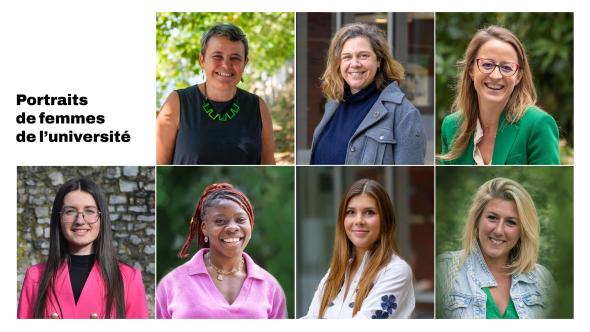
les photos portraits de 7 Femmes de l'Université 2026

Séphora Boucenna, Dean of the Faculty of Education and Training Sciences (FaSEF)

An unusual and evolving career path

A professor and now dean of the Faculty of Education and Training Sciences, Séphora joined the University of Namur in November 1999. She teaches in initial teacher training as well as in the master's degree program specializing in professional support (Mapemass). 


Séphora Boucenna doyenne faculté des sciences éducation et formation

Justine Bodart, doctoral student at the Faculty of Science

A journey built step by step

After high school, Justine entered university without any clear idea of the direction she wanted to take, except that she wanted to study science. She finally chose mathematics, without any certainty at first, but gradually discovered a real interest in the subject.  

Photo de Justine Bodart

Duvernelle Ngouzon Nguimdo, student at the Faculty of Computer Science

An international academic background

Duvernelle completed all her schooling in Cameroon, where she chose to focus on mathematics and physical sciences when she entered secondary school. After two years of studying animal biology at university, she decided to change direction and applied to the University of Namur in Belgium to study computer science. 

Photo de Durvenelle Ngouzon Nguimdo, étudiante à la Faculté d’informatique

Alisson Kabili, laboratory technician at the Faculty of Medicine

Finding her calling in the laboratory

Alisson has been working at the University of Namur for a year and a half as a laboratory technician in the Faculty of Medicine. Her role is essential: assisting researchers with their experiments, preparing practical work for students, and managing the day-to-day running of the laboratory, from ordering reagents to monitoring equipment. 

Alisson Kabili

Virginie Di Luca, administrative assistant at the EMCP Faculty

A rich, multifaceted, and resolutely human career path

Virginie joined the University of Namur in February 2023 as secretary of the Department of Political Science, Information, and Communication. It is a pivotal role at the heart of student and academic life. Her career path has not been a straight line, and that is what she loves about it today. 

Virginie Di Luca

Amélie Lachapelle, professor at the Faculty of Law

A journey marked by chance, encounters, and convictions

A lecturer at the Faculty of Law at UNamur and at Saint-Louis University, Amélie has also held the position of Project Manager for "Transitions & Sustainable Development" since 2025. Hers has been a rich journey, marked by curiosity and detours, but always guided by a desire to understand the law in a different way. 

Amélie Lachapelle (c) Sebastien Roberty

Anne Roekens, professor at the Faculty of Philosophy and Letters

Teaching at the heart of her career 

Anne immediately presents herself as passionate about teaching. A professor of contemporary history, she describes her academic career as "fairly linear," naturally leading her to the classroom. After studying history, she quickly decided to pursue a doctorate focused on language and diversity issues. 

Anne Roekens

March 8, International Women's Rights Day

International Women's Day (UN), also known as "International Day of Struggle for Women's Rights" (UN Women), is celebrated every year on March 8. This day highlights the struggles for women's rights and, more broadly, for the elimination of inequalities between women and men.  

Although International Women's Day was made official by the United Nations in 1977, following on from the International Women's Year proclaimed in 1975 by the UN General Assembly, its origins date back to the social movements that emerged in North America and Europe at the turn of the 20th century. 

The University of Namur fights against gender discrimination

The fight against gender discrimination is a priority at UNamur, which is firmly committed to promoting gender equality, non-discrimination, and respect for diversity.  

UNamur's goal is to create an inclusive university community where everyone can thrive, regardless of gender. By embracing diversity and taking concrete measures, the university affirms its commitment to a more equitable society based on the values of justice, inclusion, and respect for human dignity. 
Immersion in environmental advocacy for law students

Law
Sustainable

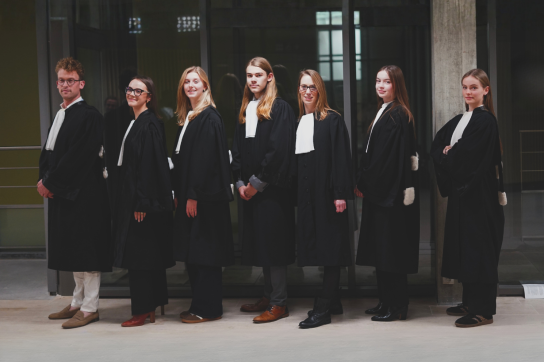
On November 18, 2025, the Faculty of Law organized the fourth edition of its traditional criminal law mock trial. Seven students, from the daytime and staggered schedules, donned their gowns to embody the various players in a trial devoted to a case of illegal rave party in the middle of a protected natural area. Pleadings and indictments were the order of the day. It was also an opportunity to recall how environmental criminal law protects nature, and to discover criminal justice a little more closely.
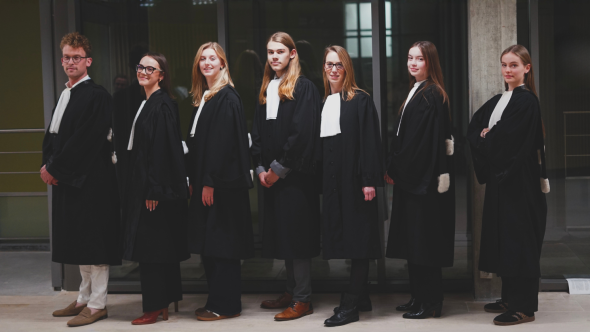
Procès simulé en droit

This year, the trial concerned a case dating back to July 2025: an illegal rave party, gathering some 1,200 people having been held at Ohey, near Namur, in the middle of a protected natural area. "This case is linked to this year's Fil Rouge, "Réenchantons la Terre".It involves a case that caused significant damage to nature, but also acts of violence, with and without a discriminatory motive, between a participant and a local resident", explains Emma Bourcelet, assistant at the Faculty of Law and co-organizer of the event. "In particular, the idea was to show how environmental criminal law can be a tool for defending nature."

Seven students carefully prepared their speeches, each in a different role: Théophile Renier, Aurélie Lemmens, Albiona Sefedini, Louis Jaspard, Dorien Huys, Nateo Carnot and Laly Vadevorst. The staff surrounding the project included: Nathalie Colette-Bazecq, Dean of the Faculty of Law, Amani Pici, PhD student, Amélie Lachapelle, UNamur doctorate in legal sciences, ELSA Namur (European Law Students' Association) and Emma Bourcelet.

Distinguished guests

Special guests

The Faculty of Law welcomed two guests: Julien Moinil, King's Public Prosecutor in Brussels and didactic collaborator in criminal law, who presided over the court during the mock trial, and Sarah Coisne, judge at the Liège Court of Appeal, who had provided the real case file that served as the basis for the facts submitted to the students.

"Julien Moinil's experience as a practitioner and alumnus of the Faculty was a real source of inspiration," Emma Bourcelet points out. "As for Sarah Coisne, she not only contributed to the deliberations for the verdict, but also shared her experience and the diversity of cases in environmental criminal law. The audience was thus able to appreciate the beauty and role of the law in shaping our world in the service of protecting living things. "

Between surpassing oneself and emotions

The pedagogical benefits of such an exercise for students are numerous! "First and foremost, it's a real collective intelligence process where personalities combine to give a unique color to the project. The rigor imposed pushes participants to develop a legal analysis applied to real facts, which enables them to go beyond pure theory. Building a coherent, relevant argument is an invaluable exercise for their future careers, whatever they may be. Finally, learning to speak, role-play and overcome certain fears is a major challenge. Seeing their evolution in just one month is impressive," enthuses Emma Bourcelet.

On this November 18, the emotion was palpable in UNamur's Pedro Arrupe auditorium. "These students are in their second year, they don't yet have all the criminal law material, they find out about the case a month before the event... and yet, the magic happens!" confides Emma Bourcelet.

Image
Emma Bourcelet

Special mention to Dorien, a Dutch-speaking student, who took up the challenge in French. Seeing them surpass themselves, the collective spirit, and even the presence of former participants in the audience... it's also a sign that this experience leaves a positive mark, and it's one of the most beautiful gifts of our professions.

Emma Bourcelet Assistant at the Faculty of Law

Two complementary points of view to put environmental protection back at the heart of public debate

Law
Environment

The University of Namur is soon to offer two inaugural lessons for two Francqui Chairs, one in the Faculty of Science and the other in the Faculty of Law. Open to all, the inaugural lectures will be followed by a local drink. These events are free, upon registration.

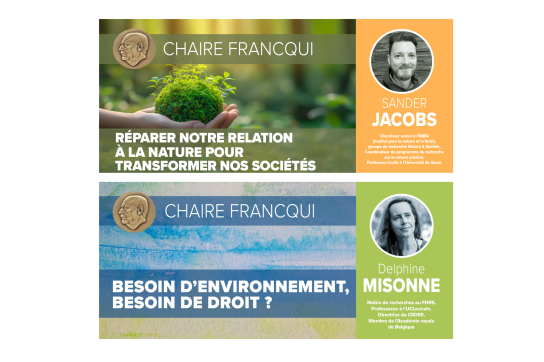
Affiches d'annonce des deux Chaires Francqui 2025-2026 à l'UNamur - Sander Jacobs (sciences) et Delphine Misonne (droit)

Chaire Francqui 2025-2026 en sciences | Repairing our relationship with Nature to transform our societies

The biodiversity crisis isn't just destroying nature: it's also threatening our societies, our well-being and our survival. Based on the scientific assessments and findings of the IPBES (Intergovernmental Science-Policy Platform on Biodiversity and Ecosystem Services), this Francqui Chair will explore our toxic relationship with nature, the global failure to protect it, and the multiple values of living things.

Speaker: Sander Jacobs, Senior Researcher at INBO (Institute for Nature and Forestry), Nature & Society research group, Coordinator of the Urban Nature research program and Visiting Professor at Ghent University.

19/11/2025 - Inaugural lecture | Biodiversity crisis: causes, consequences, and how (not) to get out of it.

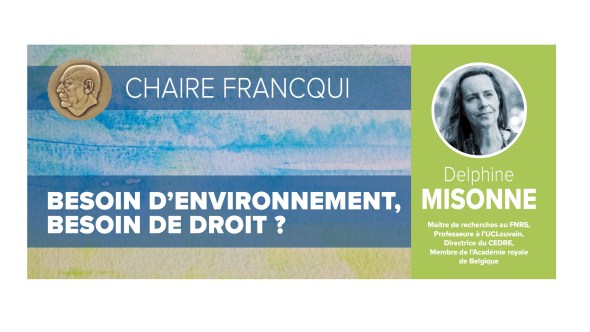
Francqui 2025-2026 Chair in Law | Need for environment, need for law?

This Francqui Chair offers a fresh look at the advances but also the tensions that today characterize the way the law organizes society's relationship with the environment. If the ambition to protect the environment has indeed become a legal issue, how are its essential mainsprings evolving, whether in climate matters, in the relationship to human health, or in the status accorded to nature?

The organization of this Chair is fully integrated into the Law School's Fil Rouge 2025-2026 dedicated to this substratum essential to life that is the environment, nature, our earth: "Réenchanter la terre".

Orator: Delphine Misonne, Senior Research Fellow FNRS, Professor at UCLouvain, Director of CEDRE and member of the Royal Academy of Belgium.

27/11/2025 - Inaugural Lesson I Protecting the environment beyond politics

Digital literacy through fiction: NaDI's interdisciplinary initiative

Artificial Intelligences (AI)
Digital transition
Pedagogy
Event

The Namur Digital Institute (NaDI) is launching a series of original events: "Les Séances du Numérique". Films followed by debates with experts to understand digital challenges and stimulate collective thinking. A project spearheaded by Anthony Simonofski, Anne-Sophie Collard, Benoît Vanderose and Fanny Barnabé.

image du film ex_machina

The Digital Sessions are an initiative launched by the NaDI, the digital research institute at UNamur. The latter brings together researchers from the Faculties of law, informatics and EMCP.

To stimulate interdisciplinary collaboration, NaDI has launched a call for projects. One of the selected projects? Les Séances du Numérique, an original format in which fiction becomes the starting point for debate. Each meeting begins with a film screening, followed by an interdisciplinary conference on a digital-related social issue.

An outstanding first Séance du Numérique

To inaugurate the cycle, the team chose to screen The Social Network last May. The film traces the creation of Facebook by Mark Zuckerberg, and the debate focused on the moderation of social networks, a hot topic since the election of Donald Trump. Two experts led the discussion: Julien Albert, expert at the PReCISE center, and Jérémy Grossman, expert at CRIDS.

Affiche du film "The social network"

Educating through fiction

The ambition of these sessions is simple: to educate about digital issues through fiction, and to confront a variety of viewpoints.

This format extends the experience of the podcast Pop-Code already hosted by Anthony Simonofski and Benoît Vanderose, but with an added dimension: interdisciplinarity and direct exchange with the audience. After the film, everyone can question the experts and enrich the reflection.

What next?

Digital technology will be at the heart of future screenings, with a dynamic that is both collaborative and rooted in current affairs:

  1. Fostering collaboration between several NaDI centers to bring disciplines into dialogue (as was the case at the first session with CRIDS and PReCISE).
  2. Bouncing off themes linked to current events to guarantee the relevance of exchanges.

Four sessions will be offered per year, open to all, with one priority: reaching out to citizens. The films are there to give the event a cultural and scientific outreach.

Eventually, the team would like to diversify its formats: screenings in cinemas like Caméo, broadcasting series, even playconferences where we play a video game during the debate. The idea: to use fiction in all its forms to kick-start discussion.

The team behind the project

  • Fanny Barnabé, lecturer at CRIDS / NaDI
  • Anne-Sophie Collard, professor at the EMCP Faculty
  • Anthony Simonofski, professor at the EMCP Faculty
  • Benoît Vanderose, professor at the Computer Science Faculty

In collaboration with the Knowledge Confluence and the Administration de la communication

Next session: November 4 - "Does AI have a conscience?"

Projection of the film Ex Machina followed by a discussion with Isabelle Linden and Benoît Frenay.

Think, think: is the human being still unique?

Behind the AI revolution, a question arises: does AI have a conscience? For this second screening-debate of Séances du Numérique, we invite you to dive into the film Ex_machina, a troubling face-off between creation and creator, between human and machine, between future and humanity.

Program:

  • 5pm: Welcome & film presentation
  • 5:15pm: Screening of the film Ex machina
  • 7:05pm: Debate "Does AI have a conscience? " (with Isabelle Linden & Benoît Frenay)
  • 19h45: end

Two experts will take part in the debate:

  • Benoît Frenay, who will shed light on the learning logics of today's artificial intelligences and the limits of their "autonomy". Can we really speak of intelligence without consciousness? How far can imitation go?
  • Isabelle Linden, who will question the very foundations of what we call "thinking" in a computer logic. Can we create a conscious machine? Or are we merely facing mirrors of our own desires?
affiche séance du numérique 25.11.04

Women at the University 2026

Institution
Gender and diversity
SDG#5 - Gender equality

To mark International Women's Day, celebrated on March 8, we invite you to discover the portraits of seven inspiring women from the university's seven faculties. 

Throughout March, a series of portraits of women from the university will be on display in various areas of the campus. Conceived and produced by four UNamur students and coordinated by the University Community Life Service (VéCU), this project offers an inspiring showcase for the careers, voices, and commitments of these women who bring the institution to life on a daily basis.  

les photos portraits de 7 Femmes de l'Université 2026

Séphora Boucenna, Dean of the Faculty of Education and Training Sciences (FaSEF)

An unusual and evolving career path

A professor and now dean of the Faculty of Education and Training Sciences, Séphora joined the University of Namur in November 1999. She teaches in initial teacher training as well as in the master's degree program specializing in professional support (Mapemass). 


Séphora Boucenna doyenne faculté des sciences éducation et formation

Justine Bodart, doctoral student at the Faculty of Science

A journey built step by step

After high school, Justine entered university without any clear idea of the direction she wanted to take, except that she wanted to study science. She finally chose mathematics, without any certainty at first, but gradually discovered a real interest in the subject.  

Photo de Justine Bodart

Duvernelle Ngouzon Nguimdo, student at the Faculty of Computer Science

An international academic background

Duvernelle completed all her schooling in Cameroon, where she chose to focus on mathematics and physical sciences when she entered secondary school. After two years of studying animal biology at university, she decided to change direction and applied to the University of Namur in Belgium to study computer science. 

Photo de Durvenelle Ngouzon Nguimdo, étudiante à la Faculté d’informatique

Alisson Kabili, laboratory technician at the Faculty of Medicine

Finding her calling in the laboratory

Alisson has been working at the University of Namur for a year and a half as a laboratory technician in the Faculty of Medicine. Her role is essential: assisting researchers with their experiments, preparing practical work for students, and managing the day-to-day running of the laboratory, from ordering reagents to monitoring equipment. 

Alisson Kabili

Virginie Di Luca, administrative assistant at the EMCP Faculty

A rich, multifaceted, and resolutely human career path

Virginie joined the University of Namur in February 2023 as secretary of the Department of Political Science, Information, and Communication. It is a pivotal role at the heart of student and academic life. Her career path has not been a straight line, and that is what she loves about it today. 

Virginie Di Luca

Amélie Lachapelle, professor at the Faculty of Law

A journey marked by chance, encounters, and convictions

A lecturer at the Faculty of Law at UNamur and at Saint-Louis University, Amélie has also held the position of Project Manager for "Transitions & Sustainable Development" since 2025. Hers has been a rich journey, marked by curiosity and detours, but always guided by a desire to understand the law in a different way. 

Amélie Lachapelle (c) Sebastien Roberty

Anne Roekens, professor at the Faculty of Philosophy and Letters

Teaching at the heart of her career 

Anne immediately presents herself as passionate about teaching. A professor of contemporary history, she describes her academic career as "fairly linear," naturally leading her to the classroom. After studying history, she quickly decided to pursue a doctorate focused on language and diversity issues. 

Anne Roekens

March 8, International Women's Rights Day

International Women's Day (UN), also known as "International Day of Struggle for Women's Rights" (UN Women), is celebrated every year on March 8. This day highlights the struggles for women's rights and, more broadly, for the elimination of inequalities between women and men.  

Although International Women's Day was made official by the United Nations in 1977, following on from the International Women's Year proclaimed in 1975 by the UN General Assembly, its origins date back to the social movements that emerged in North America and Europe at the turn of the 20th century. 

The University of Namur fights against gender discrimination

The fight against gender discrimination is a priority at UNamur, which is firmly committed to promoting gender equality, non-discrimination, and respect for diversity.  

UNamur's goal is to create an inclusive university community where everyone can thrive, regardless of gender. By embracing diversity and taking concrete measures, the university affirms its commitment to a more equitable society based on the values of justice, inclusion, and respect for human dignity. 

Immersion in environmental advocacy for law students

Law
Sustainable

On November 18, 2025, the Faculty of Law organized the fourth edition of its traditional criminal law mock trial. Seven students, from the daytime and staggered schedules, donned their gowns to embody the various players in a trial devoted to a case of illegal rave party in the middle of a protected natural area. Pleadings and indictments were the order of the day. It was also an opportunity to recall how environmental criminal law protects nature, and to discover criminal justice a little more closely.

Procès simulé en droit

This year, the trial concerned a case dating back to July 2025: an illegal rave party, gathering some 1,200 people having been held at Ohey, near Namur, in the middle of a protected natural area. "This case is linked to this year's Fil Rouge, "Réenchantons la Terre".It involves a case that caused significant damage to nature, but also acts of violence, with and without a discriminatory motive, between a participant and a local resident", explains Emma Bourcelet, assistant at the Faculty of Law and co-organizer of the event. "In particular, the idea was to show how environmental criminal law can be a tool for defending nature."

Seven students carefully prepared their speeches, each in a different role: Théophile Renier, Aurélie Lemmens, Albiona Sefedini, Louis Jaspard, Dorien Huys, Nateo Carnot and Laly Vadevorst. The staff surrounding the project included: Nathalie Colette-Bazecq, Dean of the Faculty of Law, Amani Pici, PhD student, Amélie Lachapelle, UNamur doctorate in legal sciences, ELSA Namur (European Law Students' Association) and Emma Bourcelet.

Distinguished guests

Special guests

The Faculty of Law welcomed two guests: Julien Moinil, King's Public Prosecutor in Brussels and didactic collaborator in criminal law, who presided over the court during the mock trial, and Sarah Coisne, judge at the Liège Court of Appeal, who had provided the real case file that served as the basis for the facts submitted to the students.

"Julien Moinil's experience as a practitioner and alumnus of the Faculty was a real source of inspiration," Emma Bourcelet points out. "As for Sarah Coisne, she not only contributed to the deliberations for the verdict, but also shared her experience and the diversity of cases in environmental criminal law. The audience was thus able to appreciate the beauty and role of the law in shaping our world in the service of protecting living things. "

Between surpassing oneself and emotions

The pedagogical benefits of such an exercise for students are numerous! "First and foremost, it's a real collective intelligence process where personalities combine to give a unique color to the project. The rigor imposed pushes participants to develop a legal analysis applied to real facts, which enables them to go beyond pure theory. Building a coherent, relevant argument is an invaluable exercise for their future careers, whatever they may be. Finally, learning to speak, role-play and overcome certain fears is a major challenge. Seeing their evolution in just one month is impressive," enthuses Emma Bourcelet.

On this November 18, the emotion was palpable in UNamur's Pedro Arrupe auditorium. "These students are in their second year, they don't yet have all the criminal law material, they find out about the case a month before the event... and yet, the magic happens!" confides Emma Bourcelet.

Image
Emma Bourcelet

Special mention to Dorien, a Dutch-speaking student, who took up the challenge in French. Seeing them surpass themselves, the collective spirit, and even the presence of former participants in the audience... it's also a sign that this experience leaves a positive mark, and it's one of the most beautiful gifts of our professions.
Emma Bourcelet Assistant at the Faculty of Law

Two complementary points of view to put environmental protection back at the heart of public debate

Law
Environment

The University of Namur is soon to offer two inaugural lessons for two Francqui Chairs, one in the Faculty of Science and the other in the Faculty of Law. Open to all, the inaugural lectures will be followed by a local drink. These events are free, upon registration.

Affiches d'annonce des deux Chaires Francqui 2025-2026 à l'UNamur - Sander Jacobs (sciences) et Delphine Misonne (droit)

Chaire Francqui 2025-2026 en sciences | Repairing our relationship with Nature to transform our societies

The biodiversity crisis isn't just destroying nature: it's also threatening our societies, our well-being and our survival. Based on the scientific assessments and findings of the IPBES (Intergovernmental Science-Policy Platform on Biodiversity and Ecosystem Services), this Francqui Chair will explore our toxic relationship with nature, the global failure to protect it, and the multiple values of living things.

Speaker: Sander Jacobs, Senior Researcher at INBO (Institute for Nature and Forestry), Nature & Society research group, Coordinator of the Urban Nature research program and Visiting Professor at Ghent University.

19/11/2025 - Inaugural lecture | Biodiversity crisis: causes, consequences, and how (not) to get out of it.

Francqui 2025-2026 Chair in Law | Need for environment, need for law?

This Francqui Chair offers a fresh look at the advances but also the tensions that today characterize the way the law organizes society's relationship with the environment. If the ambition to protect the environment has indeed become a legal issue, how are its essential mainsprings evolving, whether in climate matters, in the relationship to human health, or in the status accorded to nature?

The organization of this Chair is fully integrated into the Law School's Fil Rouge 2025-2026 dedicated to this substratum essential to life that is the environment, nature, our earth: "Réenchanter la terre".

Orator: Delphine Misonne, Senior Research Fellow FNRS, Professor at UCLouvain, Director of CEDRE and member of the Royal Academy of Belgium.

27/11/2025 - Inaugural Lesson I Protecting the environment beyond politics

Digital literacy through fiction: NaDI's interdisciplinary initiative

Artificial Intelligences (AI)
Digital transition
Pedagogy
Event

The Namur Digital Institute (NaDI) is launching a series of original events: "Les Séances du Numérique". Films followed by debates with experts to understand digital challenges and stimulate collective thinking. A project spearheaded by Anthony Simonofski, Anne-Sophie Collard, Benoît Vanderose and Fanny Barnabé.

image du film ex_machina

The Digital Sessions are an initiative launched by the NaDI, the digital research institute at UNamur. The latter brings together researchers from the Faculties of law, informatics and EMCP.

To stimulate interdisciplinary collaboration, NaDI has launched a call for projects. One of the selected projects? Les Séances du Numérique, an original format in which fiction becomes the starting point for debate. Each meeting begins with a film screening, followed by an interdisciplinary conference on a digital-related social issue.

An outstanding first Séance du Numérique

To inaugurate the cycle, the team chose to screen The Social Network last May. The film traces the creation of Facebook by Mark Zuckerberg, and the debate focused on the moderation of social networks, a hot topic since the election of Donald Trump. Two experts led the discussion: Julien Albert, expert at the PReCISE center, and Jérémy Grossman, expert at CRIDS.

Affiche du film "The social network"

Educating through fiction

The ambition of these sessions is simple: to educate about digital issues through fiction, and to confront a variety of viewpoints.

This format extends the experience of the podcast Pop-Code already hosted by Anthony Simonofski and Benoît Vanderose, but with an added dimension: interdisciplinarity and direct exchange with the audience. After the film, everyone can question the experts and enrich the reflection.

What next?

Digital technology will be at the heart of future screenings, with a dynamic that is both collaborative and rooted in current affairs:

  1. Fostering collaboration between several NaDI centers to bring disciplines into dialogue (as was the case at the first session with CRIDS and PReCISE).
  2. Bouncing off themes linked to current events to guarantee the relevance of exchanges.

Four sessions will be offered per year, open to all, with one priority: reaching out to citizens. The films are there to give the event a cultural and scientific outreach.

Eventually, the team would like to diversify its formats: screenings in cinemas like Caméo, broadcasting series, even playconferences where we play a video game during the debate. The idea: to use fiction in all its forms to kick-start discussion.

The team behind the project

  • Fanny Barnabé, lecturer at CRIDS / NaDI
  • Anne-Sophie Collard, professor at the EMCP Faculty
  • Anthony Simonofski, professor at the EMCP Faculty
  • Benoît Vanderose, professor at the Computer Science Faculty

In collaboration with the Knowledge Confluence and the Administration de la communication

Next session: November 4 - "Does AI have a conscience?"

Projection of the film Ex Machina followed by a discussion with Isabelle Linden and Benoît Frenay.

Think, think: is the human being still unique?

Behind the AI revolution, a question arises: does AI have a conscience? For this second screening-debate of Séances du Numérique, we invite you to dive into the film Ex_machina, a troubling face-off between creation and creator, between human and machine, between future and humanity.

Program:

  • 5pm: Welcome & film presentation
  • 5:15pm: Screening of the film Ex machina
  • 7:05pm: Debate "Does AI have a conscience? " (with Isabelle Linden & Benoît Frenay)
  • 19h45: end

Two experts will take part in the debate:

  • Benoît Frenay, who will shed light on the learning logics of today's artificial intelligences and the limits of their "autonomy". Can we really speak of intelligence without consciousness? How far can imitation go?
  • Isabelle Linden, who will question the very foundations of what we call "thinking" in a computer logic. Can we create a conscious machine? Or are we merely facing mirrors of our own desires?
affiche séance du numérique 25.11.04
All news

Agenda

30
2026

Conference - Towards a right to the perfect child?

Congress / Colloquium / Conference
-
Faculty of Law

Conference - Towards a right to the perfect child?

30
2026 18:30 - 20:30
Auditoire D02 - Faculté de droit - Rue Grandgagnage - 5000 Namur
Contact person :  Mertens Romain
Register for the event

Choice of gamete donor, IMG following the announcement of a serious condition, preimplantation genetic diagnosis to prevent the occurrence of a disease, choice of sex, reproductive cloning, creation of a child with the genes of 3 or 4 people... Some prospective parents are looking for a child without defects, or even... a perfect child! What are the limits to this potential eugenics? How much weight should be given to the interests of the parents, the (unborn) child, and society? 

Affiche de l'événement

Let's reflect together on these questions at the intersection of law and ethics, with insights from Aurélie Cassiers, visiting lecturer at UNamur.

Moderator: Géraldine Mathieu, professor at UNamur.

02
2026

Francqui Chair 2025-2026 in the Faculty of Law | Need for the environment, need for law?

Congress / Colloquium / Conference
-
Faculty of Law

Francqui Chair 2025-2026 in the Faculty of Law | Need for the environment, need for law?

Law
Environnement
Register for the event
2
2026 18:00 - 20:00
Université de Namur, Faculté de droit (D01) - rue Grangagnage - 5000 Namur
Contact person :  Lachapelle Amélie
Register for the event

Lesson 5 | Seen from above: a new perspective on environmental law

Speaker: Delphine Misonne, FNRS Senior Research Fellow, Professor at UCLouvain, Director of CEDRE and member of the Royal Academy of Belgium.
Chaire Francqui 2025-2026 en Faculté de droit Delphine Misonne

This Francqui Chair offers a fresh perspective on the advances and tensions that characterize the way in which the law currently organizes society's relationship with the environment, as an essential substrate for human life and the balance of ecosystems. Far from presenting this law as having reached its peak, it is its recent major advances that will be discussed, as well as the risks of regression that threaten it. If the ambition to protect the environment has indeed become a legal issue, how are its essential drivers evolving, whether in terms of climate, human health, or the status accorded to nature?

The conference will be followed by a local drink offered by the Cercle de Droit, the Régionale la Binchoise, and the Régionale RTM.

Free event. Registration strongly recommended.

All events

The Fil Rouge of previous years

Image
Logo fil rouge de droit 2024-25

Back to Fil rouge 2024-2025

Find out more about this year's red thread activities on our Newsroom.

Image
Logo fil rouge de droit 2023-24

Back to Fil rouge 2023-2024

Find out more about this year's red thread activities on our Newsroom.

Image
Logo fil rouge de droit 2022-23

Back to Fil rouge 2022-2023

Find out more about the activities offered as part of the 22-23 red thread on our Newsroom.