

L'informatique au service du bien-être collectif et du développement personnel.
La Faculté d'informatique a pour vision celle d'un monde dans lequel l'usage intensif et croissant de l'informatique est orienté vers le bien-être collectif et le développement personnel. Sa mission est de contribuer à cette orientation au travers de la formation, la recherche scientifique et le service à la société.
Les études
Choisir d'étudier l'informatique c'est vous garantir un accès immédiat à un métier passionnant aux multiples facettes. Au travers d'une d'offre d'enseignement complète – bachelier, masters, master de spécialisation et doctorat – la Faculté d'informatique vous offre une formation de qualité basée sur la rigueur scientifique et l'esprit critique, tout en insistant sur l'interdisciplinarité et la responsabilité sociétale.

La recherche
La Faculté d'informatique a pour mission d'assurer une recherche scientifique de pointe, ouverte à la création et à l'intégration des connaissances qui nourrit l'enseignement, l'innovation technologique et le débat de société.

Service à la société
La Faculté d'informatique contribue au développement de notre environnement social, économique, technologique et politique par la diffusion des connaissances et le conseil tant au niveau régional, national et international. Par la synergie entre chercheurs et industriels, par la mise à disposition de savoir et de savoir-faire, elle participe à de nombreuses missions de service à la société.

International
L’ouverture de la Faculté d’informatique à l’international est fondamentale pour le développement de ses activités d’enseignement et de recherche.

Organisation
La Faculté d'informatique s'est organisée afin de pouvoir gérer ses missions de manière optimale. Elle compte une centaine de membres au service de l'enseignement, de la recherche et du service à la société.
Le mot du Doyen
L'informatique est une clé de compréhension, de progrès et de responsabilité face aux défis et aux enjeux de notre société.
Lire l'article
Image

Animation
Une série d’événements et d’acteurs gravitent autour de la Faculté d’informatique.

À la une
Actualités
Article
-
Faculté d'informatique
Institut NaDI
Une étude de la VUB et de l’UNamur montre que des agents d'IA développent leur propre « langage naturel artificiel » pour communiquer sur des données complexes
Intelligence Artificielle
Une étude de la VUB et de l’UNamur montre que des agents d'IA développent leur propre « langage naturel artificiel » pour communiquer sur des données complexes
Intelligence Artificielle
Les systèmes d’IA développent spontanément leur propre langage, adapté à leurs capteurs, plutôt que de copier le langage humain.
Des chercheurs de l’Artificial Intelligence Lab de la VUB et de l’Université de Namur (UNamur) démontrent, dans une nouvelle étude à grande échelle, comment des systèmes d’IA autonomes peuvent développer spontanément, sans intervention humaine, un langage fonctionnel et partagé. Contrairement aux grands modèles linguistiques tels que ChatGPT, qui apprennent à partir de vastes corpus de textes produits par des humains, ces agents IA construisent leur propre système de communication, directement ancré dans les données fournies par leurs capteurs spécifiques et leur environnement. Cette découverte constitue une avancée majeure pour la communication entre les systèmes autonomes, tels que les voitures autonomes, les robots et les capteurs industriels.
Une couche d’abstraction pour les sens non humains
Les modèles linguistiques d’IA actuels se concentrent sur la compréhension et la génération de langues humaines telles que le néerlandais ou l’anglais. Ces langues humaines trouvent historiquement leur fondement dans nos propres perceptions sensorielles. Lorsque des agents d’IA physiques ou virtuels sont équipés de capteurs pour lesquels les humains n’ont pas d’équivalent sensoriel direct – tels que le lidar, le sonar, l’infrarouge ou l’analyse chimique –, le langage humain existant s’avère insuffisant.
Jérôme Botoko Ekila, doctorant à l’AI Lab de la VUB, explique : « Au lieu de contraindre les systèmes d’IA à communiquer dans une langue humaine qui ne correspond pas à leurs capteurs, nous leur permettons de faire développer leur propre « langue naturelle artificielle ». Ils construisent des concepts efficaces qui correspondent exactement à ce qu’ils perçoivent via leurs capteurs, même s’il s’agit de données incompréhensibles pour les humains. »
Comme, dans la pratique, les capteurs de différentes machines ou de différents véhicules ne peuvent pas toujours être calibrés de manière identique, le langage consitute, selon les chercheurs, la solution idéale.
Paul Van Eecke, professeur d’intelligence artificielle à la VUB : « Dans les applications industrielles ou physiques, il est tout simplement irréaliste de s’attendre à ce que tous les capteurs de différents robots ou véhicules soient calibrés de manière parfaitement identique. Les humains résolvent ce problème grâce au langage : si je dis que je me trouve près de la « voiture rouge », nous nous comprenons sans que nos yeux n’enregistrent exactement les mêmes valeurs de couleur. Le langage constitue une couche d’abstraction au-dessus des valeurs des capteurs, et c’est précisément ce que nous laissons désormais ces agents d’IA construire de manière autonome. »
Auto-organisation et évolution
Au lieu de mots préprogrammés ou de codes fixes, les chercheurs ont simplement fourni aux agents les mécanismes de base qui sous-tendent l’évolution du langage humain : l’invention locale de mots, l’adaptation de prototypes conceptuels et la prise en compte du retour d’information en cas de réussite ou d’erreur de communication.
Image

Ce qui est fascinant, c’est qu’il n’y a pas d’ordinateur central qui impose les règles. Nous laissons à chaque fois deux agents interagir localement, l’un avec l’autre. C’est uniquement grâce à ces interactions et mises à jour individuelles qu’une convention commune émerge spontanément au sein de toute la population. Ce principe d’auto-organisation permet au langage de s’optimiser automatiquement : les agents créent exactement le nombre de catégories nécessaires pour accomplir leurs tâches efficacement, sans détails superflus.
Testé sur 37 ensembles de données
L’applicabilité universelle de la méthode a été démontrée sur 37 ensembles de données variés et complexes. Ainsi, les agents ont réussi à développer leur propre vocabulaire pour communiquer, notamment sur des analyses physico-chimiques du vin, des données de la NASA sur les exoplanètes, des ensembles de données visuelles ou des images représentant des oiseaux ou des visages. Dans toutes ces situations, les agents ont réussi à regrouper efficacement les données en nouveaux concepts communs.
Transparents et adaptatifs
La transparence constitue un avantage notable des systèmes développés. Contrairement à de nombreux modèles d’IA de type « boîte noire », les chercheurs peuvent déterminer avec précision la signification d’un mot créé par les agents, car le prototype peut être directement rattaché aux valeurs des capteurs sous-jacents.
De plus, ces systèmes linguistiques évolutifs sont extrêmement robustes. Lorsque l’environnement change, lorsque les données des capteurs sont perturbées par du bruit ou lorsque les agents individuelsprésentent des caractéristiques ou des configurations différentes, le langage s’adapte automatiquement aux nouvelles circonstances grâce à une interaction continue.
Référence
Botoko Ekila, J., Verheyen, L., Nevens, J., Beuls, K., & Van Eecke, P. (2026). Emergent Communication in Continuous Worlds: Self-Organisation of Conceptually Grounded Vocabularies at Scale. Transactions of the Association for Computational Linguistics, vol. 14, pp. 2234–2257. DOI : 10.1162/TACL.a.799
Financement et collaboration
Cette recherche a été menée dans le cadre d'une collaboration entre le Laboratoire d'intelligence artificielle de la Vrije Universiteit Brussel (VUB) et la Faculté d'informatique de l'Université de Namur (UNamur), et a été financée par le Fonds de la recherche scientifique - de Flandre (FWO) et le Fonds de la Recherche Scientifique (FNRS) dans le cadre d’un projet WEAVE.


Article
-
Faculté d'informatique
Institut NaDI
Une recherche de l'UNamur rend les outils de l'intelligence artificielle plus fiables
Intelligence Artificielle
Informatique
Transition numérique
Une recherche de l'UNamur rend les outils de l'intelligence artificielle plus fiables
Intelligence Artificielle
Informatique
Transition numérique
Des chercheurs de l'UNamur ont développé une nouvelle méthode qui a permis de découvrir 32 bugs jusqu'alors invisibles dans certaines des bibliothèques logicielles les plus utilisées pour entraîner les modèles d'intelligence artificielle. Née d'un mémoire de master, cette recherche a déjà conduit à des corrections dans plusieurs logiciels utilisés par des millions de développeurs à travers le monde.

Avant qu'une intelligence artificielle puisse reconnaître une image, comprendre un texte ou répondre à une question, elle doit d'abord être entraînée. Pour cela, les développeurs et les data scientists utilisent des bibliothèques logicielles spécialisées, de véritables « boîtes à outils » qui permettent de construire ces modèles d'IA.
C'est sur ces logiciels que s'est penchée une équipe de recherche réunissant l'Université de Namur, l'Université de Passau (Allemagne) et la TU Delft (Pays-Bas). Leur objectif : détecter des bugs particulièrement difficiles à repérer, susceptibles de provoquer l’arrêt brutal d'un programme.
Une nouvelle méthode pour révéler les bugs invisibles
Pour vérifier que ces bibliothèques fonctionnent correctement, les chercheurs utilisent des logiciels capables de générer automatiquement des milliers de tests. Leur rôle est de pousser les programmes dans leurs retranchements afin de repérer d'éventuelles erreurs.
Jusqu'ici, ces outils avaient toutefois une limite importante Lorsqu'un test provoquait un dysfonctionnement d'une bibliothèque logicielle, le logiciel chargé d'effectuer les tests cessait lui aussi de fonctionner. Impossible, dès lors, de comprendre précisément l'origine du problème ou de le signaler aux développeurs.
Les chercheurs de l'UNamur ont donc imaginé une nouvelle méthode. Désormais, chaque test est exécuté séparément. Si l'un d'eux provoque un crash, celui-ci est isolé : le logiciel de test continue de fonctionner, enregistre l'erreur et poursuit ses analyses. Il devient ainsi possible de détecter automatiquement des bugs qui passaient jusque-là inaperçus.
32 bugs découverts et déjà corrigés
Grâce à cette nouvelle méthode, les chercheurs ont analysé 1 648 modules appartenant aux principales bibliothèques de machine learning et mis au jour 32 bugs inédits. Plusieurs concernaient des logiciels devenus incontournables pour entraîner des modèles d'intelligence artificielle.
Ces anomalies ont été signalées aux équipes de développement. Plusieurs ont déjà été reconnues puis corrigées. “Lorsqu'on corrige un bug à ce niveau-là, ce sont potentiellement des milliers, voire des millions d'utilisateurs qui en bénéficient”, souligne Xavier Devroey, professeur à la Faculté d’informatique de l’UNamur et membre du centre de recherche PReCISE du Namur Digital Institute (NaDI). Au-delà de ces corrections, cette recherche contribue à rendre plus fiables les logiciels sur lesquels reposent aujourd'hui de très nombreuses applications d'intelligence artificielle.
Une recherche née d'un mémoire
Cette avancée est née du mémoire de master de Lucas Berg, réalisé à l'UNamur sous la supervision du professeur Xavier Devroey. Dans le cadre de son stage de recherche, Lucas Berg rejoint ensuite l'équipe du professeur Annibale Panichella à la TU Delft afin de travailler sur Pynguin, l’outil open source de génération automatique de tests développé à l'Université de Passau par l'équipe du professeur Gordon Fraser évoqué précédemment.
Au départ, son objectif était d'améliorer cet outil. En évitant les crashs tout en découvrant des bugs, cette première contribution a attiré ensuite l'attention des chercheurs de l'Université de Passau, confrontés au même problème, donnant naissance à une collaboration internationale qui débouchera sur une publication scientifique commune.
Lucas Berg poursuit aujourd'hui un doctorat à la Faculté d'informatique de l'UNamur sous la supervision des professeurs Wim Vanhoof et Xavier Devroey. Les résultats de cette recherche ont été présentés à l'IEEE International Conference on Software Testing, Verification and Validation (ICST 2026), l'une des conférences internationales les plus prestigieuses dans le domaine du test logiciel.
Cette recherche a aussi bénéficié du soutien du Service public de Wallonie (SPW Recherche) et de Wallonie-Bruxelles International. Une reconnaissance qui souligne la qualité de ces travaux et leur intérêt pour la communauté scientifique internationale.
Le Namur Digital Institute (NaDI)
Au sein de NaDI, les chercheurs apportent des solutions innovantes aux nouveaux défis sociétaux posés par la révolution digitale (eGov, eHealth, eServices, Big data, etc.). Issus de différentes disciplines, les chercheurs croisent leurs expertises en informatique, technologie, éthique, droit, management ou sociologie. Regroupant six centres de recherche, le Namur Digital Institute offre une expertise multidisciplinaire unique dans tous les domaines de l'informatique, de ses applications et de son impact social.
Article
-
Faculté d'informatique
IA et contrôle qualité : quand l’humain garde la main
Intelligence Artificielle
Informatique
Médecine
IA et contrôle qualité : quand l’humain garde la main
Intelligence Artificielle
Informatique
Médecine
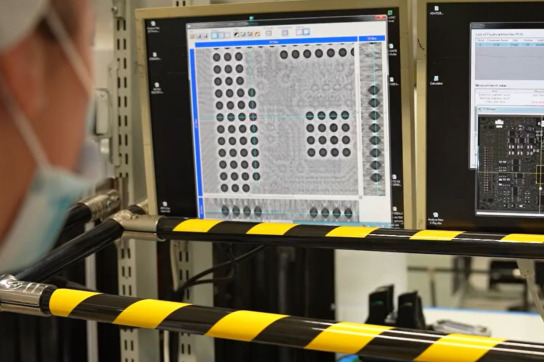
Comment améliorer la détection d’anomalies sur une chaine de production ? C’est au départ d’une problématique très concrète rencontrée au sein de l’entreprise où il travaille qu’Arnaud Bougaham, avec le soutien de son employeur a décidé de consacrer sa thèse à ce sujet, à la Faculté d’informatique de l’UNamur. Objectif ? Développer un modèle d’intelligence artificielle qui assiste les opérateurs dans la détection d’anomalies sur une chaîne de production industrielle, en réduisant les fausses alertes et en rendant le diagnostic plus lisible. Avec à la clé, des perspectives de déploiement également dans le domaine médical.
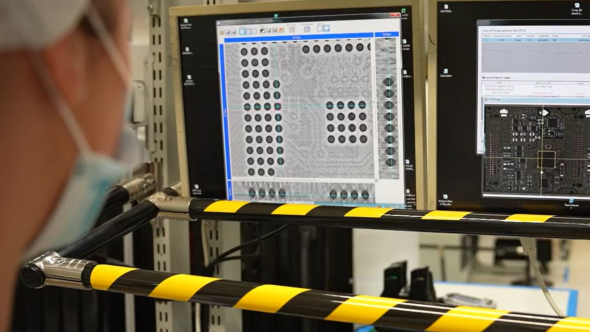
Composant manquant, soudure fragile, polarité inversée, griffe, corps étranger telle qu’une vis qui tombe sur le produit : sur une chaine de production de pièces électroniques pour l’automobile telle que celle de l’entreprise AISIN Europe, les défauts, même s’ils sont rares, doivent pouvoir être détectés de manière immédiate et pertinente. « Mon objectif était de pouvoir apprendre à un ordinateur à repérer ce qui est normal et ce qui est anormal dans des images », résume Arnaud Bougaham, ingénieur data scientist au sein de l’entreprise AISIN EUROPE mais aussi chercheur associé à la Faculté d’informatique de l’UNamur.
Sur une ligne de production, des images sont en effet prises par des caméras placées au-dessus d’un convoyeur et un système informatique est alors chargé de vérifier, à grande cadence, que chaque pièce est conforme. « Or, si le système d’inspection traditionnel fait bien son travail, il génère aussi beaucoup de faux positifs, de fausses alertes. Ce qui impacte fortement le travail des personnes chargées de confirmer ou infirmer les alertes : elles sont sollicitées sans relâche au risque d’y perdre du temps et de l’énergie ». C’est ce processus qu’Arnaud Bougaham a décidé d’améliorer pour son entreprise en commençant en 2020 une thèse de doctorat au sein du laboratoire HuMaLearn de la Faculté d’informatique reconnu pour son expertise en machine learning, sous la supervision des professeurs Benoit Frenay et Isabelle Linden.
Aujourd’hui, les résultats de sa thèse viennent d’être présentés et sont prometteurs. « J’ai mis au point un modèle qui, avec le recours de l’intelligence artificielle, repère de manière très précise et fiable une image qui est normale d’une autre qui ne l’est pas, réduisant ainsi les fausses alertes d’autrefois. »

De plus le modèle permet aussi, lorsqu’un défaut est soupçonné, d’afficher précisément la zone concernée : l’opérateur peut visualiser l’indication, manipuler la pièce si nécessaire, puis trancher.
Autre plus-value de l’outil développé ? Le système n’affiche pas seulement un verdict, il indique aussi la confiance que le système a dans sa prédiction. « L’objectif est de filtrer les cas simples et d’attirer l’attention sur des cas plus complexes, afin que les experts ne soient plus noyés par de mauvais diagnostics et puissent se concentrer sur l’essentiel », insiste Arnaud Bougaham.
Un potentiel au-delà de l’automobile
Si l’outil a avant tout été conçu pour répondre au besoin de l’entreprise de production automobile, la logique est générique. « Il pourrait être transposable au sein d’usines qui fabriquent du parquet, du bois, du tissu. Mais aussi dans le secteur médical », s’enthousiasme Arnaud Bougaham. « Une maladie, c’est finalement une anomalie dans une image. Les contraintes se ressemblent : quand il y a un défaut, il faut absolument le détecter, tout en limitant, autant que possible, les fausses alertes. Dans le secteur médical, avoir un outil similaire qui dégrossit l’analyse tout en laissant la responsabilité au médecin peut être impactant. »
Dans cette approche, l’IA n’est donc pas un pilote automatique, mais un outil d’aide à la décision et se met ainsi au service de l’humain. « L’objectif, c’est de faire prendre la décision finale par la personne, pas de manière automatique », ajoute Arnaud Bougaham. Il s’agit d’un assistant qui « filtre, explique et donne toutes les informations pour que derrière, une personne puisse être décisionnaire ».

Quand la recherche rencontre la « vérité terrain »
La thèse d’Arnaud Bougaham est née d’un double ancrage : doctorant à l’UNamur et, en parallèle, ingénieur chez AISIN Europe. Cette position lui a donné accès à ce qu’il appelle « la vérité terrain ». « En laboratoire, on peut obtenir de très bons résultats, mais en production il y a une réalité avec un environnement précis. » Données bruitées, conditions variables, contraintes de coûts, et surtout cadence : « il faut que notre système fonctionne au rythme de la ligne ». En partageant son temps de travail entre l’entreprise AISIN Europe et l’UNamur, Arnaud Bougaham démontre ainsi comment une thèse peut avoir un impact concret sur les besoins du terrain. Le tout en devant concilier les fonctionnements et obligations de chacun.
Image

Côté académique, on va davantage se situer dans l’analyse fine pour trouver des solutions pérennes, là où côté industriel on va davantage être à la recherche d’une solution fiable, ici et maintenant. C’est là que lorsque l’on travaille simultanément pour les deux secteurs, il faut faire preuve de compromis, de dialogue, de confiance. Mais cette complémentarité entre recherche académique et réalité industrielle permet d’aboutir sur des résultats très riches
Déployer, généraliser, renforcer
Au-delà des promesses, ces travaux sont déjà confrontés à des cas d’usage concrets. Au sein d’AISIN Europe, le cadre développé est notamment en intégration au sein d’une ligne de production active pour détecter des composants inattendus (comme une vis) sur les cartes de circuits imprimés. Dans le domaine médical, l’approche est orientée pour l’analyse de la réceptivité au coma via un examen d’imagerie médicale qui permet d’observer le fonctionnement des organes et des tissus. Certaines techniques sont également reprises pour une application de segmentation du cancer de l’ovaire ou du lymphome.
Ces résultats démontrent aussi comment une intelligence artificielle peut être fiable et centrée sur l’humain dans des environnements à haut risque.
Le projet en images : L'IA au service de l'humain dans le milieu industriel, mythe ou réalité ? :
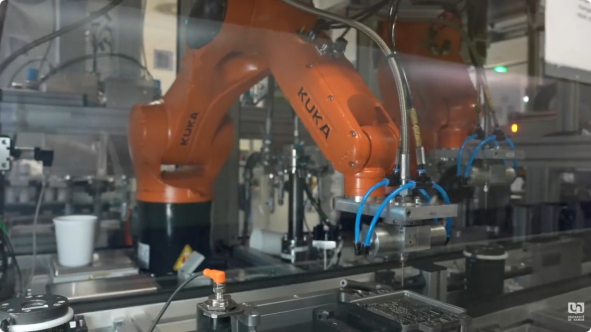
Cet article est tiré de la rubrique "Impact" du magazine Omalius #41 (Juin 2026).


Actualité
-
Faculté de droit
Institut NaDI
Des doctorants du NaDI lancent “Et si l'IA…”, un cycle de conférences pour “démystifier l'intelligence artificielle”
Intelligence Artificielle
Des doctorants du NaDI lancent “Et si l'IA…”, un cycle de conférences pour “démystifier l'intelligence artificielle”
Intelligence Artificielle
À travers cinq conférences-ateliers interdisciplinaires, les doctorants de l’UNamur NaDI invitent le grand public à développer un regard critique sur l’intelligence artificielle qui transforme déjà notre quotidien.
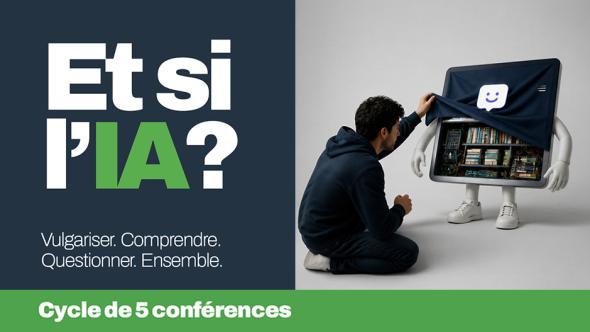
L'intelligence artificielle est aujourd'hui à la portée de tous. Pourtant, si beaucoup l'utilisent au quotidien, rares sont ceux qui en comprennent réellement le fonctionnement, les limites ou les enjeux. C'est pour répondre à ce besoin que le Namur Digital Institute (NaDI) lance “Et si l'IA…”, un cycle de conférences-ateliers ouvert au grand public, coordonné par les doctorantes Elisa De Coster (PReCISE) et Aline Nardi (CRIDS).
“L'idée du projet est de démystifier l'intelligence artificielle”, entame Elisa De Coster. “Nous avons la chance, en tant que chercheurs, d'être sensibilisés aux questions que soulèvent l’IA. Nous voulions que les citoyens curieux puissent eux aussi disposer de ces clés de compréhension.”
“Avant 2022 et l'essor de ChatGPT, ces outils étaient réservés à une niche”, poursuit Aline Nardi."Depuis, l'usage de l'IA s'est généralisé à une vitesse record, mais la réflexion sur les enjeux sociétaux de ces usages n'a pas suivi le rythme. Cette série de conférences est une invitation à faire un pas de côté pour comprendre ce qui se joue en coulisses"
Des regards croisés pour mieux comprendre l'IA
Chaque séance, d'une durée d'environ deux heures, croisera les regards de plusieurs spécialistes. Un doctorant en informatique expliquera le fonctionnement technique de l'IA, tandis que son homologue en droit abordera les implications juridiques, éthiques et sociétales.
Des intervenants issus du monde professionnel viendront partager leur expérience de terrain et une activité interactive permettra au public de mettre ces notions en pratique. Parmis ces intervenants, on peut notamment citer Alice Gorissen (CEO & Head of Animation à Dreamwall), Jean-Philippe Demiddeleer (juge de paix à Gembloux) et Zoé Dewinter (psychologue clinique, spécialisée sur l’IA en santé mentale). L'interactivité, l'interdisciplinarité et l'ouverture au grand public constituent les trois piliers du projet.
Cinq conférences pour explorer les enjeux de l'IA
Chaque rencontre abordera une question de société différente :
- 1er octobre 2026 – La Nef
Et si l'IA était votre confidente ?
Peut-on se confier à un chatbot ? Quels en sont les risques ? - 22 octobre 2026 – PA02
Et si l'IA se trompait ?
Comment reconnaître les erreurs d'une intelligence artificielle et conserver son esprit critique ? - 19 novembre 2026 – Caméo
Et si l'IA était subjective ?
Les intelligences artificielles sont-elles réellement neutres ou reproduisent-elles certains biais ? - 25 février 2027 – Quai 22
Et si l'IA volait vos créations ?
Quels défis l'IA générative pose-t-elle en matière de droit d'auteur et de propriété intellectuelle ? - 18 mars 2027 – TRAKK
Et si l'IA vous connaissait trop bien ?
Que deviennent nos données personnelles et jusqu'où l'IA peut-elle apprendre à nous connaître ?
Si Elisa De Coster et Aline Nardi coordonnent le projet, elles insistent sur le fait qu'il s'agit avant tout d'un travail collectif. Le cycle de conférences est porté par dix doctorants issus des centres de recherche PReCISE et CRIDS : Elisa De Coster, Adélaïde Couplet, Jules Dejaeghere, Pierre Luycx, Pierre Poitier, Aline Nardi, Alix Gobert, Florian Jacques, Martin Rappe, Lionel Goffaux et Olga Thiry. Ensemble, ils veulent aider le grand public à mieux comprendre l'intelligence artificielle, sans la diaboliser ni la présenter comme une solution miracle.
Vous souhaitez participer ? Inscrivez-vous !
Événements
Soutenance publique de thèse de doctorat en informatique - Guillaume Nguyen
Informatique
Intelligence artificielle
3
2026
14:00
-
17:00
Université de Namur, Faculté d'informatique, auditoire I02 - rue Grandgagnage - 5000 Namur
Personne de contact
:
Nguyen Guillaume
Harmonizing Regulations and Source Code: a Symphony of Compliance
Résumé
The increasing regulatory pressure on Cyber-Physical Systems (CPS), particularly in Europe, has transformed compliance into a critical yet complex challenge for industry stakeholders. Many of those CPS are often long-lived systems with legacy code and limited access (i.e., none) to a representative documentation. This causes a problem when those systems need to comply to newer regulatory frameworks. Indeed, current conformity assessment practices rely predominantly on documentation review and operational observations, while the analysis of software artefacts remains underexploited. This situation is accompanied by a persistent communication gap between legal experts and engineers, and a lack of systematic traceability between high-level regulatory obligations and low-level technical implementations. Such decoupling frequently results in inconsistencies detected late in the development process, increasing correction costs and delaying time-to-market. Furthermore, the growing complexity of regulations, such as the Medical Device Regulation (MDR), contributes to the perception that compliance impairs innovation.
Transitioning from theoretical frameworks to industrial implementation presents significant challenges. During this research, efforts to validate the approach in real-world production environments were troubled by restricted access to sensitive data and architectures, as well as the inherent risks of intrusive analysis in highly interconnected systems. Consequently, this thesis emphasizes a conceptual framework validated through modular prototypes and isolated CPS categories (e.g., medical devices), demonstrating the effectiveness of the proposed methods where full-scale production deployment is not yet feasible.
This thesis addresses these challenges by investigating how regulatory requirements can be transformed into structured, traceable, and partially automatable elements directly linked to software artefacts. The research adopts an industrially grounded exploratory approach structured around three main axes: (1) the formalization of regulatory requirements to bridge the semantic gap between legal and technical domains; (2) the extraction of system functionalities from source code using Large Language Models; and (3) a unified framework, supported by tool prototypes, to bridge expected system behaviour and actual implementation through evidence-based assessment.
By combining regulatory analysis, software engineering, and AI-based methods, this work contributes to redefining compliance as a continuous, traceability-driven process. Ultimately, it aims to support a paradigm shift toward "compliant-by-design'' systems, enabling earlier detection of discrepancies and a better alignment between regulatory intent and technical implementation in complex CPS environments.
Jury
- Prof. Xavier Devroey - Université de Namur, Belgique
- Prof. Anthony Cleve - Université de Namur, Belgique
- Prof. Benoit Vanderose - Université de Namur, Belgique
- Prof. Jun Yang, P. Eng - Concordia Montreal, Canada
- Prof. Fuyuki Ishikawa - NII, Japon
- Prof. Paolo Arcaini - NII, Japon
Soutenance publique de thèse de doctorat en informatique - Tony Leclercq
Informatique
6
2026
15:00
-
18:00
Université de Namur, Faculté d'informatique, auditoire I02 - rue Grandgagnage - 5000 Namur
Designing UI/UX guidelines for web sales configurators
La personnalisation de masse constitue aujourd’hui un paradigme industriel majeur permettant de concilier les économies d’échelle de la production de masse avec la prise en compte des besoins et des préférences individuelles des clients. Les configurateurs Web jouent un rôle central dans cette approche en permettant aux utilisateurs de personnaliser des produits ou services directement en ligne selon leurs préférences.
Les technologies de configuration ont fait l’objet de nombreuses recherches. Malheureusement, la plupart portent sur le côté du raisonnement du configurateur (également appelé backend), notamment sur la représentation des connaissances, les mécanismes de raisonnement et la résolution de contraintes. La conception de l’expérience utilisateur (UX) et des interfaces utilisateur (UI) de ces systèmes demeure relativement peu étudiée. Pourtant, de nombreuses études montrent que la qualité de l’interface influence directement l’expérience de configuration, la satisfaction des utilisateurs et la valeur perçue du produit personnalisé; mais aussi la nécessité de s'y intéresser.
Dans cette thèse, nous proposons un ensemble de recommandations visant à améliorer l’interface et l’expérience utilisateur des configurateurs Web.
Pour atteindre cet objectif, un état de l'art sur le design des configurateurs web a été réalisé afin d'identifier les manquements, et un second sur les valeurs perçues. Une introspection portant sur 100 configurateurs a été menée afin d'identifier les caractéristiques susceptibles d'influencer leur qualité. Une étude auprès d'utilisateurs et de concepteurs de configurateurs a également été menée pour identifier leurs attentes et préférences, l'étude auprès des concepteurs permettant de vérifier que ces dernières sont correctement identifiées. Une phase de prototypage a ensuite été menée afin de vérifier comment satisfaire les attentes des utilisateurs dans les interfaces des configurateurs, ainsi que les compromis parfois nécessaires. Enfin, après la conception des guidelines, celles-ci ont été testées auprès d'utilisateurs pour leur efficacité et auprès des concepteurs pour vérifier leur compréhension.
Cette recherche contribue ainsi à rapprocher les domaines des technologies de configuration et de l’interaction homme-machine. Elle fournit à la fois une meilleure compréhension des facteurs influençant l’expérience utilisateur dans les configurateurs Web et un ensemble de recommandations directement exploitables pour concevoir des configurateurs plus efficaces, plus intuitifs et davantage centrés sur les besoins des utilisateurs.
Le jury
- Prof. Patrick Heymans - Université de Namur, Belgique
- Prof. Florentin Rochet - Université de Namur, Belgique
- Prof. Bruno Dumas - Université de Namur, Belgique
- Prof. Männistö Tomi - Université d’Helsinki, Finlande
- Prof. Jean Vanderdonckt - UCLouvain, Belgique
- Prof. Dhungana Deepak - IMC – Université des Sciences Appliquées, Autriche
Défense de thèse
-
Faculté d'informatique
Faculté de philosophie et lettres
Institut NaDI
Institut NaLTT
Soutenance publique de thèse de doctorat en informatique - Liesbet De Vos
Informatique
Langue des signes (LSFB)
19
2026
15:00
-
19:00
Université de Namur, Faculté d'informatique, auditoire I02 - rue Grandgagnage - 5000 Namur
Personne de contact
:
Medugno Sara
SignFCG : A Framework for Operationalising Sign Language Constructions in Computational Construction Grammar.
Abstract
Sign languages express meaning through sequentially and simultaneously produced manual and non-manual articulations, making them structurally different from spoken languages. However, because the linguistic description of sign languages is relatively young, many linguistic theories are biased towards spoken language structures. An exception is construction grammar, a linguistic theory that analyses language through form-meaning mappings that can encompass any observable form. While construction grammar is increasingly used to describe sign languages, computational implementations of constructions are sparse, limiting the possibility of applying the described constructions to corpora of language use. To address this gap, this thesis introduces SignFCG, a framework supporting the representation and processing of operationalised sign language constructions. It introduces phonetic representations for the manual movements of signed languages, taking into account their sequential and simultaneous organisation. It also provides avatar visualisations for signed forms and tools to transform linguistic annotations into the proposed format. To validate SignFCG's functionality, a computational construction grammar comprising 904 constructions was manually developed for a corpus of French-Belgian Sign Language questions about US geography. The corpus is an extension of the multilingual GeoQuery corpus and was created as part of this thesis. Finally, the usability and adoption requirements for SignFCG were identified through a user study that assessed user perception. An evaluation of the developed grammar shows high coverage across a train and test set, confirming SignFCG's ability to support the development and application of large-scale grammars. The resulting set of constructions demonstrates how different types of constructions can be implemented computationally, serving as a reference for future research. The user study identified several promising applications of the framework, including the exploration of constructions in corpora, the formalisation of constructions described in the literature and the study of constructional variation across contexts. It also highlighted the importance of flexibility in the wider adoption of the framework, especially regarding the proposed representation. Overall, this thesis bridges the gap between theoretical descriptions and concrete implementations of sign language constructions, providing the infrastructure for their systematic representation and processing.
Jury
- Prof. Katrien BEULS - Université de Namur, Belgique
- Prof. Bruno DUMAS - Université de Namur, Belgique
- Prof. Anthony CLEVE - Université de Namur, Belgique
- Prof. Laurence MEURANT - Université de Namur, Belgique
- Prof. Paul VAN EECKE - Artificiel Intelligence Laboratory, Vrije Universiteit Brussel, Belgique
- Dr. Remi VAN TRIJP - Sony Computer Science Laboratories, France
- Dr. Michael FILHOL - LISN, CNRS, France

