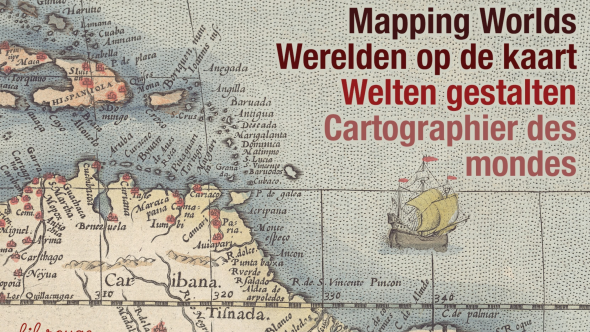
Willkommen, Welcome, Welkom! The Bachelor's degree in Germanic Languages and Literatures is defined by the transmission and development of a whole range of linguistic, analytical, critical and communicative skills. These skills are not only highly valuable on the job market, but also have a significant human value. The Department of Germanic Languages and Literatures is a department apart, in a university apart: human-sized, human-centered, friendly and family-oriented, qualitative, competitive and immersive: it's made for you!

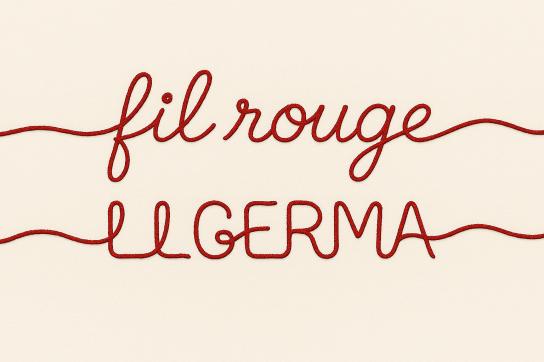
Le Fil rouge Germa

Since 2025, the Department of Germanic Languages and Literatures has chosen a year-long theme that unites the entire community: students and teachers, all blocks combined. This year will be devoted to the theme of "Lifelines" or in target languages "Lifelines, Levenslijnen, Lebenslinien", a red thread that explores the lives of individuals, their evolution, their transmission and the links that weave between the ages.

Logo du Fil rouge du département de Langues et littératures germaniques

Find out more about the Germanic languages and literature department

SVG

The units

See content
SVG

Research

See content
SVG

Activities

See content
SVG

Mobility

See content
SVG

Alumni

See content
SVG

Contact

See content
Image
Aides à la réussite - Germa - Heures de boost

Studies in Germanic languages and literature

The Department of Germanic Languages and Literatures at UNamur offers bachelor's and doctoral programs that combine academic rigor with active teaching methods. Through a comprehensive approach combining linguistics, literature, and culture, students develop solid language skills in English, Dutch, or German that are directly applicable in the job market.

Spotlight

News

From the 16th century to the present: Two professors from UNamur explore what we can still learn from the books of printer and publisher Christophe Plantin

Classical languages and literature
History
Literature
History

Edited by two professors from UNamur, this anthology brings together the work of 18 researchers focusing on some 50 rare books, selected from among the more than 900 editions by Christophe Plantin held by the University. Supported by the Institut Moretus Plantin Public Benefit Foundation, this project marks the first step leading up to the launch, in September, of a new research initiative on multilingualism and translation practices in the editions of the Antwerp printer. 
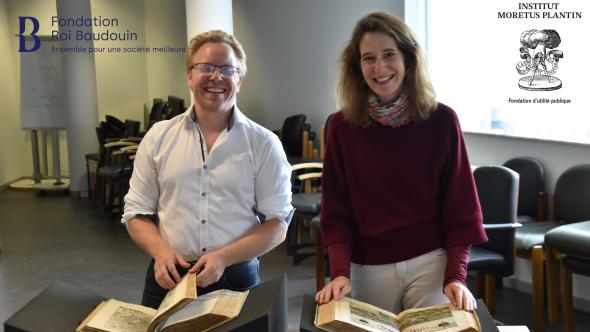
Pierre Assenmaker et Valérie Leyh

With 905 editions published by Christophe Plantin, the Moretus Plantin University Library (BUMP) at UNamur is now home to one of the largest Plantin collections in Belgium. The largest collection is housed at the Plantin-Moretus Museum in Antwerp, located in the former home and printing house of Christophe Plantin. This rich heritage was significantly expanded in 2020, when the collection assembled by Philippe de Dorlodot, a prominent private collector of Plantin editions, was donated to the King Baudouin Foundation, with the wish that it be preserved at UNamur. This exceptional collection has already been the subject of a catalog and has inspired a collective work dedicated to the legacy of this great Renaissance printer. 

“It all began with a phone call from the BUMP Heritage Center, which wanted to organize an exhibition dedicated to Christophe Plantin to mark the 500th anniversary of his birth in 2020,” recalls Pierre Assenmaker, professor of Latin language and literature at UNamur and scientific co-director of the book. Together with Valérie Leyh, a professor of German-language literature who also teaches a course on the history of the book, they began to envision a collaborative project centered on this major figure in European printing. But the initiative quickly took on a new dimension. “When we saw the scope of this collection, we realized we had to go beyond a simple exhibition,” emphasizes Valérie Leyh. “That’s where the idea came from to produce a book that would showcase this exceptional collection held at UNamur.” 

The book thus brings together contributions from 18 researchers from UNamur and other institutions in Belgium and the Netherlands. Since the collection had already been the subject of a comprehensive catalog, published with the support of the King Baudouin Foundation, the authors chose a thematic approach: to understand how Christophe Plantin became, in the 16th century, one of the most influential printers in Europe. “We tried to identify the various factors behind this success, explains Pierre Assenmaker. “Through his network of humanists, as well as his incredible business acumen, Christophe Plantin knew how to adapt his books to different audiences, varying formats, languages, and illustrations. He already possessed the ability to conceive of multiple versions of the same work based on his readers’ expectations.” 
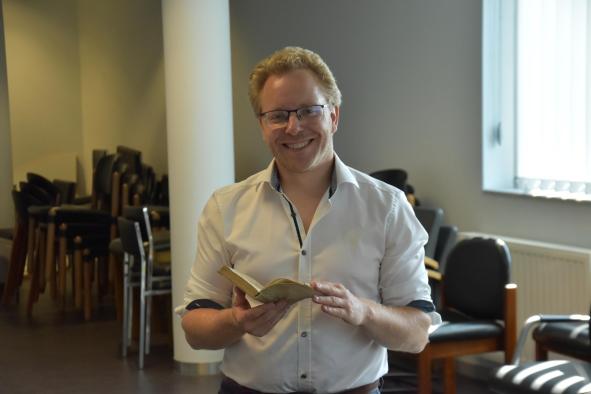
“Nous avons essayé d'identifier les différents facteurs de cette réussite”

Books: A Record of Several Centuries of History

Studying all 905 works held by the BUMP would have been a Herculean task. The researchers had to make some choices. “We analyzed about fifty works that seemed most revealing to us, continues Pierre Assenmaker. “Some stand out for their rarity, others for their beauty, or because they particularly well illustrate Plantin’s editorial strategies. Inevitably, any selection involves making sacrifices, and there are still a great many treasures that deserve to be studied.” The researchers were also able to compare several copies of the same edition. “Some books belonged to several collectors. Others have been annotated over the centuries, adds Valérie Leyh. “These handwritten notes allow us to trace the books’ circulation and understand how they were used or passed down.”
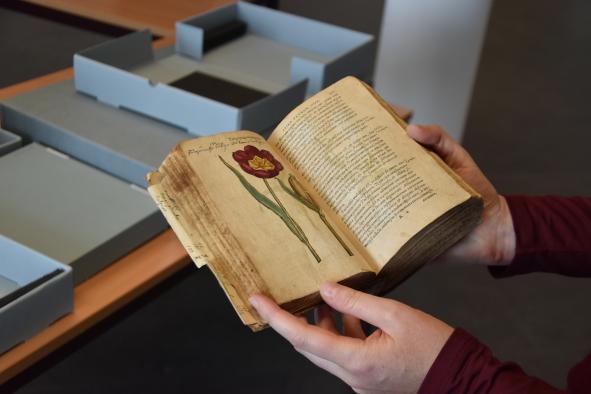
 “Ces notes manuscrites permettent de suivre la circulation des livres et de comprendre comment ils ont été utilisés ou transmis.”

Beyond the texts themselves, researchers have also focused on the book as an object. While today we choose between a large format and a paperback, during the Renaissance, the options were far more numerous. In the 16th century, books were often sold as unbound quires. The buyer then decided on the binding—which could be more or less luxurious—and could even choose to add certain illustrations. Each copy thus became a unique object. Furthermore, as Valérie Leyh points out, a single text could be published in several languages, with or without illustrations, in order to reach different audiences. This was a particularly modern publishing strategy for the time, demonstrating that printers were thoughtful about how to adapt to their readers’ expectations. 
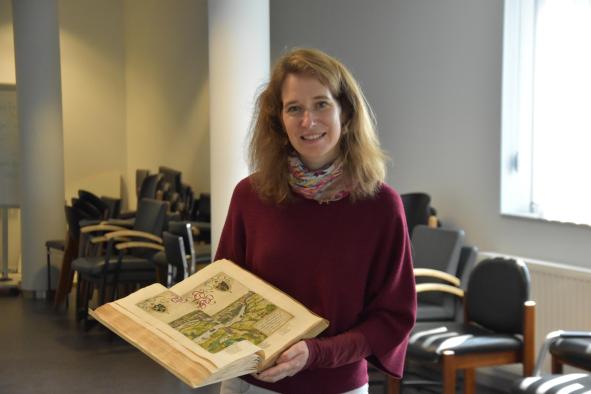
Un même texte pouvait être décliné en plusieurs langues, avec ou sans illustrations, dans le but de toucher des publics différents.

This research also finds a direct extension in the courses offered at UNamur, particularly in the course “The Book and Digital Culture” taught by Valérie Leyh. Students are encouraged to examine a selection of historical books held at the BUMP in order to study their physical characteristics. This is also a way to put these objects into context with current reading practices and digital uses. 

A new chapter will begin in September

While this book marks the culmination of several years of work, it also paves the way for new research. In September, Pierre Assenmaker and Valérie Leyh launched, with the support of the Institut Moretus Plantin Public Benefit Foundation, a two-year research project focused on multilingualism and translation in the works of Christophe Plantin. The goal will be to study some 40 to 50 works held at the BUMP in order to better understand how the Antwerp printer made use of the linguistic diversity of his time. “Today, with machine translation tools and artificial intelligence, we sometimes tend to forget the full complexity of translation, notes Valérie Leyh. “During the Renaissance, translating also meant adapting a work for a new audience. Translators sometimes became co-authors.” 

The project, conducted in collaboration with Asseline Sel, a postdoctoral researcher, aims to better understand Plantin’s editorial strategies through the lens of language. Why were certain works translated? Which readers were they intended for? How could the same text be transformed, shortened, expanded, or illustrated differently depending on the target audience? These are the kinds of questions the researchers will seek to answer by analyzing not only the content of the works but also their physical form, their handwritten annotations, and their history over the centuries. 

Beyond the history of the book, the two researchers also see this as an invitation to better understand our own era. “The 16th century was a period of profound transformations, marked by political, religious, and economic crises, but also by a remarkable exchange of ideas, concludes Pierre Assenmaker. “Studying this period reminds us that times of crisis are not incompatible with the development of culture and knowledge. This is undoubtedly one of the most relevant lessons that Christophe Plantin leaves us today.” 

Want to learn more?

The book, available from Presses Universitaires de Namur, and the new project will be presented on October 8, 2026, at UNamur (L03 lecture hall, accessible via Rue Grafé). Registration for this event is free and can be done via this link. Everyone is welcome! 

Étudier cette période nous rappelle que les temps de crise ne sont pas incompatibles avec le développement de la culture et des connaissances.

The Department of Germanic Languages and Literatures mobilizes around lifelines

Germanic languages
Pedagogy

At the Department of Germanic Languages and Literatures, the year 2025-2026 is placed under the theme of "Lifelines" or in target languages "Lifelines, Levenslijnen, Lebenslinien". For the first time, the teaching team and students will be meeting around a common theme that will accompany them throughout the academic year. The aim: to strengthen coherence between courses, create a collective dynamic and explore Germanic languages and their cultures in a new way.

.
Logo du Fil rouge du département de Langues et littératures germaniques

"Our wish was to create a real dynamic in our teaching and offer coherence to our students by all working around the same theme. Our team was also inspired by initiatives at the Faculty of Law, which has been practicing Fil Rouge for several years," explains Laurence Mettewie, head of the Department of Germanic Languages and Literatures. "Already last year, without it having been explicitly thought of, several of our department's activities revolved around questions of reconstruction, transmission or even resilience." This observation prompted the team to formalize this approach by choosing a common theme.

The starting point for this first edition is "Lifelines", organized on December 11 and 12, 2025 by the English Unit team with the involvement of students from the Language & Society course, which will be devoted to language and literature across the ages of life (info Lifespan).

Logo fil rouge langues et littératures germaniques 2025

Thus, the Department of Germanic Languages and Literatures has chosen to extend this reflection by looking at how individuals evolve, grow and pass on, with an intergenerational dimension that is particularly close to the team's heart.

A program of activities to explore lifelines

Common readings, cinéclub, didactic trips, introductory research topics... there are several educational activities that will illustrate this common thread throughout the year.

The Germa Cinéclub will offer six films, in English, Dutch and German. To inaugurate this cycle, the team has chosen a film that illustrates the theme of lifelines: " Honig im Kopf" by Til Schweiger. This humorous and moving film tells the story of a grandfather suffering from Alzheimer's disease and his granddaughter who will do anything to "save" him, and thus takes a sympathetic look at themes such as dementia, family and memory.

In Dutch, research work in linguistics will focus on the question of linguistic transmission. Students will thus explore how languages are transmitted, are present at different stages of life or how they shed light on intergenerational links, for example through the use of WhatsApp.

The traditional study trip to the Netherlands will also be part of this theme. This year, we're heading for Rotterdam and Fenix, its new museum dedicated to art and migration, where one of the exhibitions recounts stories of mobility, anchorage and passage towards lives they hope will be better. This is an opportunity for students to confront notions of memory, displacement and cultural heritage at the very heart of a museum itinerary conceived as a succession of life lines.

Other activities will enrich the program: student projects specially designed to explore life trajectories, analyses of literary works guided by the theme and meetings with authors from Northern Ireland and Flanders: Wendy Erskine, and Lara Taveirne as well as her French translator Guillaume Deneufbourg.

Discover the Department of Germanic Languages and Literatures

When internet memes become a subject of research

Literature

Born on the internet, memes are an integral part of digital culture. These images, often humorous, combine text and visuals to convey a message. At UNamur, Lieven Vandelanotte, professor of English language and linguistics and general linguistics at the Faculty of Philosophy and Letters, has taken an interest in them from a linguistic point of view. In his new book, co-written with Barbara Dancygier of the University of British Columbia, he deciphers how these creations play with words, images, and grammar. 

Lieven Vandelanotte

First appearing in 1976, the concept of a meme was used by biologist Richard Dawkins to refer to an idea or habit that spreads from one person to another. With the rise of digital technology, the term has taken on a new meaning, now referring to images shared and repurposed online, often accompanied by text, which comment on current events, express an emotion, or describe a situation in a few words. But for Lieven Vandelanotte, professor at the Faculty of Philosophy and Letters, memes represent a new type of language. "Memes are not just illustrations. They combine text and image in a way that transforms how meaning is constructed," he explains.

A linguistic look at digital language

A specialist in discourse and English linguistics, Lieven Vandelanotte has been studying reported speech and multimodality for several years, i.e., productions that combine several modes of expression, such as images and text. 

Thanks to his Francqui Research Professorship, obtained in 2023, he has been able to devote more time to this topic. "This position gives me the opportunity to further my research on multimodality and to finalize this book, a project I have been working on for a long time."

The goal of his work? To show that in memes, images play a linguistic role in their own right. "They can replace a word, complete a sentence, or express a point of view. They are a true grammatical component."

When images construct meaning

Among the memes he analyzes, Lieven Vandelanotte cites the famous Distracted Boyfriend: a man looks away from his girlfriend to admire another woman.
"This meme illustrates the idea of making a choice, changing preferences, turning away from one option to another. A similar idea is expressed by the meme called "Exit 12." An example that combines the two shows that users are well aware that these images are not really used to describe a scenario between lovers or a situation on the highway, but they perceive that different forms, with different images, can have more or less the same meaning."

Mème distracted boyfriend exit 12

Another example is the Good Girl Gina meme, where a smiling young woman is associated with phrases describing "positive" behavior. In the Gets mad at you / Tells you why version, the humor is based on the contrast with a sexist stereotype: the protagonist gets angry, but, contrary to the stereotype, she explains why. "In this case, the image acts as the subject of the sentence. It doesn't illustrate the text, it's an integral part of it and plays a full role in constructing meaning," emphasizes Lieven Vandelanotte.

Mème Get mad at you

He also mentions the category of when-memes, where a sentence beginning with When... ends with an image. For example: "When you're at a party full of people you don't know so you stay with your friend the whole time ," accompanied by a photo of a small koala clinging to a leg. "Here, the image completes the sentence. It does not directly illustrate the situation, but provides the conclusion, like a separate syntactic segment."

mème when

These analyses are at the heart of the book The Language of Memes, co-authored by Barbara Dancygier and Lieven Vandelanotte and published by Cambridge University Press.

Presented as the first book to offer an in-depth linguistic analysis of Internet memes, it proposes a new approach to the study of multimodal genres and explores how images and texts work together to create meaning.

Cover de l’ouvrage The Language of Memes

When it happens on the train...

In recent years, Lieven Vandelanotte has participated in numerous conferences to present the results of his research on memes, but none were as original as the recent "Railway Aesthetics" conference. This conference took place on moving trains. Traveling from Vienna to Bucharest, then from Bucharest to Istanbul, the participants lived together in the train cars for the entire duration of the conference. Together with Justin Bai from the University of Colorado, he gave a presentation on the use of trains in internet memes and social media discourse, as in the attached example (a "when-meme" featuring the late chef Anthony Bourdain looking very cool, ironically reflecting the attitude of someone who manages not to be mocked by a French waiter). 

mème train

Visiting London with UNamur students in your ears

Students
Germanic languages

Bachelor 2 and 3 students in the Department of Germanic Languages and Literatures have taken on a rather unusual challenge: creating audio guides to London's main monuments and sites. An original and successful educational project, well worth a listen!

Visiter Londres avec les étudiants de l'Unamur dans les oreilles

The British Library, Westminster Abbey, Buckingham Palace, Trafalgar Square, The Tower Bridge : si vous envisagez de faire du tourisme à Londres, ces lieux feront certainement partie de votre liste de « must-see ». Sachez que désormais vous pourrez aussi les découvrir en écoutant les étudiants de Bloc 2 et 3 du Département de Langues et littératures germaniques. 

Dans le cadre de leur formation, ces étudiantes et étudiants ont la possibilité de participer à un voyage pédagogique de quelques jours dans une ville étrangère pour exercer leurs compétences linguistiques et renforcer leur connaissance de la culture étrangère. Destination choisie cette année ? London !  

Dès le premier quadrimestre, les étudiants ont été encadrés par l’équipe pédagogique du Département de langues et littératures germaniques pour développer ce projet de création d’audioguide. « L’idée de base était de leur demander de créer de petits exposés en anglais sur quelques sites emblématiques de Londres », explique Dirk Delabastita, Professeur de littérature anglaise. « Mais il nous a semblé plus efficace d’enregistrerces exposés sous forme audio, vu la difficulté de se faire entendre par un groupe entier dans la rue », ajoute le Professeur Lieven Vandelanotte, directeur du Département de langues et littératures germaniques .  

Une liste de 23 sites londoniens fut alors dressée, et les sujets répartis entre les étudiants. Encadrés par Noémie Nélis et Louise Dumont, assistantes au Département de langues et littératures germaniques, ces derniers ont été invités dans un premiertemps à mettre par écrit leur propositiond’exposés. « Il fallait s’assurer que le contenu était correct tant sur le fond que sur la forme », explique Noémie Nélis. « Ensuite, un premier enregistrement sonore via smartphone a été réalisé pour permettre de corriger la prononciation », poursuit elle. Quelques semaines plus tard, c’est dans le studio du service audio-visuel de l’UNamurque les apprentis guides touristiques ont pu passer derrière le micro pour enregistrerleurs podcasts. « Nous avons pu bénéficier des conseils et d’un encadrement très professionnel du service audio-visuel », se réjouit Noémie Nélis.  

Résultat final ? 23 podcasts d’une durée de 3 minutes environ, pour connaitre l’histoire, le rôle ou encore le fonctionnement des grands lieux de Londres ! Le tout agrémenté d’une touche d’humour et de quelques anecdotes ! Ils sont accessibles à tous, gratuitement:

« Ces podcasts ont été testés lors de notre voyage fin mars à Londres avec l’ensemble du groupe. Et les retours tant des étudiants que del’équipe pédagogique étaient très satisfaisants. Les étudiants ont aimé l’expérience malgré la charge de travail que cela leur a demandé. Et sur le plan pédagogique, le bilan est aussi positif puisque cela permet de développer différentes compétences comme la maitrise de l’anglais, dans le registre particulier que demande le podcast, et la connaissance de la culture anglaise », se réjouit Lieven Vandelanotte.  

Et il est d’ores et déjà décidé que l’expérience sera reconduite lors de voyages pédagogiques futurs.  

From the 16th century to the present: Two professors from UNamur explore what we can still learn from the books of printer and publisher Christophe Plantin

Classical languages and literature
History
Literature
History

Edited by two professors from UNamur, this anthology brings together the work of 18 researchers focusing on some 50 rare books, selected from among the more than 900 editions by Christophe Plantin held by the University. Supported by the Institut Moretus Plantin Public Benefit Foundation, this project marks the first step leading up to the launch, in September, of a new research initiative on multilingualism and translation practices in the editions of the Antwerp printer. 

Pierre Assenmaker et Valérie Leyh

With 905 editions published by Christophe Plantin, the Moretus Plantin University Library (BUMP) at UNamur is now home to one of the largest Plantin collections in Belgium. The largest collection is housed at the Plantin-Moretus Museum in Antwerp, located in the former home and printing house of Christophe Plantin. This rich heritage was significantly expanded in 2020, when the collection assembled by Philippe de Dorlodot, a prominent private collector of Plantin editions, was donated to the King Baudouin Foundation, with the wish that it be preserved at UNamur. This exceptional collection has already been the subject of a catalog and has inspired a collective work dedicated to the legacy of this great Renaissance printer. 

“It all began with a phone call from the BUMP Heritage Center, which wanted to organize an exhibition dedicated to Christophe Plantin to mark the 500th anniversary of his birth in 2020,” recalls Pierre Assenmaker, professor of Latin language and literature at UNamur and scientific co-director of the book. Together with Valérie Leyh, a professor of German-language literature who also teaches a course on the history of the book, they began to envision a collaborative project centered on this major figure in European printing. But the initiative quickly took on a new dimension. “When we saw the scope of this collection, we realized we had to go beyond a simple exhibition,” emphasizes Valérie Leyh. “That’s where the idea came from to produce a book that would showcase this exceptional collection held at UNamur.” 

The book thus brings together contributions from 18 researchers from UNamur and other institutions in Belgium and the Netherlands. Since the collection had already been the subject of a comprehensive catalog, published with the support of the King Baudouin Foundation, the authors chose a thematic approach: to understand how Christophe Plantin became, in the 16th century, one of the most influential printers in Europe. “We tried to identify the various factors behind this success, explains Pierre Assenmaker. “Through his network of humanists, as well as his incredible business acumen, Christophe Plantin knew how to adapt his books to different audiences, varying formats, languages, and illustrations. He already possessed the ability to conceive of multiple versions of the same work based on his readers’ expectations.” 

“Nous avons essayé d'identifier les différents facteurs de cette réussite”

Books: A Record of Several Centuries of History

Studying all 905 works held by the BUMP would have been a Herculean task. The researchers had to make some choices. “We analyzed about fifty works that seemed most revealing to us, continues Pierre Assenmaker. “Some stand out for their rarity, others for their beauty, or because they particularly well illustrate Plantin’s editorial strategies. Inevitably, any selection involves making sacrifices, and there are still a great many treasures that deserve to be studied.” The researchers were also able to compare several copies of the same edition. “Some books belonged to several collectors. Others have been annotated over the centuries, adds Valérie Leyh. “These handwritten notes allow us to trace the books’ circulation and understand how they were used or passed down.”

 “Ces notes manuscrites permettent de suivre la circulation des livres et de comprendre comment ils ont été utilisés ou transmis.”

Beyond the texts themselves, researchers have also focused on the book as an object. While today we choose between a large format and a paperback, during the Renaissance, the options were far more numerous. In the 16th century, books were often sold as unbound quires. The buyer then decided on the binding—which could be more or less luxurious—and could even choose to add certain illustrations. Each copy thus became a unique object. Furthermore, as Valérie Leyh points out, a single text could be published in several languages, with or without illustrations, in order to reach different audiences. This was a particularly modern publishing strategy for the time, demonstrating that printers were thoughtful about how to adapt to their readers’ expectations. 

Un même texte pouvait être décliné en plusieurs langues, avec ou sans illustrations, dans le but de toucher des publics différents.

This research also finds a direct extension in the courses offered at UNamur, particularly in the course “The Book and Digital Culture” taught by Valérie Leyh. Students are encouraged to examine a selection of historical books held at the BUMP in order to study their physical characteristics. This is also a way to put these objects into context with current reading practices and digital uses. 

A new chapter will begin in September

While this book marks the culmination of several years of work, it also paves the way for new research. In September, Pierre Assenmaker and Valérie Leyh launched, with the support of the Institut Moretus Plantin Public Benefit Foundation, a two-year research project focused on multilingualism and translation in the works of Christophe Plantin. The goal will be to study some 40 to 50 works held at the BUMP in order to better understand how the Antwerp printer made use of the linguistic diversity of his time. “Today, with machine translation tools and artificial intelligence, we sometimes tend to forget the full complexity of translation, notes Valérie Leyh. “During the Renaissance, translating also meant adapting a work for a new audience. Translators sometimes became co-authors.” 

The project, conducted in collaboration with Asseline Sel, a postdoctoral researcher, aims to better understand Plantin’s editorial strategies through the lens of language. Why were certain works translated? Which readers were they intended for? How could the same text be transformed, shortened, expanded, or illustrated differently depending on the target audience? These are the kinds of questions the researchers will seek to answer by analyzing not only the content of the works but also their physical form, their handwritten annotations, and their history over the centuries. 

Beyond the history of the book, the two researchers also see this as an invitation to better understand our own era. “The 16th century was a period of profound transformations, marked by political, religious, and economic crises, but also by a remarkable exchange of ideas, concludes Pierre Assenmaker. “Studying this period reminds us that times of crisis are not incompatible with the development of culture and knowledge. This is undoubtedly one of the most relevant lessons that Christophe Plantin leaves us today.” 

Want to learn more?

The book, available from Presses Universitaires de Namur, and the new project will be presented on October 8, 2026, at UNamur (L03 lecture hall, accessible via Rue Grafé). Registration for this event is free and can be done via this link. Everyone is welcome! 
Étudier cette période nous rappelle que les temps de crise ne sont pas incompatibles avec le développement de la culture et des connaissances.

The Department of Germanic Languages and Literatures mobilizes around lifelines

Germanic languages
Pedagogy

At the Department of Germanic Languages and Literatures, the year 2025-2026 is placed under the theme of "Lifelines" or in target languages "Lifelines, Levenslijnen, Lebenslinien". For the first time, the teaching team and students will be meeting around a common theme that will accompany them throughout the academic year. The aim: to strengthen coherence between courses, create a collective dynamic and explore Germanic languages and their cultures in a new way.

.
Logo du Fil rouge du département de Langues et littératures germaniques

"Our wish was to create a real dynamic in our teaching and offer coherence to our students by all working around the same theme. Our team was also inspired by initiatives at the Faculty of Law, which has been practicing Fil Rouge for several years," explains Laurence Mettewie, head of the Department of Germanic Languages and Literatures. "Already last year, without it having been explicitly thought of, several of our department's activities revolved around questions of reconstruction, transmission or even resilience." This observation prompted the team to formalize this approach by choosing a common theme.

The starting point for this first edition is "Lifelines", organized on December 11 and 12, 2025 by the English Unit team with the involvement of students from the Language & Society course, which will be devoted to language and literature across the ages of life (info Lifespan).

Logo fil rouge langues et littératures germaniques 2025

Thus, the Department of Germanic Languages and Literatures has chosen to extend this reflection by looking at how individuals evolve, grow and pass on, with an intergenerational dimension that is particularly close to the team's heart.

A program of activities to explore lifelines

Common readings, cinéclub, didactic trips, introductory research topics... there are several educational activities that will illustrate this common thread throughout the year.

The Germa Cinéclub will offer six films, in English, Dutch and German. To inaugurate this cycle, the team has chosen a film that illustrates the theme of lifelines: " Honig im Kopf" by Til Schweiger. This humorous and moving film tells the story of a grandfather suffering from Alzheimer's disease and his granddaughter who will do anything to "save" him, and thus takes a sympathetic look at themes such as dementia, family and memory.

In Dutch, research work in linguistics will focus on the question of linguistic transmission. Students will thus explore how languages are transmitted, are present at different stages of life or how they shed light on intergenerational links, for example through the use of WhatsApp.

The traditional study trip to the Netherlands will also be part of this theme. This year, we're heading for Rotterdam and Fenix, its new museum dedicated to art and migration, where one of the exhibitions recounts stories of mobility, anchorage and passage towards lives they hope will be better. This is an opportunity for students to confront notions of memory, displacement and cultural heritage at the very heart of a museum itinerary conceived as a succession of life lines.

Other activities will enrich the program: student projects specially designed to explore life trajectories, analyses of literary works guided by the theme and meetings with authors from Northern Ireland and Flanders: Wendy Erskine, and Lara Taveirne as well as her French translator Guillaume Deneufbourg.
Discover the Department of Germanic Languages and Literatures

When internet memes become a subject of research

Literature

Born on the internet, memes are an integral part of digital culture. These images, often humorous, combine text and visuals to convey a message. At UNamur, Lieven Vandelanotte, professor of English language and linguistics and general linguistics at the Faculty of Philosophy and Letters, has taken an interest in them from a linguistic point of view. In his new book, co-written with Barbara Dancygier of the University of British Columbia, he deciphers how these creations play with words, images, and grammar. 
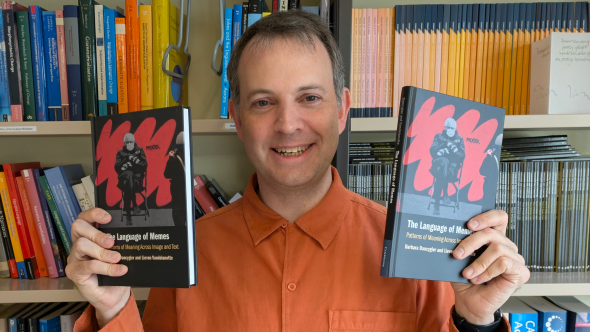
Lieven Vandelanotte

First appearing in 1976, the concept of a meme was used by biologist Richard Dawkins to refer to an idea or habit that spreads from one person to another. With the rise of digital technology, the term has taken on a new meaning, now referring to images shared and repurposed online, often accompanied by text, which comment on current events, express an emotion, or describe a situation in a few words. But for Lieven Vandelanotte, professor at the Faculty of Philosophy and Letters, memes represent a new type of language. "Memes are not just illustrations. They combine text and image in a way that transforms how meaning is constructed," he explains.

A linguistic look at digital language

A specialist in discourse and English linguistics, Lieven Vandelanotte has been studying reported speech and multimodality for several years, i.e., productions that combine several modes of expression, such as images and text. 

Thanks to his Francqui Research Professorship, obtained in 2023, he has been able to devote more time to this topic. "This position gives me the opportunity to further my research on multimodality and to finalize this book, a project I have been working on for a long time."

The goal of his work? To show that in memes, images play a linguistic role in their own right. "They can replace a word, complete a sentence, or express a point of view. They are a true grammatical component."

When images construct meaning

Among the memes he analyzes, Lieven Vandelanotte cites the famous Distracted Boyfriend: a man looks away from his girlfriend to admire another woman.
"This meme illustrates the idea of making a choice, changing preferences, turning away from one option to another. A similar idea is expressed by the meme called "Exit 12." An example that combines the two shows that users are well aware that these images are not really used to describe a scenario between lovers or a situation on the highway, but they perceive that different forms, with different images, can have more or less the same meaning."

Mème distracted boyfriend exit 12

Another example is the Good Girl Gina meme, where a smiling young woman is associated with phrases describing "positive" behavior. In the Gets mad at you / Tells you why version, the humor is based on the contrast with a sexist stereotype: the protagonist gets angry, but, contrary to the stereotype, she explains why. "In this case, the image acts as the subject of the sentence. It doesn't illustrate the text, it's an integral part of it and plays a full role in constructing meaning," emphasizes Lieven Vandelanotte.

Mème Get mad at you

He also mentions the category of when-memes, where a sentence beginning with When... ends with an image. For example: "When you're at a party full of people you don't know so you stay with your friend the whole time ," accompanied by a photo of a small koala clinging to a leg. "Here, the image completes the sentence. It does not directly illustrate the situation, but provides the conclusion, like a separate syntactic segment."

mème when

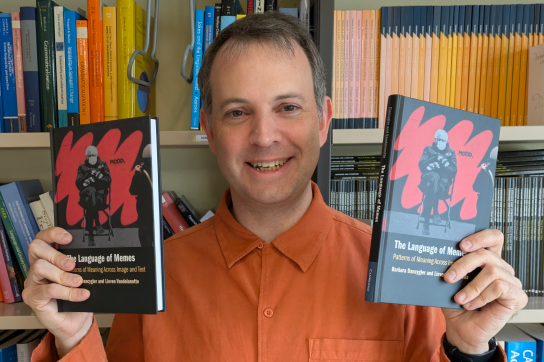
These analyses are at the heart of the book The Language of Memes, co-authored by Barbara Dancygier and Lieven Vandelanotte and published by Cambridge University Press.

Presented as the first book to offer an in-depth linguistic analysis of Internet memes, it proposes a new approach to the study of multimodal genres and explores how images and texts work together to create meaning.

Cover de l’ouvrage The Language of Memes

When it happens on the train...

In recent years, Lieven Vandelanotte has participated in numerous conferences to present the results of his research on memes, but none were as original as the recent "Railway Aesthetics" conference. This conference took place on moving trains. Traveling from Vienna to Bucharest, then from Bucharest to Istanbul, the participants lived together in the train cars for the entire duration of the conference. Together with Justin Bai from the University of Colorado, he gave a presentation on the use of trains in internet memes and social media discourse, as in the attached example (a "when-meme" featuring the late chef Anthony Bourdain looking very cool, ironically reflecting the attitude of someone who manages not to be mocked by a French waiter). 

mème train

Visiting London with UNamur students in your ears

Students
Germanic languages

Bachelor 2 and 3 students in the Department of Germanic Languages and Literatures have taken on a rather unusual challenge: creating audio guides to London's main monuments and sites. An original and successful educational project, well worth a listen!

Visiter Londres avec les étudiants de l'Unamur dans les oreilles

The British Library, Westminster Abbey, Buckingham Palace, Trafalgar Square, The Tower Bridge : si vous envisagez de faire du tourisme à Londres, ces lieux feront certainement partie de votre liste de « must-see ». Sachez que désormais vous pourrez aussi les découvrir en écoutant les étudiants de Bloc 2 et 3 du Département de Langues et littératures germaniques. 

Dans le cadre de leur formation, ces étudiantes et étudiants ont la possibilité de participer à un voyage pédagogique de quelques jours dans une ville étrangère pour exercer leurs compétences linguistiques et renforcer leur connaissance de la culture étrangère. Destination choisie cette année ? London !  

Dès le premier quadrimestre, les étudiants ont été encadrés par l’équipe pédagogique du Département de langues et littératures germaniques pour développer ce projet de création d’audioguide. « L’idée de base était de leur demander de créer de petits exposés en anglais sur quelques sites emblématiques de Londres », explique Dirk Delabastita, Professeur de littérature anglaise. « Mais il nous a semblé plus efficace d’enregistrerces exposés sous forme audio, vu la difficulté de se faire entendre par un groupe entier dans la rue », ajoute le Professeur Lieven Vandelanotte, directeur du Département de langues et littératures germaniques .  

Une liste de 23 sites londoniens fut alors dressée, et les sujets répartis entre les étudiants. Encadrés par Noémie Nélis et Louise Dumont, assistantes au Département de langues et littératures germaniques, ces derniers ont été invités dans un premiertemps à mettre par écrit leur propositiond’exposés. « Il fallait s’assurer que le contenu était correct tant sur le fond que sur la forme », explique Noémie Nélis. « Ensuite, un premier enregistrement sonore via smartphone a été réalisé pour permettre de corriger la prononciation », poursuit elle. Quelques semaines plus tard, c’est dans le studio du service audio-visuel de l’UNamurque les apprentis guides touristiques ont pu passer derrière le micro pour enregistrerleurs podcasts. « Nous avons pu bénéficier des conseils et d’un encadrement très professionnel du service audio-visuel », se réjouit Noémie Nélis.  

Résultat final ? 23 podcasts d’une durée de 3 minutes environ, pour connaitre l’histoire, le rôle ou encore le fonctionnement des grands lieux de Londres ! Le tout agrémenté d’une touche d’humour et de quelques anecdotes ! Ils sont accessibles à tous, gratuitement:

« Ces podcasts ont été testés lors de notre voyage fin mars à Londres avec l’ensemble du groupe. Et les retours tant des étudiants que del’équipe pédagogique étaient très satisfaisants. Les étudiants ont aimé l’expérience malgré la charge de travail que cela leur a demandé. Et sur le plan pédagogique, le bilan est aussi positif puisque cela permet de développer différentes compétences comme la maitrise de l’anglais, dans le registre particulier que demande le podcast, et la connaissance de la culture anglaise », se réjouit Lieven Vandelanotte.  

Et il est d’ores et déjà décidé que l’expérience sera reconduite lors de voyages pédagogiques futurs.  

All news

Agenda

All events

Contact

Laurence Mettewie

Head of the Department of Germanic Languages and Literatures