

Image

Studying abroad, hosting international students, and developing exchanges with partner universities: the UNamur Faculty of Philosophy and Letters brings an international dimension to its programs.
Whether you’re a student or a staff member, whether you want to participate in the Erasmus program, spend time studying at a foreign university, discover a different academic culture, or come to the University of Namur as part of an exchange program, the Faculty will support you in your international mobility plans.

Discover other courses, teaching methods, and learning environments.
Practice a foreign language every day and connect with native speakers.
Discover a new culture and develop your intercultural skills through interactions and everyday life.
Meet students from other countries and expand your network beyond UNamur.
A mobility experience invites you to take on new challenges, make decisions, and develop transferable skills such as curiosity, problem-solving, and self-confidence.
International experience is also a valuable asset in your career and on your resume.
Students in the Philosophy, Ancient and Modern Languages and Literature, French and Romance Languages and Literature, and Germanic Languages and Literatures programs can spend a study abroad term at a foreign university during the first quadrimester of their final year of undergraduate studies.
This international exchange program allows students to take courses at a partner university while continuing their academic studies at UNamur. The exchange is supported by a “course mobility” grant and is organized in close collaboration with UNamur’s International Relations Office.
The Faculty of Philosophy and Letters draws on a network of more than 30 partner universities through programs such as Erasmus+, Erasmus Belgica, and exchanges outside Europe.
Among the destinations offered are:
Study abroad opportunities depend on the academic program and agreements with partner universities.
It was all so intense. My Erasmus experience—with all the experiences, discoveries, and people that were part of it—will remain etched in my memory and in my heart.
To study abroad, an application must be submitted during the academic year prior to departure. The quality of the student’s academic record, their proficiency in the target language, and their motivation are all taken into account when evaluating applications. Specific academic criteria are defined by each department.
There are several opportunities throughout the year to learn about the exchange program and plan it step by step. An initial information session is held during the first quarter.
A “Student Testimonials” session is also organized each year with students returning from an exchange program, who share their experiences with anyone interested in going the following year.
For more information, you can
This Erasmus exchange allowed me to strengthen my command of Spanish, both in terms of comprehension and speaking. I realized that cultural exchanges are invaluable and very enriching. Traveling alone for the first time, I learned to fend for myself and live on my own, but also to be bold enough to reach out to people.
The Faculty of Philosophy and Letters also participates in the short-term hybrid mobility programs offered through Erasmus+.
Students from various programs can apply to participate in summer or winter schools (Summer Schools / Winter Schools), some of which are organized through the UniverSeH alliance.
When a short-term hybrid mobility opportunity is available, students are notified by their professors or by the faculty’s international mobility coordinator, Valérie Leyh.
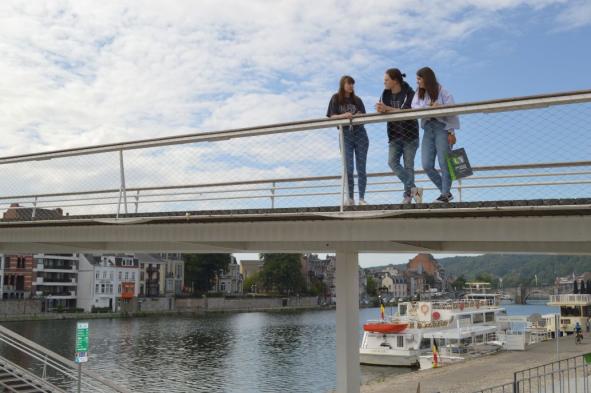
The Faculty of Philosophy and Letters welcomes international students across all its programs.
Exchange students can create a personalized program by selecting courses from the Faculty’s various programs. They may also supplement their program with two courses from another UNamur faculty.
This flexibility allows them to tailor their program to the requirements of their home university and their academic background.
In addition to the courses offered by the Faculty of Philosophy and Letters in French, many courses taught in specific foreign languages (English, Dutch, German, Spanish, Italian) are conducted in those target languages. Others are labeled “English-friendly.”
The Faculty of Philosophy and Letters coordinates the welcome of international students in collaboration with the International Relations Office and the Faculty’s student office. The faculty coordinator ensures personalized support for each student.
The personalized support at UNamur and the many courses taught in a seminar format facilitate interaction between international students and students from Namur.
The integration of international students into the Faculty of Philosophy and Letters is also supported by an “Erasmus buddies” program: local Namur students meet with them at the start of their stay and can help them navigate the university, their courses, and daily life.
The many cultural activities (film club, field trips, author readings, Christmas party) and academic events (conferences and symposia) organized within the faculty offer international students the opportunity to meet others outside of class hours, in a setting that encourages interaction and the spoken practice of foreign languages.
In several departments, conversation circles are also organized by and for international students.
These activities provide opportunities to meet others and practice foreign languages in a friendly setting.
All staff members—whether academic, research, administrative, technical, or managerial—have the opportunity to participate in a training mobility program abroad or in Flanders. Such a stay lasts between 2 and 5 days and includes teaching and/or training activities.
An Erasmus+ mobility program is an opportunity to
As with students, the UNamur Faculty of Philosophy and Letters also hosts colleagues from partner universities. Their visits help strengthen international relations, offer specific activities to students, bring an international dimension to the curriculum, and deepen intercultural exchanges.
Students in certain programs—Philosophy, Ancient and Modern Languages and Literature, French and Romance Languages and Literature, and Germanic Languages and Literature—can spend a semester studying at a partner university abroad. This semester takes place during the first quadrimester of the final year of the undergraduate program. The available options depend on the mobility agreements associated with the student’s program of study.
The Faculty has more than 30 partner universities, notably in Germany, Austria, Belgium, Spain, France, Ireland, Italy, the Netherlands, Canada, Argentina, and the United States. Available destinations vary depending on the study program and the agreements in place with partner universities.
Yes. Students in several programs within the Faculty can participate in an exchange program during their bachelor’s degree, including Philosophy, Ancient and Modern Languages and Literature, French and Romance Languages and Literature, and Germanic Languages and Literature. To find out about the destinations and requirements for your program, please consult your program’s mobility information and contact the faculty coordinator, Valérie Leyh.
The Faculty of Philosophy and Humanities welcomes international students in all its programs. They can design a personalized curriculum by selecting courses from different programs and receive individualized support. The “Erasmus buddies” program, cultural and academic activities, and conversation circles help facilitate their integration and interaction with Namur students.