

NaLTT
Bringing together linguists and literary scholars, UNamur's Institute of Language, Text and Transmediality provides a platform for interdisciplinary diachronic and synchronic research into the multiple ways in which different types of verbal and multimodal communicative practices manifest themselves in, give shape to, are regulated by and reflect culture and society.


Points forts
NaLTT réunit des chercheurs spécialisés dans l’étude des attitudes, des contacts et des conflits linguistiques, de la politique et de la planification linguistiques, du discours rapporté et de l’expression du point de vue, ainsi que dans l’étude de la multimodalité. L’analyse linguistique des langues signées sur des données de corpus constitue l’une des originalités de NaLTT au sein du LSFB Lab.
Dans le domaine littéraire, NaLTT fédère les travaux de spécialistes des biographies littéraires, de la théorie de la littérature, de la littérature du Moyen Âge, de la littérature missionnaire, de l’édition de textes, de la sociologie de la littérature et de la théorie de la traduction.
NaLTT propose aux doctorants un environnement de recherche stimulant et convivial. Il se veut un incitant pour le développement des collaborations entre chercheurs juniors et seniors et un espace de formation (continue) à la recherche.
Spotlight
News

Article
-
Faculty of Philosophy and Letters
Department of Classical Languages and Literatures NaLTT Institute
From the 16th century to the present: Two professors from UNamur explore what we can still learn from the books of printer and publisher Christophe Plantin
Classical languages and literature
History
Literature
History
Article
-
Faculty of Philosophy and Letters
Department of Classical Languages and Literatures
Department of Germanic Languages and Literatures
NaLTT Institute
PaTHs Institute
From the 16th century to the present: Two professors from UNamur explore what we can still learn from the books of printer and publisher Christophe Plantin
Classical languages and literature
History
Literature
History
Edited by two professors from UNamur, this anthology brings together the work of 18 researchers focusing on some 50 rare books, selected from among the more than 900 editions by Christophe Plantin held by the University. Supported by the Institut Moretus Plantin Public Benefit Foundation, this project marks the first step leading up to the launch, in September, of a new research initiative on multilingualism and translation practices in the editions of the Antwerp printer.
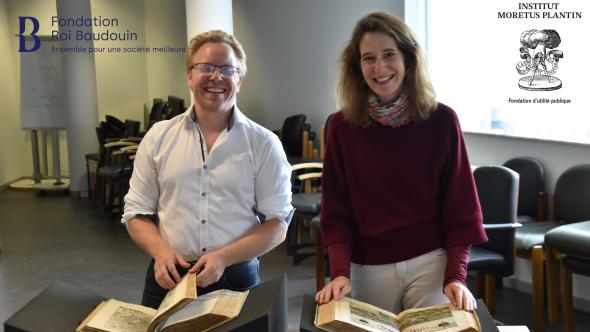
With 905 editions published by Christophe Plantin, the Moretus Plantin University Library (BUMP) at UNamur is now home to one of the largest Plantin collections in Belgium. The largest collection is housed at the Plantin-Moretus Museum in Antwerp, located in the former home and printing house of Christophe Plantin. This rich heritage was significantly expanded in 2020, when the collection assembled by Philippe de Dorlodot, a prominent private collector of Plantin editions, was donated to the King Baudouin Foundation, with the wish that it be preserved at UNamur. This exceptional collection has already been the subject of a catalog and has inspired a collective work dedicated to the legacy of this great Renaissance printer.
“It all began with a phone call from the BUMP Heritage Center, which wanted to organize an exhibition dedicated to Christophe Plantin to mark the 500th anniversary of his birth in 2020,” recalls Pierre Assenmaker, professor of Latin language and literature at UNamur and scientific co-director of the book. Together with Valérie Leyh, a professor of German-language literature who also teaches a course on the history of the book, they began to envision a collaborative project centered on this major figure in European printing. But the initiative quickly took on a new dimension. “When we saw the scope of this collection, we realized we had to go beyond a simple exhibition,” emphasizes Valérie Leyh. “That’s where the idea came from to produce a book that would showcase this exceptional collection held at UNamur.”
The book thus brings together contributions from 18 researchers from UNamur and other institutions in Belgium and the Netherlands. Since the collection had already been the subject of a comprehensive catalog, published with the support of the King Baudouin Foundation, the authors chose a thematic approach: to understand how Christophe Plantin became, in the 16th century, one of the most influential printers in Europe. “We tried to identify the various factors behind this success,” explains Pierre Assenmaker. “Through his network of humanists, as well as his incredible business acumen, Christophe Plantin knew how to adapt his books to different audiences, varying formats, languages, and illustrations. He already possessed the ability to conceive of multiple versions of the same work based on his readers’ expectations.”
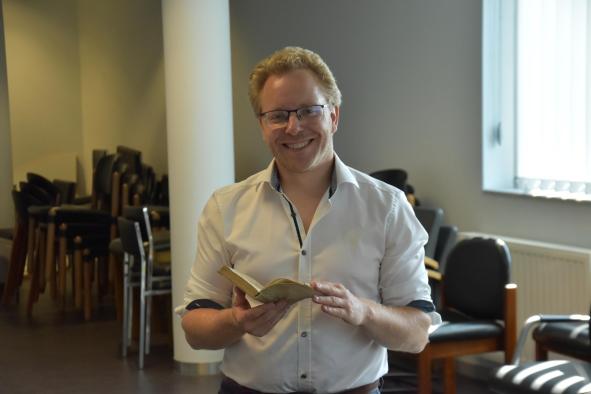
Books: A Record of Several Centuries of History
Studying all 905 works held by the BUMP would have been a Herculean task. The researchers had to make some choices. “We analyzed about fifty works that seemed most revealing to us,” continues Pierre Assenmaker. “Some stand out for their rarity, others for their beauty, or because they particularly well illustrate Plantin’s editorial strategies. Inevitably, any selection involves making sacrifices, and there are still a great many treasures that deserve to be studied.” The researchers were also able to compare several copies of the same edition. “Some books belonged to several collectors. Others have been annotated over the centuries,” adds Valérie Leyh. “These handwritten notes allow us to trace the books’ circulation and understand how they were used or passed down.”
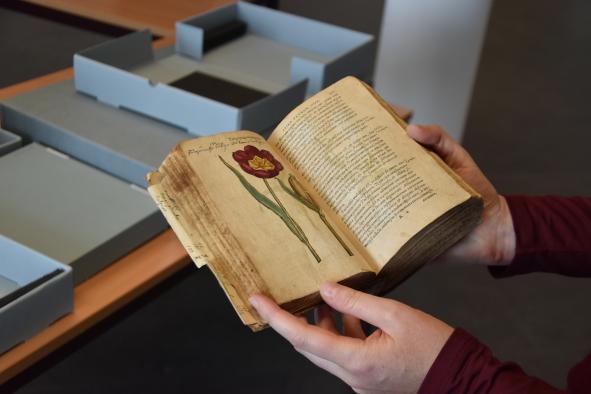
Beyond the texts themselves, researchers have also focused on the book as an object. While today we choose between a large format and a paperback, during the Renaissance, the options were far more numerous. In the 16th century, books were often sold as unbound quires. The buyer then decided on the binding—which could be more or less luxurious—and could even choose to add certain illustrations. Each copy thus became a unique object. Furthermore, as Valérie Leyh points out, a single text could be published in several languages, with or without illustrations, in order to reach different audiences. This was a particularly modern publishing strategy for the time, demonstrating that printers were thoughtful about how to adapt to their readers’ expectations.
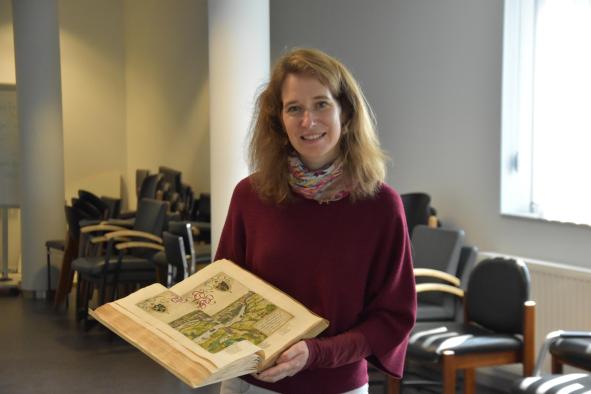
This research also finds a direct extension in the courses offered at UNamur, particularly in the course “The Book and Digital Culture” taught by Valérie Leyh. Students are encouraged to examine a selection of historical books held at the BUMP in order to study their physical characteristics. This is also a way to put these objects into context with current reading practices and digital uses.
A new chapter will begin in September
While this book marks the culmination of several years of work, it also paves the way for new research. In September, Pierre Assenmaker and Valérie Leyh launched, with the support of the Institut Moretus Plantin Public Benefit Foundation, a two-year research project focused on multilingualism and translation in the works of Christophe Plantin. The goal will be to study some 40 to 50 works held at the BUMP in order to better understand how the Antwerp printer made use of the linguistic diversity of his time. “Today, with machine translation tools and artificial intelligence, we sometimes tend to forget the full complexity of translation,” notes Valérie Leyh. “During the Renaissance, translating also meant adapting a work for a new audience. Translators sometimes became co-authors.”
The project, conducted in collaboration with Asseline Sel, a postdoctoral researcher, aims to better understand Plantin’s editorial strategies through the lens of language. Why were certain works translated? Which readers were they intended for? How could the same text be transformed, shortened, expanded, or illustrated differently depending on the target audience? These are the kinds of questions the researchers will seek to answer by analyzing not only the content of the works but also their physical form, their handwritten annotations, and their history over the centuries.
Beyond the history of the book, the two researchers also see this as an invitation to better understand our own era. “The 16th century was a period of profound transformations, marked by political, religious, and economic crises, but also by a remarkable exchange of ideas,” concludes Pierre Assenmaker. “Studying this period reminds us that times of crisis are not incompatible with the development of culture and knowledge. This is undoubtedly one of the most relevant lessons that Christophe Plantin leaves us today.”
Want to learn more?
The book, available from Presses Universitaires de Namur, and the new project will be presented on October 8, 2026, at UNamur (L03 lecture hall, accessible via Rue Grafé). Registration for this event is free and can be done via this link. Everyone is welcome!

News
-
Faculty of Sciences
DeFIPP Institute
28 new research projects funded by the FNRS
Award
News
-
Faculty of Sciences
Faculty of Philosophy and Letters
Faculty of Computer Science
Faculty Economics Management Communication Politics (EMCP)
DeFiPP Institute
ILEE Institute
NaDI Institute
Narilis Institute
NaLTT Institute
IRDENa Institute
Institute
28 new research projects funded by the FNRS
Award
The F.R.S.-FNRS has just published the results of its various 2025 calls for proposals. These include the "Credits & Projects" and "WelCHANGE" calls, as well as the "FRIA" (Fund for Research Training in Industry and Agriculture) and "FRESH" (Fund for Research in the Humanities) calls, which aim to support doctoral theses. What are the results for UNamur? Twenty-eight projects have been selected, demonstrating the quality and richness of research at UNamur.
The "Credits & Projects" call for proposals resulted in 12 grants being awarded for ambitious new projects. These include two "equipment" grants, eight "research credits (CDR)" grants, and two "research projects (PDR)" grants, one of which is in collaboration with the ULB. The FRIA call for doctoral research support will fund eleven doctoral scholarships and the FRESH call will fund three.
Two prestigious Scientific Impulse Mandates (MIS) were also obtained. This three-year funding supports young permanent researchers who wish to develop an original and innovative research program by acquiring scientific autonomy within their department.
We would also like to highlight the two projects funded under the "WelCHANGE" call, a funding instrument for research projects with potential societal impact, led by a principal investigator in the humanities and social sciences.
Detailed results
Call for Equipment
- Xavier De Bolle, Narilis Institute, Co-promoter in collaboration with UCLouvain
- Luca Fusaro, NISM Institute
Call for Research Grants (CDR)
- Marc Hennequart, NARILIS Institute
- Nicolas Gillet, NARILIS Institute
- Jean-Yves Matroule, NARILIS Institute
- Patricia Renard, NARILIS Institute
- Francesco Renzi, NARILIS Institute
- Stéphane Vincent, NISM Institute
- Laurence Meurant, NaLTT Institute
- Emma-Louise Silva, NaLTT Institute
Call for Research Projects (PDR)
- Jérémy Dodeigne, Transitions Institute, Co-supervisor in collaboration with ULB
- Luc Henrard, NISM Institute; Co-supervisor: Yoann Olivier, NISM Institute
Fund for Training in Research in Industry and Agriculture (FRIA)
- Emma Bongiovanni - Supervisor: Catherine Michaux, NISM Institute
- Simon Chabot - Supervisor: Carine Michiels, Narilis Institute; Co-supervisor: Anne-Catherine Heuskin, Narilis Institute
- Lee Denis - Supervisor: Muriel Lepère, ILEE Institute
- Maé Desclez - Supervisor: Johan Yans, ILEE Institute; Co-supervisor: Hamed Pourkhorsandi (University of Toulouse)
- Pierre Lombard - Supervisor: Benoît Muylkens, Narilis Institute; Co-supervisor: Damien Coupeau, Narilis Institute
- Amandine Pecquet - Supervisor: Nicolas Gillet, Narilis Institute; Co-supervisor: Damien Coupeau, Narilis Institute
- Kilian Petit - Supervisor: Henri-François Renard, Narilis Institute; Co-supervisor: Xavier De Bolle, Narilis Institute
- Simon Rouxhet - Supervisor: Catherine Michaux, NISM Institute; Co-supervisor: Nicolas Gillet, Narilis Institute
- William Soulié - Supervisor: Yoann Olivier, NISM Institute
- Elisabeth Wanlin - Supervisor: Xavier De Bolle, Narilis Institute
- Laura Willam - Supervisor: Frédérik De Laender, ILEE Institute
Fund for Research in the Humanities (FRESH)
- Louis Droussin - Supervisor: Arthur Borriello, Transitions Institute; Co-supervisor: Vincent Jacquet, Transitions Institute
- Nicolas Larrea Avila - Supervisor: Guilhem Cassan, DeFIPP Institute
- Victor Sluyters – Supervisor: Wafa Hammedi, NADI Institute
- Amandine Leboutte - Co-supervisor: Erika Wauthia (UMons); Co-supervisor: Cédric Vanhoolandt, IRDENa Institute.
Scientific Impulse Mandate (MIS)
- Charlotte Beaudart, Narilis Institute
- Eli Thoré ILEE Institute
WelCHANGE Call
- Nathalie Burnay Transitions Institute, in collaboration with UCLouvain
- Catherine Guirkinger, DeFIPP Institute
Congratulations to all!
Article
-
Faculty of Philosophy and Letters
Department of Germanic Languages and Literatures NaLTT Institute
When internet memes become a subject of research
Literature
Article
-
Faculty of Philosophy and Letters
Department of Germanic Languages and Literatures
NaLTT Institute
When internet memes become a subject of research
Literature
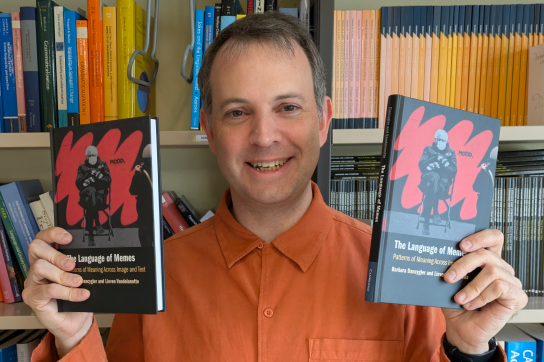
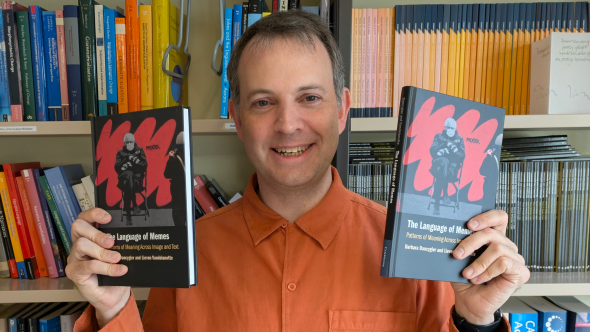
Born on the internet, memes are an integral part of digital culture. These images, often humorous, combine text and visuals to convey a message. At UNamur, Lieven Vandelanotte, professor of English language and linguistics and general linguistics at the Faculty of Philosophy and Letters, has taken an interest in them from a linguistic point of view. In his new book, co-written with Barbara Dancygier of the University of British Columbia, he deciphers how these creations play with words, images, and grammar.
First appearing in 1976, the concept of a meme was used by biologist Richard Dawkins to refer to an idea or habit that spreads from one person to another. With the rise of digital technology, the term has taken on a new meaning, now referring to images shared and repurposed online, often accompanied by text, which comment on current events, express an emotion, or describe a situation in a few words. But for Lieven Vandelanotte, professor at the Faculty of Philosophy and Letters, memes represent a new type of language. "Memes are not just illustrations. They combine text and image in a way that transforms how meaning is constructed," he explains.
A linguistic look at digital language
A specialist in discourse and English linguistics, Lieven Vandelanotte has been studying reported speech and multimodality for several years, i.e., productions that combine several modes of expression, such as images and text.
Thanks to his Francqui Research Professorship, obtained in 2023, he has been able to devote more time to this topic. "This position gives me the opportunity to further my research on multimodality and to finalize this book, a project I have been working on for a long time."
The goal of his work? To show that in memes, images play a linguistic role in their own right. "They can replace a word, complete a sentence, or express a point of view. They are a true grammatical component."
When images construct meaning
Among the memes he analyzes, Lieven Vandelanotte cites the famous Distracted Boyfriend: a man looks away from his girlfriend to admire another woman.
"This meme illustrates the idea of making a choice, changing preferences, turning away from one option to another. A similar idea is expressed by the meme called "Exit 12." An example that combines the two shows that users are well aware that these images are not really used to describe a scenario between lovers or a situation on the highway, but they perceive that different forms, with different images, can have more or less the same meaning."

Another example is the Good Girl Gina meme, where a smiling young woman is associated with phrases describing "positive" behavior. In the Gets mad at you / Tells you why version, the humor is based on the contrast with a sexist stereotype: the protagonist gets angry, but, contrary to the stereotype, she explains why. "In this case, the image acts as the subject of the sentence. It doesn't illustrate the text, it's an integral part of it and plays a full role in constructing meaning," emphasizes Lieven Vandelanotte.

He also mentions the category of when-memes, where a sentence beginning with When... ends with an image. For example: "When you're at a party full of people you don't know so you stay with your friend the whole time ," accompanied by a photo of a small koala clinging to a leg. "Here, the image completes the sentence. It does not directly illustrate the situation, but provides the conclusion, like a separate syntactic segment."

These analyses are at the heart of the book The Language of Memes, co-authored by Barbara Dancygier and Lieven Vandelanotte and published by Cambridge University Press.
Presented as the first book to offer an in-depth linguistic analysis of Internet memes, it proposes a new approach to the study of multimodal genres and explores how images and texts work together to create meaning.

When it happens on the train...
In recent years, Lieven Vandelanotte has participated in numerous conferences to present the results of his research on memes, but none were as original as the recent "Railway Aesthetics" conference. This conference took place on moving trains. Traveling from Vienna to Bucharest, then from Bucharest to Istanbul, the participants lived together in the train cars for the entire duration of the conference. Together with Justin Bai from the University of Colorado, he gave a presentation on the use of trains in internet memes and social media discourse, as in the attached example (a "when-meme" featuring the late chef Anthony Bourdain looking very cool, ironically reflecting the attitude of someone who manages not to be mocked by a French waiter).

News
-
NaLTT Institute
UNamur and UCLouvain win awards for sign language training
Languages
Award
UNamur and UCLouvain win awards for sign language training
Languages
Award
This is a great reward for the Interuniversity Certificate in Sign Language and French: it has just been distinguished by the European Innovative Teaching Award (EITA) in the "European Language Label" category.
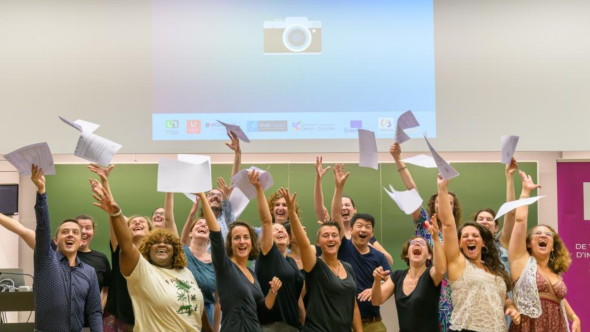
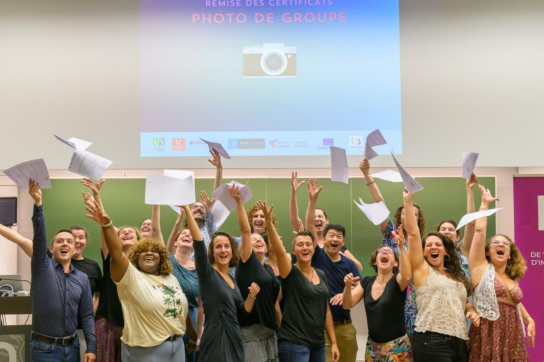
This prestigious prize, awarded by the European Commission, recognizes educational projects that promote innovative, inclusive and collaborative teaching practices. In 2025, only 117 projects were selected across Europe, including three in the Wallonia-Brussels Federation.
The award-winning project concerns the Certificat interuniversitaire en Langue des signes de Belgique francophone (LSFB) et français, co-organized by UNamur and UCLouvain Saint-Louis Bruxelles and supported by the Université de Toulouse Jean Jaurès (UTJJ) thanks to Erasmus+ funding. Running from September 2023 to June 2024, it aims to professionalize deaf interpreters in French-speaking Belgium and France, by offering them a unique training course leading to certification. Thanks to an innovative pedagogical approach, combining formal, non-formal and informal learning, 19 deaf adults were able to obtain certification, strengthening their professional recognition and role in society.
"We implemented this certificate because of the urgency and need to develop continuing education for deaf interpreters in French-speaking Belgium and the necessary reflection on the new profession of deaf interpreter in France," emphasizes Professor Dany Etienne (UCLouvain Saint-Louis Bruxelles), Dean of the Marie Haps Faculty of Translation and Interpreting.
"Deaf interpreters in Belgium are often self-trained, with no official recognition, which limits their professionalization and affects the services offered to deaf people. By integrating knowledge and tools from other universities, we have been able to develop suitable training, guaranteeing professionalism and ethics, in order to improve the quality of interpreting services and encourage recognition of the profession," adds Professor Laurence Meurant (UNamur).
This project thus marks a first in Belgium and France, filling a major gap in the training of deaf interpreters. It paves the way for better quality interpreting services and official recognition of the profession.
An exemplary university collaboration
The complementary expertise of the three partners has enabled the development of a unique training program of excellence:
- The research into the linguistic study of LSFB at UNamur conducted in collaboration with the ASBL École et surdité and the Centre scolaire Sainte-Marie Namur.
- Research and practice in the field of co-interpretation for UCLouvain Saint-Louis Bruxelles.
- Translation didactics for UTJJ.
This collaborative work has made it possible to develop tailor-made modules, adapted to the specific needs of deaf learners, and to create transnational links with experts in the UK, USA and Germany.
Find out more
- About the certificate in Interuniversity Certificate in Sign Language of French-speaking Belgium (LSFB) and French
- About the Laboratoire de langue des signes de Belgique francophone (LSFB-Lab)
- On the French-LSFB bilingual dictionary
This is also a project to support ! More info: https://unamur.be/fr/soutenir/lsfb
This project was made possible thanks to co-financing from the European Union.
Les thématiques de recherche
- Pratiques langagières, politique et planification linguistiques en contexte multilingue
- Propriétés structurelles et discursives des constructions linguistiques et des variétés linguistiques
- Multilinguisme et apprentissage d’une langue
- Traduction et hétérolinguisme comme manifestations du contact linguistique et du transfert interculturel
- Littérature, société et transmédialité
- Pratiques et concepts littéraires à travers les temps et les espaces
Contact
Pour toute question : info.naltt@unamur.be