

NaLTT
Composed of researchers in linguistics and literature, the Institute for Language, Text, and Transmediality (NaLTT) serves as an interdisciplinary forum for diachronic and synchronic research on verbal and multimodal communicative practices that manifest themselves in, are shaped by, and/or regulated by culture and society.


Strengths
Within the field of linguistics NaLLT is home to experts on language attitudes, language contact and conflict, language policy and planning, reported speech and viewpoint, and multimodality. A major distinctive focus within NaLLT is on the corpus-based linguistic study of sign languages in the LSFB Lab.
Within the field of literature NaLLT is home to experts on literary biographies, literary theory, medieval literature, missionary literature, text edition, the sociology of literature and translation theory.
NaLTT offers PhD students a stimulating and supportive research environment, encouraging collaborations between junior and senior researchers and promoting (further) research training.
Spotlight
News

Article
-
ESPHIN Institute
Post-truth: What if the truth were no longer the issue?
Democracy
Law
Political science
Post-truth: What if the truth were no longer the issue?
Democracy
Law
Political science
The measles vaccine supposedly causes autism. Global warming is supposedly just a natural phenomenon. Immigrants supposedly eat the neighborhood’s cats. These claims all have one thing in common: they have been disproved by the facts. Yet they continue to circulate, to be shared, and sometimes to influence elections. Even more surprising, some are repeated by figures in the highest political offices. What becomes of our relationship with the truth when opinion is presented as fact, when humor obscures intentions, and when information spreads without going through traditional intermediaries? To understand these changes, four researchers from UNamur share their perspectives. Behind the debates on fake news, they see a deeper shift taking shape: the truth still matters, but it is no longer always enough to convince people.

“There is no established, consensus-based definition of ‘post-truth,’” warns Olivier Sartenaer, director of the Department of Sciences, Philosophy, and Society and a member of the ESPHIN Institute (Namur Philosophical Forum). He prefers to describe four trends that, together, shape the phenomenon.
First observation: our relationship with established consensus is becoming more fragile. Ideas that were once marginal now enjoy unprecedented visibility thanks to social media. Second transformation: the line between opinion and knowledge is blurring. “Everyone’s opinion is considered knowledge.” ” Third change: lying has lost some of its symbolic cost. “Until recently, when a political figure was caught lying shamelessly, they had to pay a price—whether electoral or symbolic. Today, lying can even become a sort of badge of honor.”
The fourth transformation, the most subtle, concerns what philosophers call “rhetoric.” “While a liar knows the truth and conceals it, a rhetorician produces discourse to seduce, frighten, or convince, regardless of whether it is true. ” Thus, when Donald Trump claims that one should drink bleach to treat COVID, the most important thing may not be the content of the statement. “Saying that positions him against the elites and gets people talking about him. Is it true? He doesn’t even ask himself that question.”
Olivier Sartenaer explains the emergence of post-truth through the “epistemic deluge”—this overabundance of information driven in particular by digital technologies. Our critical faculties have not necessarily weakened, but the environment in which they operate has become infinitely more complex. This complexity also poses challenges for the law.

Olivier Sartenaer
The Law in the Face of Information Chaos
While “post-truth” is not a legal category in and of itself, Alejandra Michel, a researcher at CRIDS (Center for Research on Information, Law, and Society) within the NaDI Institute (Namur Digital Institute), approaches the phenomenon through what are known as “information disorders.” A key distinction sheds light on the mechanisms at work: “misinformation” refers to incorrect information disseminated without the intent to deceive; “disinformation,” by contrast, implies an intent to manipulate; and “malinformation” is based on true information that has been taken out of context or used to cause harm. In practice, however, these categories remain difficult to distinguish. Intentionally produced false information can be shared in good faith by thousands of people who believe it to be authentic, and its status then changes as it circulates.
From a legal perspective, the issue is all the more delicate because freedom of expression protects both the speaker and the recipient of the information. Should the authors of false information be punished? It’s not that simple: criminalization could backfire on journalists, whistleblowers, or those who disseminate information that is inconvenient for those in power.
Alejandra Michel is therefore more interested in the right to receive high-quality information—not with an absolute obligation to truth, but with a requirement to strive for accuracy and to comply with the rules governing the collection and dissemination of information.
On the European front, the Digital Services Act addresses the information environment itself, notably by requiring large digital platforms to implement measures related to moderation, transparency, and the adaptation of recommendation systems.

Alejandra Michel
The fight against disinformation cannot, therefore, be solely a legal one. It also requires media literacy, support for quality journalism, and the protection of pluralism. One question remains that the law cannot resolve: when no one seems to regard the truth as a common reference point anymore, what still underpins a person’s credibility?
Authenticity: The New Currency of Credibility
Part of the answer lies in humor, which has become a dominant form of communication on the web. According to Fanny Barnabé, a lecturer at CRIDS/NaDI, memes, parodies, trolling, and shitposting play such a significant role in digital cultures that they, too, blur our relationship with the truth.
In classical irony, the speaker says the opposite of what they mean while leaving their listener enough clues to grasp the message’s true meaning. Irony has now lost its transgressive nature because it has become ubiquitous. To continue to surprise, internet users have therefore developed new levels of ambiguity. Today, the lines are blurred: “We no longer know whether a statement is ironic, sincere, or partly both.” This is what is known as post-irony.
A content creator’s credibility therefore no longer rests on their relationship to the truth, but on their authenticity. Fanny Barnabé observes this shift on the streaming platform Twitch, where the relationship between streamers and their community hinges on a sense of direct and sincere connection: awkward moments, spontaneous reactions, and an unfiltered personality are valued more highly than accuracy.
For Fanny Barnabé, the real question, then, may be whether it’s still possible to be serious on the Internet. On Twitch, the reversal has become so complete that “users sometimes explicitly state that they’re being serious. People no longer indicate that a message is ironic. It’s the literal meaning that now needs to be made clear.”

Fanny Barnabé
When Authenticity Becomes a Political Issue
We see exactly this same mechanism at work in politics. Figures like Donald Trump and Elon Musk now use memes, provocation, trolling, and references to gaming culture to speak directly to their audience. Post-irony offers them powerful rhetorical protection. Serious statements can be made in a joking manner, and if the reaction is negative, all one has to do is say, “I was just kidding.”
For Arthur Borriello, a professor of political science at UNamur and a researcher at the Transitions Institute, credibility in politics is measured the same way as it is on Twitch: by perceived authenticity rather than truthfulness. “Trump can afford to come across as a liar or a crackpot. What matters is that he appears authentic,” explains the political scientist. Insults, extravagance, and the transgression of linguistic norms thus become markers of closeness to ordinary people, as opposed to the polished discourse of the elites.

Arthur Boriello
Authenticity doesn’t promise virtue; it promises closeness. It means standing with ordinary people, with all their flaws, their anger, and sometimes even their transgressions. Facing off against Hillary Clinton, Trump essentially declared: Yes, the Wall Street system is corrupt—since I make use of it myself. He didn’t promise to put an end to it; he promised to be authentic.
The political scientist goes further. He questions the very idea that politics is a matter of truth. “Political discourse is not a discourse of truth. That is not its aim.” Its strength lies rather in its internal coherence and its ability to give meaning to lived experience. Trumpism, for example, links economic decline, unemployment, immigration, and a sense of American decline into a single narrative. “Do immigrants eat pets? It doesn’t matter whether that statement is true or false. What matters is that it fits with the other elements in this coherent narrative,” summarizes the political scientist.
The Cost of Distorting the Truth
For Olivier Sartenaer, the consequences of this new relationship with the truth are not merely rhetorical. “If, for example, one claims that the recommendations of the IPCC (Intergovernmental Panel on Climate Change) are merely the ‘religion’ of bourgeois-bohemian environmentalists and that one prefers the popular common sense that favors coal-fired power plants, one creates a climate that becomes uninhabitable. ” The problem here isn’t just being mistaken about a scientific phenomenon; it’s choosing to ignore available knowledge even when the consequences are predictable.
The same mechanism is at work in debates about vaccination. When scientific knowledge gives way to “common sense” or political convictions, collective decisions can have dramatic consequences. “The resurgence of measles in the United States is directly linked to the spread of doubts about vaccines. Today, children are dying from a disease that had been eradicated long ago,” laments the philosopher.
Beyond poor decision-making, it is the very possibility of living together as a society that is at stake. “To discuss and reach agreement, we need a shared world. If we polarize to the extreme, we lose that shared world. We can no longer understand one another or act together.”
Respond Differently
Beyond fake news and conspiracy theories, the “post-truth” and “post-irony” eras thus reveal a profound transformation in our relationship with the shared world. Authenticity versus expert opinion, humor that obscures intentions: the issue is becoming less one of truth and more one of trust. Hence the importance, for researchers, of rebuilding shared spaces through quality information, media literacy, a vibrant civil society, forums for debate, and collective narratives. For without a shared world, it becomes difficult not only to agree on the facts, but also to form a society. One final, distinctly political question remains: can we even combat this obfuscation with “truth” alone? Arthur Borriello believes not, and explains why in the sidebar.
Arthur Borriello: “You have to fight ideology with ideology.”
According to political scientist Arthur Borriello, we must first distance ourselves from two concepts that have become ubiquitous. “The concepts of ‘post-truth’ and ‘populism’ play the same role in public debate today: they serve as catch-all terms that allow us to broadly describe political developments without always analyzing them with the precision they deserve.”
The dominant definition of populism is based on a contrast between a “virtuous people” and “corrupt elites,” which leads to very different movements—including those on the far right—being labeled as populist. In his book *Populism: The Misnamed Phenomenon*, the political scientist defends a view—which he acknowledges is in the minority—that populism is above all a democratic moment, driven by a desire to deepen democracy and return more power to the people. “This definition effectively excludes the far right, which does not seek to deepen democracy but rather to restrict the circle of those who benefit from it.”
But why is this promise to return power to the people used by so many political movements, including the far right? It responds to a very real experience. Many citizens feel they have lost some of their ability to influence political decisions. Arthur Borriello attributes this to the disintermediation observed since the 1970s: political parties, unions, and associations—which traditionally served to transform individual concerns into collective demands—have lost their significance.
The power of political discourse therefore rests more on its ability to give meaning to lived experience and on its internal coherence. This perspective leads him to question the effectiveness of a strategy that consists solely of “fact-checking” the rhetoric of the far right. He illustrates this with a deliberately radical example: “Faced with Hitler, who claimed that Jews were the cause of all evil, would fact-checking have weakened that discourse? Certainly not. The only way to combat this type of rhetoric is to offer an alternative narrative that is sufficiently convincing and resonates with people’s lived experiences. Ideology must be countered with ideology.”
In practical terms, Arthur Borriello advocates for the rebuilding of spaces for mediation: associations, collective organizations, and forums for debate and mobilization that enable citizens to regain their capacity for action and representation. French-speaking Belgium offers an interesting point for reflection in this regard. While the far right is making significant gains in several European countries, it has so far remained relatively marginal there. He attributes this resilience in particular to the persistence of a dense network of associations and to the local roots of certain political groups, such as the PTB through its youth organizations, community health centers, and so on.
The response to the far right, therefore, is not solely a matter of the accuracy of information. It also hinges on a society’s ability to forge connections and offer collective narratives in which everyone can see themselves reflected.
Further Reading
The Truth in Crisis: Disinformation, Critical Thinking, and the Right to Information
A collective work to be published in the fall of 2026 by Larcier Intersentia. This book brings together several contributions, including texts by Alejandra Michel and Fanny Barnabé.
Arthur Borriello, Populism: The Misnamed
University of Brussels Press, “Débats” series.
In this essay, the political scientist examines contemporary uses of the notion of populism and offers a critical analysis of a concept that has become ubiquitous in public debate.
Denis Saint-Amand, Countering Fascist Laughter: Trolling and Resistance
Éditions Rue de l’Échiquier, “Les Incisives” series.
An analysis of the political uses of humor, trolling, and digital cultures, as well as the forms of resistance they can inspire.
Denis Saint-Amand is a qualified researcher at the FNRS at UNamur and president of the Namur Institute of Language, Text, and Transmediality (NALTT)
“The measles vaccine causes autism”: The topic of fake news in the field of health—and specifically regarding vaccination—was one of the subjects discussed during UNamur’s official 2026 academic year opening ceremony. Watch the video of this presentation.
This article is taken from the "Issues" section of Omalius magazine, Issue #42 (September 2026).


Article
-
Faculty of Philosophy and Letters
Department of Classical Languages and Literatures NaLTT Institute
From the 16th century to the present: Two professors from UNamur explore what we can still learn from the books of printer and publisher Christophe Plantin
Classical languages and literature
History
Literature
History
Article
-
Faculty of Philosophy and Letters
Department of Classical Languages and Literatures
Department of Germanic Languages and Literatures
NaLTT Institute
PaTHs Institute
From the 16th century to the present: Two professors from UNamur explore what we can still learn from the books of printer and publisher Christophe Plantin
Classical languages and literature
History
Literature
History
Edited by two professors from UNamur, this anthology brings together the work of 18 researchers focusing on some 50 rare books, selected from among the more than 900 editions by Christophe Plantin held by the University. Supported by the Institut Moretus Plantin Public Benefit Foundation, this project marks the first step leading up to the launch, in September, of a new research initiative on multilingualism and translation practices in the editions of the Antwerp printer.
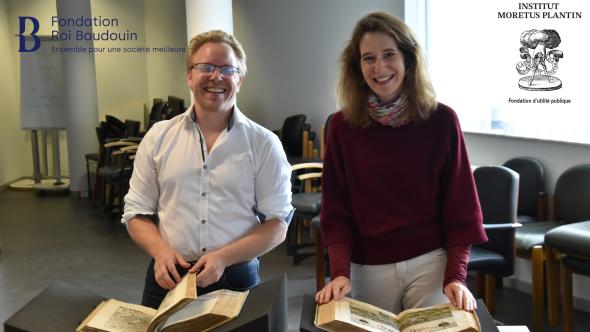
With 905 editions published by Christophe Plantin, the Moretus Plantin University Library (BUMP) at UNamur is now home to one of the largest Plantin collections in Belgium. The largest collection is housed at the Plantin-Moretus Museum in Antwerp, located in the former home and printing house of Christophe Plantin. This rich heritage was significantly expanded in 2020, when the collection assembled by Philippe de Dorlodot, a prominent private collector of Plantin editions, was donated to the King Baudouin Foundation, with the wish that it be preserved at UNamur. This exceptional collection has already been the subject of a catalog and has inspired a collective work dedicated to the legacy of this great Renaissance printer.
“It all began with a phone call from the BUMP Heritage Center, which wanted to organize an exhibition dedicated to Christophe Plantin to mark the 500th anniversary of his birth in 2020,” recalls Pierre Assenmaker, professor of Latin language and literature at UNamur and scientific co-director of the book. Together with Valérie Leyh, a professor of German-language literature who also teaches a course on the history of the book, they began to envision a collaborative project centered on this major figure in European printing. But the initiative quickly took on a new dimension. “When we saw the scope of this collection, we realized we had to go beyond a simple exhibition,” emphasizes Valérie Leyh. “That’s where the idea came from to produce a book that would showcase this exceptional collection held at UNamur.”
The book thus brings together contributions from 18 researchers from UNamur and other institutions in Belgium and the Netherlands. Since the collection had already been the subject of a comprehensive catalog, published with the support of the King Baudouin Foundation, the authors chose a thematic approach: to understand how Christophe Plantin became, in the 16th century, one of the most influential printers in Europe. “We tried to identify the various factors behind this success,” explains Pierre Assenmaker. “Through his network of humanists, as well as his incredible business acumen, Christophe Plantin knew how to adapt his books to different audiences, varying formats, languages, and illustrations. He already possessed the ability to conceive of multiple versions of the same work based on his readers’ expectations.”
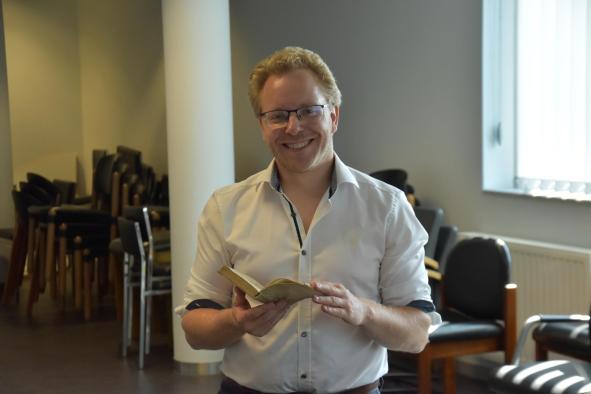
Books: A Record of Several Centuries of History
Studying all 905 works held by the BUMP would have been a Herculean task. The researchers had to make some choices. “We analyzed about fifty works that seemed most revealing to us,” continues Pierre Assenmaker. “Some stand out for their rarity, others for their beauty, or because they particularly well illustrate Plantin’s editorial strategies. Inevitably, any selection involves making sacrifices, and there are still a great many treasures that deserve to be studied.” The researchers were also able to compare several copies of the same edition. “Some books belonged to several collectors. Others have been annotated over the centuries,” adds Valérie Leyh. “These handwritten notes allow us to trace the books’ circulation and understand how they were used or passed down.”
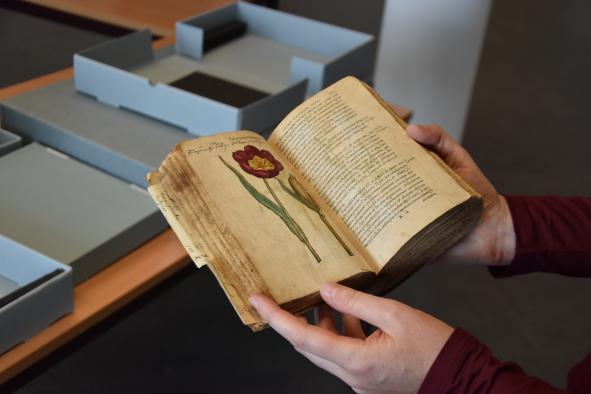
Beyond the texts themselves, researchers have also focused on the book as an object. While today we choose between a large format and a paperback, during the Renaissance, the options were far more numerous. In the 16th century, books were often sold as unbound quires. The buyer then decided on the binding—which could be more or less luxurious—and could even choose to add certain illustrations. Each copy thus became a unique object. Furthermore, as Valérie Leyh points out, a single text could be published in several languages, with or without illustrations, in order to reach different audiences. This was a particularly modern publishing strategy for the time, demonstrating that printers were thoughtful about how to adapt to their readers’ expectations.
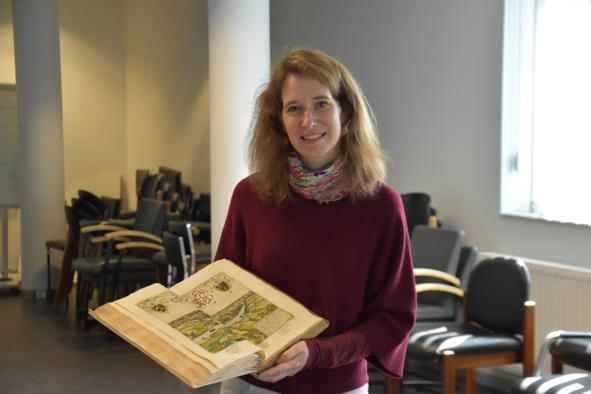
This research also finds a direct extension in the courses offered at UNamur, particularly in the course “The Book and Digital Culture” taught by Valérie Leyh. Students are encouraged to examine a selection of historical books held at the BUMP in order to study their physical characteristics. This is also a way to put these objects into context with current reading practices and digital uses.
A new chapter will begin in September
While this book marks the culmination of several years of work, it also paves the way for new research. In September, Pierre Assenmaker and Valérie Leyh launched, with the support of the Institut Moretus Plantin Public Benefit Foundation, a two-year research project focused on multilingualism and translation in the works of Christophe Plantin. The goal will be to study some 40 to 50 works held at the BUMP in order to better understand how the Antwerp printer made use of the linguistic diversity of his time. “Today, with machine translation tools and artificial intelligence, we sometimes tend to forget the full complexity of translation,” notes Valérie Leyh. “During the Renaissance, translating also meant adapting a work for a new audience. Translators sometimes became co-authors.”
The project, conducted in collaboration with Asseline Sel, a postdoctoral researcher, aims to better understand Plantin’s editorial strategies through the lens of language. Why were certain works translated? Which readers were they intended for? How could the same text be transformed, shortened, expanded, or illustrated differently depending on the target audience? These are the kinds of questions the researchers will seek to answer by analyzing not only the content of the works but also their physical form, their handwritten annotations, and their history over the centuries.
Beyond the history of the book, the two researchers also see this as an invitation to better understand our own era. “The 16th century was a period of profound transformations, marked by political, religious, and economic crises, but also by a remarkable exchange of ideas,” concludes Pierre Assenmaker. “Studying this period reminds us that times of crisis are not incompatible with the development of culture and knowledge. This is undoubtedly one of the most relevant lessons that Christophe Plantin leaves us today.”
Want to learn more?
The book, available from Presses Universitaires de Namur, and the new project will be presented on October 8, 2026, at UNamur (L03 lecture hall, accessible via Rue Grafé). Registration for this event is free and can be done via this link. Everyone is welcome!

News
-
Faculty of Sciences
DeFIPP Institute
28 new research projects funded by the FNRS
Award
News
-
Faculty of Sciences
Faculty of Philosophy and Letters
Faculty of Computer Science
Faculty Economics Management Communication Politics (EMCP)
DeFiPP Institute
ILEE Institute
NaDI Institute
Narilis Institute
NaLTT Institute
IRDENa Institute
Institute
28 new research projects funded by the FNRS
Award
The F.R.S.-FNRS has just published the results of its various 2025 calls for proposals. These include the "Credits & Projects" and "WelCHANGE" calls, as well as the "FRIA" (Fund for Research Training in Industry and Agriculture) and "FRESH" (Fund for Research in the Humanities) calls, which aim to support doctoral theses. What are the results for UNamur? Twenty-eight projects have been selected, demonstrating the quality and richness of research at UNamur.

The "Credits & Projects" call for proposals resulted in 12 grants being awarded for ambitious new projects. These include two "equipment" grants, eight "research credits (CDR)" grants, and two "research projects (PDR)" grants, one of which is in collaboration with the ULB. The FRIA call for doctoral research support will fund eleven doctoral scholarships and the FRESH call will fund three.
Two prestigious Scientific Impulse Mandates (MIS) were also obtained. This three-year funding supports young permanent researchers who wish to develop an original and innovative research program by acquiring scientific autonomy within their department.
We would also like to highlight the two projects funded under the "WelCHANGE" call, a funding instrument for research projects with potential societal impact, led by a principal investigator in the humanities and social sciences.
Detailed results
Call for Equipment
- Xavier De Bolle, Narilis Institute, Co-promoter in collaboration with UCLouvain
- Luca Fusaro, NISM Institute
Call for Research Grants (CDR)
- Marc Hennequart, NARILIS Institute
- Nicolas Gillet, NARILIS Institute
- Jean-Yves Matroule, NARILIS Institute
- Patricia Renard, NARILIS Institute
- Francesco Renzi, NARILIS Institute
- Stéphane Vincent, NISM Institute
- Laurence Meurant, NaLTT Institute
- Emma-Louise Silva, NaLTT Institute
Call for Research Projects (PDR)
- Jérémy Dodeigne, Transitions Institute, Co-supervisor in collaboration with ULB
- Luc Henrard, NISM Institute; Co-supervisor: Yoann Olivier, NISM Institute
Fund for Training in Research in Industry and Agriculture (FRIA)
- Emma Bongiovanni - Supervisor: Catherine Michaux, NISM Institute
- Simon Chabot - Supervisor: Carine Michiels, Narilis Institute; Co-supervisor: Anne-Catherine Heuskin, Narilis Institute
- Lee Denis - Supervisor: Muriel Lepère, ILEE Institute
- Maé Desclez - Supervisor: Johan Yans, ILEE Institute; Co-supervisor: Hamed Pourkhorsandi (University of Toulouse)
- Pierre Lombard - Supervisor: Benoît Muylkens, Narilis Institute; Co-supervisor: Damien Coupeau, Narilis Institute
- Amandine Pecquet - Supervisor: Nicolas Gillet, Narilis Institute; Co-supervisor: Damien Coupeau, Narilis Institute
- Kilian Petit - Supervisor: Henri-François Renard, Narilis Institute; Co-supervisor: Xavier De Bolle, Narilis Institute
- Simon Rouxhet - Supervisor: Catherine Michaux, NISM Institute; Co-supervisor: Nicolas Gillet, Narilis Institute
- William Soulié - Supervisor: Yoann Olivier, NISM Institute
- Elisabeth Wanlin - Supervisor: Xavier De Bolle, Narilis Institute
- Laura Willam - Supervisor: Frédérik De Laender, ILEE Institute
Fund for Research in the Humanities (FRESH)
- Louis Droussin - Supervisor: Arthur Borriello, Transitions Institute; Co-supervisor: Vincent Jacquet, Transitions Institute
- Nicolas Larrea Avila - Supervisor: Guilhem Cassan, DeFIPP Institute
- Victor Sluyters – Supervisor: Wafa Hammedi, NADI Institute
- Amandine Leboutte - Co-supervisor: Erika Wauthia (UMons); Co-supervisor: Cédric Vanhoolandt, IRDENa Institute.
Scientific Impulse Mandate (MIS)
- Charlotte Beaudart, Narilis Institute
- Eli Thoré ILEE Institute
WelCHANGE Call
- Nathalie Burnay Transitions Institute, in collaboration with UCLouvain
- Catherine Guirkinger, DeFIPP Institute
Congratulations to all!
Article
-
Faculty of Philosophy and Letters
Department of Germanic Languages and Literatures NaLTT Institute
When internet memes become a subject of research
Literature
Article
-
Faculty of Philosophy and Letters
Department of Germanic Languages and Literatures
NaLTT Institute
When internet memes become a subject of research
Literature
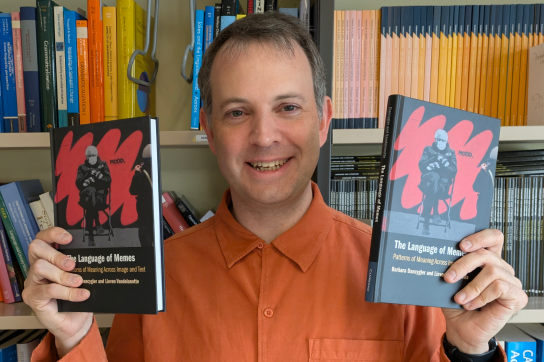
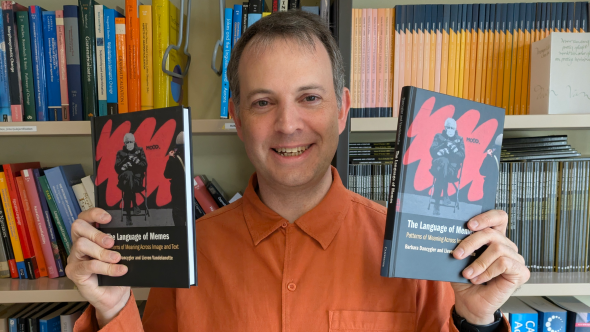
Born on the internet, memes are an integral part of digital culture. These images, often humorous, combine text and visuals to convey a message. At UNamur, Lieven Vandelanotte, professor of English language and linguistics and general linguistics at the Faculty of Philosophy and Letters, has taken an interest in them from a linguistic point of view. In his new book, co-written with Barbara Dancygier of the University of British Columbia, he deciphers how these creations play with words, images, and grammar.
First appearing in 1976, the concept of a meme was used by biologist Richard Dawkins to refer to an idea or habit that spreads from one person to another. With the rise of digital technology, the term has taken on a new meaning, now referring to images shared and repurposed online, often accompanied by text, which comment on current events, express an emotion, or describe a situation in a few words. But for Lieven Vandelanotte, professor at the Faculty of Philosophy and Letters, memes represent a new type of language. "Memes are not just illustrations. They combine text and image in a way that transforms how meaning is constructed," he explains.
A linguistic look at digital language
A specialist in discourse and English linguistics, Lieven Vandelanotte has been studying reported speech and multimodality for several years, i.e., productions that combine several modes of expression, such as images and text.
Thanks to his Francqui Research Professorship, obtained in 2023, he has been able to devote more time to this topic. "This position gives me the opportunity to further my research on multimodality and to finalize this book, a project I have been working on for a long time."
The goal of his work? To show that in memes, images play a linguistic role in their own right. "They can replace a word, complete a sentence, or express a point of view. They are a true grammatical component."
When images construct meaning
Among the memes he analyzes, Lieven Vandelanotte cites the famous Distracted Boyfriend: a man looks away from his girlfriend to admire another woman.
"This meme illustrates the idea of making a choice, changing preferences, turning away from one option to another. A similar idea is expressed by the meme called "Exit 12." An example that combines the two shows that users are well aware that these images are not really used to describe a scenario between lovers or a situation on the highway, but they perceive that different forms, with different images, can have more or less the same meaning."

Another example is the Good Girl Gina meme, where a smiling young woman is associated with phrases describing "positive" behavior. In the Gets mad at you / Tells you why version, the humor is based on the contrast with a sexist stereotype: the protagonist gets angry, but, contrary to the stereotype, she explains why. "In this case, the image acts as the subject of the sentence. It doesn't illustrate the text, it's an integral part of it and plays a full role in constructing meaning," emphasizes Lieven Vandelanotte.

He also mentions the category of when-memes, where a sentence beginning with When... ends with an image. For example: "When you're at a party full of people you don't know so you stay with your friend the whole time ," accompanied by a photo of a small koala clinging to a leg. "Here, the image completes the sentence. It does not directly illustrate the situation, but provides the conclusion, like a separate syntactic segment."

These analyses are at the heart of the book The Language of Memes, co-authored by Barbara Dancygier and Lieven Vandelanotte and published by Cambridge University Press.
Presented as the first book to offer an in-depth linguistic analysis of Internet memes, it proposes a new approach to the study of multimodal genres and explores how images and texts work together to create meaning.

When it happens on the train...
In recent years, Lieven Vandelanotte has participated in numerous conferences to present the results of his research on memes, but none were as original as the recent "Railway Aesthetics" conference. This conference took place on moving trains. Traveling from Vienna to Bucharest, then from Bucharest to Istanbul, the participants lived together in the train cars for the entire duration of the conference. Together with Justin Bai from the University of Colorado, he gave a presentation on the use of trains in internet memes and social media discourse, as in the attached example (a "when-meme" featuring the late chef Anthony Bourdain looking very cool, ironically reflecting the attitude of someone who manages not to be mocked by a French waiter).

Agenda
Thesis defense
-
Faculty of Computer Science
Faculty of Philosophy and Letters
NaDI Institute
NaLTT Institute
Public Defense of a Doctoral Dissertation in Computer Science - Liesbet De Vos
Computer science
Sign language (LSFB)
19
2026
15:00
-
19:00
Université de Namur, Faculté d'informatique, auditoire I02 - rue Grandgagnage - 5000 Namur
Contact person
:
Medugno Sara
SignFCG: A Framework for Operationalizing Sign Language Constructions in Computational Construction Grammar.
Abstract
Sign languages express meaning through sequentially and simultaneously produced manual and non-manual articulations, making them structurally different from spoken languages. However, many linguistic theories remain biased towards spoken language structures. An exception is construction grammar, a linguistic theory which analyses language through form-meaning mappings that can involve manual and non-manual articulations and can combine specific and schematic structures. While construction grammar is increasingly used to describe sign language constructions theoretically, computational implementations remain sparse, limiting its systematic application to corpora. The theoretical applicability of construction grammar to signed languages, however, does not guarantee that the theory can be computationally operationalised, which introduces challenges in representation and processing. This thesis addresses these challenges by introducing SignFCG, an extension of Fluid Construction Grammar (FCG). SignFCG introduces phonetic representations of manual articulations that account for their sequential and simultaneous organisation. It also provides avatar visualisations for signed forms and tools to transform linguistic annotations into the proposed format. To investigate the types of constructions that can be operationalised for a restricted domain of French-Belgian Sign Language (LSFB), a computational grammar comprising 904 constructions was manually developed using GeoQuery-LSFB, an extension of the multilingual GeoQuery corpus created as part of this thesis. The grammar was evaluated in comprehension and production, achieving high coverage. A user study based on semi-structured interviews with sign language researchers identified perceptions of SignFCG’s usability and potential adoption. Participants identified promising applications, including exploring and formalising constructions and studying constructional variation across contexts. The user study also identified a need for greater flexibility in SignFCG’s form representation, which may require varying levels of detail to answer different research questions. The contributions of this thesis are situated at the intersection of sign language linguistics research, construction grammar, and computational linguistics. For construction grammar, it demonstrates how constructional principles can be operationalised for the visual-gestural modality and how the combination of specific and schematic structures within constructions can facilitate this. For computational linguistics, it demonstrates the feasibility of bidirectional processing between manually signed forms and structured meanings within a restricted domain, while providing resources for further research. Extending FCG to signed languages also provides a basis for exploring other computational research areas in which FCG has been applied.
Jury
- Prof. Katrien BEULS - University of Namur, Belgium
- Prof. Bruno DUMAS - University of Namur, Belgium
- Prof. Anthony CLEVE - University of Namur, Belgium
- Prof. Laurence MEURANT - University of Namur, Belgium
- Prof. Paul VAN EECKE - Artificial Intelligence Laboratory, Vrije Universiteit Brussel, Belgium
- Dr. Remi VAN TRIJP - Sony Computer Science Laboratories, France
- Dr. Michael FILHOL - LISN, CNRS, France
Research Topics
- Language Practices, Language Policy, and Language Planning in a Multilingual Context
- Structural and Discursive Properties of Linguistic Constructions and Language Varieties
- Multilingualism and language learning
- Translation and heterolingualism as manifestations of language contact and intercultural transfer
- Literature, Society, and Transmediality
- Literary practices and concepts across time and space
Contact
If you have any questions: info.naltt@unamur.be