Image

NaLTT
Supported by an FNRS research grant (2025–2027), this project takes as its starting point the fact that the adaptation of poetry to advertising has helped to reinforce its presence in urban spaces, so that it now frequently appears on the walls of our cities, often in the form of fragmentary quotations and isolated verses.
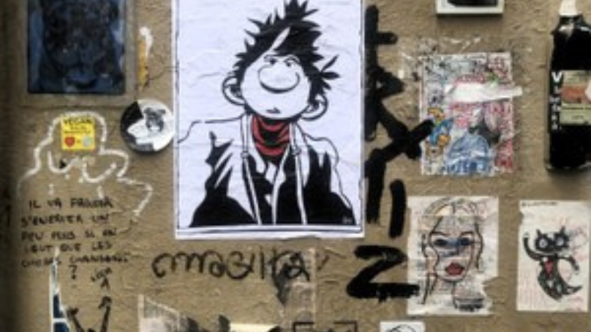
The aim is to take these writings seriously and to examine the forms, uses, and functions of poetic inscriptions in contemporary urban space.Here, we distinguish between authorized inscriptions (commissioned murals, window poetry, and other installations conceived in collaboration with public authorities) and “wild” writings (spontaneous, raw, ephemeral). Among the authorized inscriptions, we find, in particular, quotations from canonical works, but also unpublished works by established authors, created to adorn public buildings—which raises a series of questions: Is poetry reduced in this case to a mere decorative function? Which texts or excerpts—and which locations for their display—are chosen? Which forms are favored? Is the focus on phrases that function as “inspiring” or “feel-good” maxims or proverbs, or on emblematic excerpts intended to preserve a shared heritage? Should these works be viewed as manifestations of a soothing “artistic capitalism,” or can they be seen as mediations that make poetry visible and serve as a first point of contact and an incentive to explore more complex texts? How is the presentation of the text conceived in material terms (typography, colors, integration with illustrations, etc.)?As for “wild” writings—those not based on commissions and lacking official authorization—they give rise to other forms and conceptions of poetry, ranging from lyrical slogans to ironic catchphrases and from puns to absurd aphorisms. These statements represent a lively form of speech that vaguely disrupts everyday life by introducing highlights, playfulness, and the incongruous—thereby breaking the routine. However, this is not to exaggerate the gap between institutional and “wild” poetic writing: it is striking to observe the proliferation of writings that draw on an imagery of illegality and protest while simultaneously making it possible to adapt them to other, more established—and, above all, potentially more marketable—so that the gentrification of “wild” writing will also be a focus of study in this context.