The RCO (Organometallic Reactivity and Catalysis) research team is based in the Department of Chemistry at the University of Namur. The researchers are based in two newly equipped synthesis laboratories and a laboratory for physical measurements and spectroscopy. Offices and a meeting room are located next to the laboratories, in a space dedicated to team members and students.
Promoter (PI)
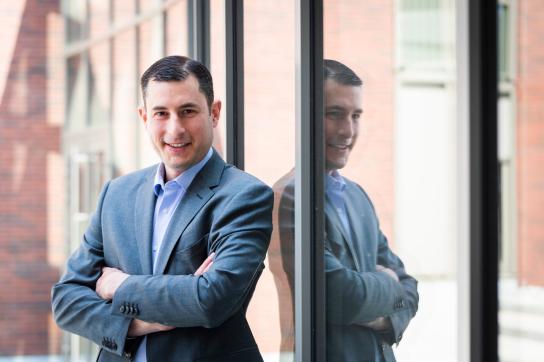
Professor Guillaume BERIONNI, also affiliated with the NISM Institute (FSM Division)
Research Topics
Our team aims to develop bifunctional catalysts consisting of Lewis acid and Lewis base functions to activate small molecules (H₂, CO₂, SO₂, C₂H₂, CH₄, etc.). The reactivity of these catalysts, as well as the mechanism and kinetics of the activation reactions, are studied using advanced spectroscopic methods.
These research topics lie at the intersection of organic chemistry, organometallic chemistry, heterochemistry (Groups 13 and 14 elements), and coordination chemistry, and advance the development of new concepts in homogeneous catalysis. Our research projects are funded by the FNRS, the ERC, the Wallonia-Brussels Federation, and the University of Namur.
Spotlight
News
First MG-ERC conference brings together the world's inorganic chemistry elite
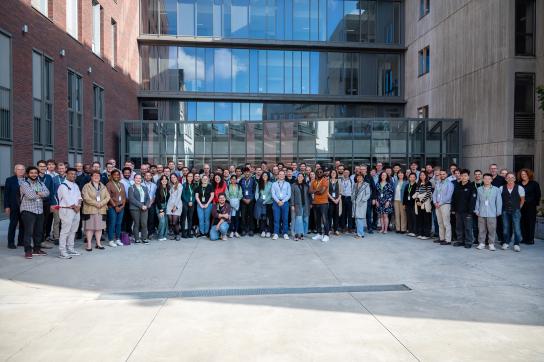
In early September, the University of Namur hosted the first Main-Group Elements Reactivity Conference (MG-ERC). Over 100 researchers from 12 countries and 32 institutions gathered around Professor Guillaume Berionni. An event hailed as "one of the best chemistry conferences" by its prestigious guests.
A unique event
The first MG-ERC conference, dedicated to advances in inorganic chemistry, coordination chemistry and catalysis, is a first in Europe. Over a hundred researchers from 12 countries and 32 institutions accepted the invitation from Professor Guillaume Berionni, who organized the event with Professor Steven Nolan (Ghent University). The two researchers succeeded in bringing together leading experts working in the fields of heteroatom chemistry, coordination chemistry, catalysis, and inorganic chemistry.
An acclaimed first
The luminaries from prestigious universities (Oxford, Berlin, Laval, Paris-Saclay...) unanimously praised the scientific excellence and "exemplary" organization of this first edition. Many even described MG-ERC as "one of the best chemistry conferences" they had ever attended.
.An initiative supported by UNamur
The driving force behind this European first is Professor Guillaume Berionni, director of the laboratory in reactivity and organometallic catalysis (RCO) at UNamur and a member of the Namur Institute of Structured Matter (NISM). His team of 14 researchers is dedicated to the reactivity of main group elements and the development of new approaches to catalysis.
Strong support
The event was co-financed by the European Research Council (ERC), ChemistryEurope, the Royal Society of Chemistry, the CGB, the FNRS CHIM Doctoral School, the NISM, as well as several industrial partners (ACS Publications, Analis & Advion Interchim Scientific®, BUCHI, Chemical Synthesis, Magritek). The organizers would like to thank these sponsors for their support in raising the international profile of this first event. They have also made it possible to award prizes for the best oral and poster presentations by young researchers.
Guillaume Berionni in brief
- Doctorate in Science (2010, Université de Versailles, Institut Lavoisier).
- Post-doctorate at Ludwig Maximilian University Munich (Humboldt fellow).
- Professor of Chemistry at the University of Namur since 2017.
- Winner of a Mandat d'Impulsion Scientifique (MIS) from the FNRS in 2018.
- ERC Consolidator Grant (2023) for the B-YOND
- Elected Member of Chemistry Europe (2024-2026).
- Triennial Prize of the Royal Society of Chemistry (2025).
Chemical research
The Department of Chemistry has 11 laboratories that make up the 5 research units. The themes studied are health and healthcare, energy, energy storage and depollution, the pharmaceutical and chemical industry, corrosion and medical materials and innovative pedagogies.
Guillaume Berionni receives the CRS Triennial Award
In October 2024, Guillaume Berionni, a researcher in the Department of Chemistry at the University of Namur, received the Royal Society of Chemistry's (RSC) triennial prize from its President, Professor Anne-Sophie Duwez. A fine reward for his research team in organometallic reactivity and catalysis (RCO), but also for our institution and its Department of Chemistry.
The RSC Triennial Prize is intended to honor a researcher in full scientific bloom whose work receives an international audience and is considered seminal.
Since 1969, this prize has rewarded numerous chemists recognized in Belgium and particularly from UNamur since 3 other members of the Department have already received it: Jean-Marie André (1984); Benoît Champagne (2002) and Johan Wouters (2008).
The research team
These research topics, which Professor Guillaume Berionni's Laboratoire de Réactivité et Catalyse Organométallique (RCO) team is working on, are located at the frontier between organic, organometallic, heterochemistry (Group 13 and 14 elements), and coordination chemistry, and are advancing the development of new concepts in homogeneous catalysis.
These research projects are financed by various funding bodies, including the FNRS, the European Union via the ERC, or the Wallonia-Brussels Federation.
Guillaume Berionni is also a member of the Namur Institute of Structured Matter - NISM (Pôle FSM). He currently leads a research team of 14 PhD students, post-docs and master's students.
A year after receiving prestigious funding from the European Research Council (ERC) for his B-Yond project, Prof Guillaume Berionni was appointed a Fellow of the prestigious European chemistry society Chemistry Europe in early 2024. This distinction makes him the new representative for Belgium for a period of 2 years.
Congratulations to him and his team!
Read our previous articles
- Guillaume Berionni Belgian representative at the European Chemical Society: Read article...
- An ERC Consolidator fellowship for Guillaume Berionni's B-YOND project: Read article...
The 1st MG-ERC conference
From September 10 to 12, 2025, the 1st MG-ERC conference will take place. The Main-Group Elements Reactivity Conference (MG-ERC) is a new meeting, created to bring together researchers working in the fields of main-group chemistry, coordination chemistry and inorganic chemistry to discuss new concepts, ideas and trends in these dynamic fields, and to establish links and collaborations.
Studying chemistry at UNamur
Now known as ‘chemists’, specialists in the reactivity of matter pursue the art of experimentation and discovery. The products of their essential knowledge are applied in the fields of nutrition, health, hygiene, transport, sport, construction and environmental protection.
An ERC Consolidator grant for Professor Guillaume Berionni's B-YOND project!
The ERC CoG, a funding instrument of the European Research Council (ERC), enables outstanding scientists to implement innovative concepts over a period of five years and thus strengthens the European research landscape. The B-YOND project will focus on the reprogramming of chemical elements properties in order to initiate the creation of a new generation of more robust and accessible catalysts.
De nos jours, 80 % des procédés industriels utilisent des catalyseurs. Un catalyseur, c’est un élément ou une molécule chimique qui provoque ou augmente la vitesse d'une réaction chimique. La vision populaire du domaine est généralement négative car elle fait penser à la pollution (catalyseurs des voitures) avec dispersions de poussières de métaux rares et dangereux et de gaz à effets de serre.
Le projet B-YOND va étudier les possibilités de reprogrammer la structure de certaines molécules afin d’outrepasser les limites de réactivité chimique des catalyseurs utilisés à l’heure actuelle. De plus, au lieu d’utiliser des métaux précieux ou des éléments rares, le projet va se focaliser sur d’autres éléments comme le bore, le carbone, le silicium. Avec le double avantage qu’on en trouve à foison sur notre planète, qu’ils sont accessibles et plus facilement recyclables !
Les résultats de cette recherche jetteront les bases du développement de nouvelles stratégies de gestion de l'énergie et des ressources, notamment grâce à de nouvelles approches de conception de catalyseurs et de développement de matériaux durables qui permettront de transformer des molécules présentes en abondance dans notre atmosphère (dioxyde de carbone, méthane, diazote) en produits chimiques et fuels à hautes valeurs ajoutées.
CV express
Guillaume Berionni a obtenu son doctorat en 2010 à l'Université de Versailles (Institut Lavoisier) pour ses recherches en chimie organique physique. Il a ensuite rejoint l'Université Ludwig Maximilian de Munich en tant que boursier postdoctoral Humboldt sous la direction du professeur Herbert Mayr et du professeur Paul Knochel. Depuis 2017, il est Professeur de chimie à l'Université de Namur et membre du Namur Institute of Structured Matter (NISM). En 2018, il s’est vu octroyer un Mandat d'Impulsion Scientifique (MIS) du FNRS pour développer le projet de recherche « Bifunctional Boron Catalysts and Receptors ».
Il dirige actuellement une équipe de recherche composée de 8 doctorants, post-doctorants et étudiants en master. A l’automne 2022, son équipe s’agrandira avec le recrutement de 6 nouveaux chercheurs (doctorants et post-doctorants) financés grâce à la bourse octroyée.
Pour cet appel 2021, l'ERC a reçu 2652 propositions de subventions de consolidation et un total de 313 lauréats sont financés en Europe. Dans le panel PE5 (Synthetic Chemistry and Materials) en Sciences physiques et Ingénierie, un total de 12 bourses ERC CoG ont été attribuées cette année en Europe, dont une seule a été attribuée en Belgique au Professeur Berionni.
Félicitations à lui !
Le projet ERC B-YOND
Ce projet a été financé par le Conseil européen de la recherche (ERC) dans le cadre du programme de recherche et d'innovation Horizon Europe de l'Union européenne (convention de subvention n° 101078226).
Guillaume Berionni Belgian representative at the European Chemical Society
One year after receiving funding from the European Research Council (ERC) for his B-Yond project, Prof Guillaume Berionni has just been named a Fellow of the prestigious European chemistry society Chemistry Europe. This distinction makes him the new representative for Belgium for a period of 2 years.
Guillaume Berionni is a member of the Namur Institute of Structured Matter (NISM). He currently leads a research team of 14 PhD students, post-docs and Masters students. The B-YOND project, funded by the European Research Council's ERC CoG instrument, focuses on modifying the properties of chemical elements to initiate the creation of a new generation of more sustainable and accessible catalysts. This 5-year fellowship enables outstanding scientists to implement innovative concepts, thereby strengthening the European research landscape.
Chemistry Europe, the European Chemical Society, is an organization representing national chemical societies and other chemistry-related organizations in Europe. Objective: to create a platform for scientific discussion and to provide a single, impartial European voice on key policy issues in chemistry and related fields.
Representing over 130,000 chemists from 50 member societies, including the Société Royale de Chimie (SRC) and the Jeunes Chimistes de la SRC for the Belgian French-speaking section, as well as other chemistry-related organizations in Europe, Chemistry Europe associated with the EuChemS organization draws on a unique network of researchers active in all areas of chemistry.
By promoting chemistry and providing its scientific expertise and advice, Chemistry Europe and EuChemS aim to participate in the resolution of today's major societal challenges.
A fine recognition of the researcher's expertise in the design of catalysts and sustainable materials. Congratulations to him!
This project was funded by the European Research Council (ERC) as part of the European Union's Horizon Europe research and innovation program (grant agreement no. 101044649.
First MG-ERC conference brings together the world's inorganic chemistry elite
In early September, the University of Namur hosted the first Main-Group Elements Reactivity Conference (MG-ERC). Over 100 researchers from 12 countries and 32 institutions gathered around Professor Guillaume Berionni. An event hailed as "one of the best chemistry conferences" by its prestigious guests.
A unique event
The first MG-ERC conference, dedicated to advances in inorganic chemistry, coordination chemistry and catalysis, is a first in Europe. Over a hundred researchers from 12 countries and 32 institutions accepted the invitation from Professor Guillaume Berionni, who organized the event with Professor Steven Nolan (Ghent University). The two researchers succeeded in bringing together leading experts working in the fields of heteroatom chemistry, coordination chemistry, catalysis, and inorganic chemistry.
An acclaimed first
The luminaries from prestigious universities (Oxford, Berlin, Laval, Paris-Saclay...) unanimously praised the scientific excellence and "exemplary" organization of this first edition. Many even described MG-ERC as "one of the best chemistry conferences" they had ever attended.
.An initiative supported by UNamur
The driving force behind this European first is Professor Guillaume Berionni, director of the laboratory in reactivity and organometallic catalysis (RCO) at UNamur and a member of the Namur Institute of Structured Matter (NISM). His team of 14 researchers is dedicated to the reactivity of main group elements and the development of new approaches to catalysis.
Strong support
The event was co-financed by the European Research Council (ERC), ChemistryEurope, the Royal Society of Chemistry, the CGB, the FNRS CHIM Doctoral School, the NISM, as well as several industrial partners (ACS Publications, Analis & Advion Interchim Scientific®, BUCHI, Chemical Synthesis, Magritek). The organizers would like to thank these sponsors for their support in raising the international profile of this first event. They have also made it possible to award prizes for the best oral and poster presentations by young researchers.
Guillaume Berionni in brief
- Doctorate in Science (2010, Université de Versailles, Institut Lavoisier).
- Post-doctorate at Ludwig Maximilian University Munich (Humboldt fellow).
- Professor of Chemistry at the University of Namur since 2017.
- Winner of a Mandat d'Impulsion Scientifique (MIS) from the FNRS in 2018.
- ERC Consolidator Grant (2023) for the B-YOND
- Elected Member of Chemistry Europe (2024-2026).
- Triennial Prize of the Royal Society of Chemistry (2025).
Chemical research
The Department of Chemistry has 11 laboratories that make up the 5 research units. The themes studied are health and healthcare, energy, energy storage and depollution, the pharmaceutical and chemical industry, corrosion and medical materials and innovative pedagogies.
Guillaume Berionni receives the CRS Triennial Award
In October 2024, Guillaume Berionni, a researcher in the Department of Chemistry at the University of Namur, received the Royal Society of Chemistry's (RSC) triennial prize from its President, Professor Anne-Sophie Duwez. A fine reward for his research team in organometallic reactivity and catalysis (RCO), but also for our institution and its Department of Chemistry.
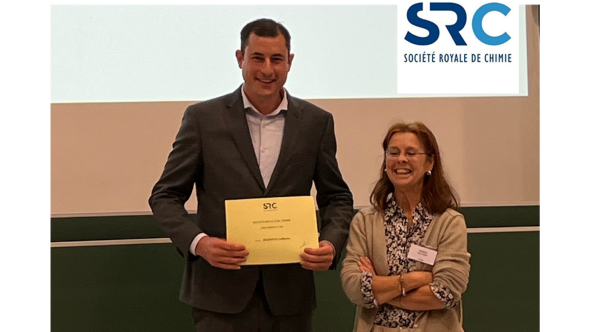
The RSC Triennial Prize is intended to honor a researcher in full scientific bloom whose work receives an international audience and is considered seminal.
Since 1969, this prize has rewarded numerous chemists recognized in Belgium and particularly from UNamur since 3 other members of the Department have already received it: Jean-Marie André (1984); Benoît Champagne (2002) and Johan Wouters (2008).
The research team
These research topics, which Professor Guillaume Berionni's Laboratoire de Réactivité et Catalyse Organométallique (RCO) team is working on, are located at the frontier between organic, organometallic, heterochemistry (Group 13 and 14 elements), and coordination chemistry, and are advancing the development of new concepts in homogeneous catalysis.
These research projects are financed by various funding bodies, including the FNRS, the European Union via the ERC, or the Wallonia-Brussels Federation.
Guillaume Berionni is also a member of the Namur Institute of Structured Matter - NISM (Pôle FSM). He currently leads a research team of 14 PhD students, post-docs and master's students.
A year after receiving prestigious funding from the European Research Council (ERC) for his B-Yond project, Prof Guillaume Berionni was appointed a Fellow of the prestigious European chemistry society Chemistry Europe in early 2024. This distinction makes him the new representative for Belgium for a period of 2 years.
Congratulations to him and his team!
Read our previous articles
- Guillaume Berionni Belgian representative at the European Chemical Society: Read article...
- An ERC Consolidator fellowship for Guillaume Berionni's B-YOND project: Read article...
The 1st MG-ERC conference
From September 10 to 12, 2025, the 1st MG-ERC conference will take place. The Main-Group Elements Reactivity Conference (MG-ERC) is a new meeting, created to bring together researchers working in the fields of main-group chemistry, coordination chemistry and inorganic chemistry to discuss new concepts, ideas and trends in these dynamic fields, and to establish links and collaborations.
Studying chemistry at UNamur
Now known as ‘chemists’, specialists in the reactivity of matter pursue the art of experimentation and discovery. The products of their essential knowledge are applied in the fields of nutrition, health, hygiene, transport, sport, construction and environmental protection.
An ERC Consolidator grant for Professor Guillaume Berionni's B-YOND project!
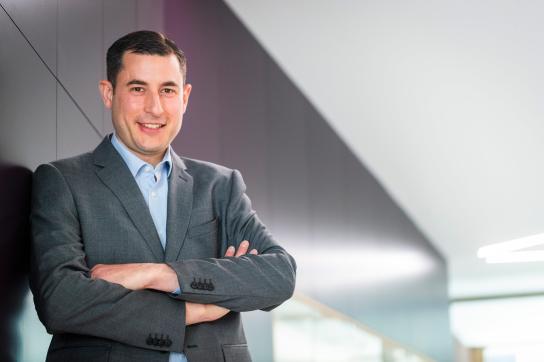
The ERC CoG, a funding instrument of the European Research Council (ERC), enables outstanding scientists to implement innovative concepts over a period of five years and thus strengthens the European research landscape. The B-YOND project will focus on the reprogramming of chemical elements properties in order to initiate the creation of a new generation of more robust and accessible catalysts.
De nos jours, 80 % des procédés industriels utilisent des catalyseurs. Un catalyseur, c’est un élément ou une molécule chimique qui provoque ou augmente la vitesse d'une réaction chimique. La vision populaire du domaine est généralement négative car elle fait penser à la pollution (catalyseurs des voitures) avec dispersions de poussières de métaux rares et dangereux et de gaz à effets de serre.
Le projet B-YOND va étudier les possibilités de reprogrammer la structure de certaines molécules afin d’outrepasser les limites de réactivité chimique des catalyseurs utilisés à l’heure actuelle. De plus, au lieu d’utiliser des métaux précieux ou des éléments rares, le projet va se focaliser sur d’autres éléments comme le bore, le carbone, le silicium. Avec le double avantage qu’on en trouve à foison sur notre planète, qu’ils sont accessibles et plus facilement recyclables !
Les résultats de cette recherche jetteront les bases du développement de nouvelles stratégies de gestion de l'énergie et des ressources, notamment grâce à de nouvelles approches de conception de catalyseurs et de développement de matériaux durables qui permettront de transformer des molécules présentes en abondance dans notre atmosphère (dioxyde de carbone, méthane, diazote) en produits chimiques et fuels à hautes valeurs ajoutées.
CV express
Guillaume Berionni a obtenu son doctorat en 2010 à l'Université de Versailles (Institut Lavoisier) pour ses recherches en chimie organique physique. Il a ensuite rejoint l'Université Ludwig Maximilian de Munich en tant que boursier postdoctoral Humboldt sous la direction du professeur Herbert Mayr et du professeur Paul Knochel. Depuis 2017, il est Professeur de chimie à l'Université de Namur et membre du Namur Institute of Structured Matter (NISM). En 2018, il s’est vu octroyer un Mandat d'Impulsion Scientifique (MIS) du FNRS pour développer le projet de recherche « Bifunctional Boron Catalysts and Receptors ».
Il dirige actuellement une équipe de recherche composée de 8 doctorants, post-doctorants et étudiants en master. A l’automne 2022, son équipe s’agrandira avec le recrutement de 6 nouveaux chercheurs (doctorants et post-doctorants) financés grâce à la bourse octroyée.
Pour cet appel 2021, l'ERC a reçu 2652 propositions de subventions de consolidation et un total de 313 lauréats sont financés en Europe. Dans le panel PE5 (Synthetic Chemistry and Materials) en Sciences physiques et Ingénierie, un total de 12 bourses ERC CoG ont été attribuées cette année en Europe, dont une seule a été attribuée en Belgique au Professeur Berionni.
Félicitations à lui !
Le projet ERC B-YOND
Ce projet a été financé par le Conseil européen de la recherche (ERC) dans le cadre du programme de recherche et d'innovation Horizon Europe de l'Union européenne (convention de subvention n° 101078226).
Guillaume Berionni Belgian representative at the European Chemical Society
One year after receiving funding from the European Research Council (ERC) for his B-Yond project, Prof Guillaume Berionni has just been named a Fellow of the prestigious European chemistry society Chemistry Europe. This distinction makes him the new representative for Belgium for a period of 2 years.
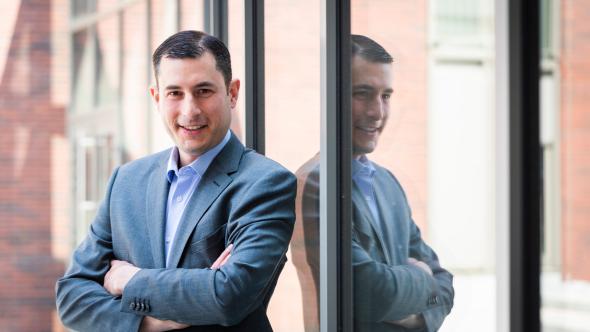
Guillaume Berionni is a member of the Namur Institute of Structured Matter (NISM). He currently leads a research team of 14 PhD students, post-docs and Masters students. The B-YOND project, funded by the European Research Council's ERC CoG instrument, focuses on modifying the properties of chemical elements to initiate the creation of a new generation of more sustainable and accessible catalysts. This 5-year fellowship enables outstanding scientists to implement innovative concepts, thereby strengthening the European research landscape.
Chemistry Europe, the European Chemical Society, is an organization representing national chemical societies and other chemistry-related organizations in Europe. Objective: to create a platform for scientific discussion and to provide a single, impartial European voice on key policy issues in chemistry and related fields.
Representing over 130,000 chemists from 50 member societies, including the Société Royale de Chimie (SRC) and the Jeunes Chimistes de la SRC for the Belgian French-speaking section, as well as other chemistry-related organizations in Europe, Chemistry Europe associated with the EuChemS organization draws on a unique network of researchers active in all areas of chemistry.
By promoting chemistry and providing its scientific expertise and advice, Chemistry Europe and EuChemS aim to participate in the resolution of today's major societal challenges.
A fine recognition of the researcher's expertise in the design of catalysts and sustainable materials. Congratulations to him!
This project was funded by the European Research Council (ERC) as part of the European Union's Horizon Europe research and innovation program (grant agreement no. 101044649.
Agenda
Main-Group Elements Reactivity Conference (MG-ERC) — 2nd Edition
The “Main-Group Elements Reactivity Conference ” (MG-ERC) brings together researchers working in the fields of main-group chemistry, coordination chemistry, and inorganic chemistry to discuss new concepts, ideas, and trends in these rapidly evolving fields, and to forge connections and collaborations.
Funding
Fund for Scientific Research – FNRS
Since 2018, our group has been funded by the FNRS.
Wallonia-Brussels Federation through Concerted Research Actions (ARC)
As part of an interuniversity ARC collaboration with UCLouvain, our group receives support from the Wallonia-Brussels Federation for basic research.
European Research Council (ERC)
In 2022, Professor Guillaume Berionni was awarded an ERC Consolidator Grant.
With this funding, the European Research Council enables exceptional scientists to implement pioneering concepts over a five-year period, thereby strengthening the European research landscape.
The ERC received 2,652 proposals for Consolidator Grants, and 313 recipients were awarded funding from the EU. In the PE5 panel for physical sciences and engineering, 12 grants were awarded across Europe, including just one for Belgium: Professor Guillaume Berionni’s B-YOND project. ERC Consolidator Grants are designed to support outstanding research programs that must demonstrate innovation and a multidisciplinary scope.
Inspired by transition-metal catalysis and main-group chemistry, the B-YOND project aims to reprogram molecular systems based on elements from the s and p blocks to overcome current rules of chemical reactivity.
Follow us!
Our funding