
Master in Chemistry
-
Schedule
regular course
- ECTS Credits 60
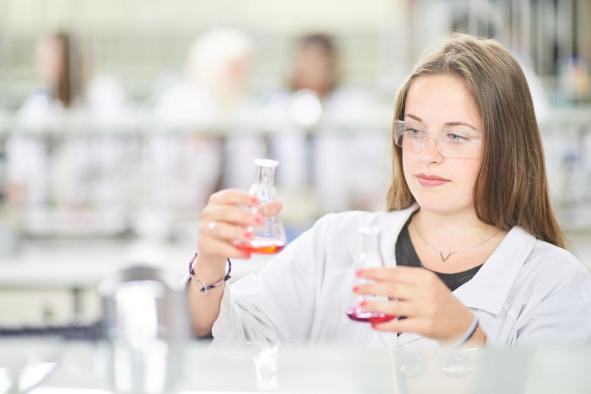
Overview
Taught in English, the Master’s in Chemistry at UNamur specializes in fields focused, on the one hand, on life sciences, particularly biological chemistry and medicinal chemistry, and, on the other hand, on materials chemistry with applications closely linked to the Sustainable Development Goals (SDGs).
Your goals
- Gain expertise in the two major areas of contemporary chemistry:
- biochemistry, that is, the chemical aspects of biology and pharmacology;
- the chemistry of new materials, with significant implications in the fields of surfaces, materials, and nanomaterials.
- Give your degree a strong experimental component—essential for your entry into the job market—while pursuing rigorous training in theoretical chemistry and numerical modeling.
- Expose you to other disciplines—notably physics and biology—with a view toward multidisciplinary applications.
The Benefits of Studying at UNamur
- You are versatile chemists with an excellent background in both theory and experimentation.
- You benefit from close contact with professors and a rapid, in-depth immersion in research laboratories.
- You will study in a department that conducts research in chemistry education and offers numerous continuing education programs for teachers.
The program
The 60-credit master’s program provides you with a solid foundation in biological chemistry, surface and nanomaterials chemistry, and theoretical chemistry.
This master’s program is taught in English, but you can also complete the entire program in French!
Other master's programs in chemistry
The University of Namur organizes
- the master 120 in chemical sciences
- the master 60 in chemical sciences
- the master 60 in chemistry
- the master in chemistry education
- 120 credits - section 4 (from 2025)
- 60 credits - section 5 (from 2025)
And after the master's degree
You want to empower young people to learn and collaborate, guide them, help them become agents of change?
Discover how to become a teacher in upper secondary (secondary 4-6) after your master's degree.
Contacts
Faculty of Science
2 Grafé Street • B-5000 Namur
Department of Chemistry
Tel.: +32 (0) 81 72 54 44
enseignement.chimie@unamur.be
-
General courses
The student chooses 18 credits.
Code Name Staff Th.+Ex. Credits/Block 1 SCHIM106 Advanced Organic Chemistry Berionni Guillaume Lanners Steve 36h th. + 24h ex. 6 SCHIM102 Advanced Theoretical Chemistry Olivier Yoann Champagne Benoît Nascimento Ramos Tárcius 36h th. + 24h ex. 6 SCHIM103 Advanced Inorganic Chemistry: Adsorption, Interfaces, Heterogeneous Catalysis Barakat Tarek Su Bao Lian Aprile Carmela 36h th. + 24h ex. 6 SCHIM203 Supramolecular Chemistry Berionni Guillaume Davies Jack 18h th. 4 SCHIM202 Green Chemistry Lanners Steve 18h th. 4 SCHIM104 Characterization Techniques in Life and Materials Chemistry Aprile Carmela Michaux Catherine 36h th. + 24h ex. 6 SCHIM204 Solid state chemistry Kale Amanda Su Bao Lian 18h th. 4 -
Advanced courses
The student chooses 12 credits in the following list, of wich 9 at leat must be chosen among his research orientation. These 9 credits may be completed by (at least) 3 credits of the other orientation of the master's degree in chemical sciences or within a master's degree programme in chemical sciences of another university of the Fédération Wallonie-Bruxelles, or in another master's degree of the faculties of science or medicine of UNamur, under the condition of acceptance by the admission committee.
Code Name Staff Th.+Ex. Credits/Block 1 SCHIM114 Organometallic Synthesis and Catalysis Berionni Guillaume Berionni Guillaume 18h th. 4 SCHIM109 Scientific Programming for Chemists Liégeois Vincent Liégeois Vincent 18h th. 4 Cyclic course not organized this yearImage
SCHIM224 Organic photochemistry Berionni Guillaume 18h th. 4 English Friendly CoursesImage Cyclic course organized this yearImage
SCHIM222 Nanotechnologies Aprile Carmela Aprile Carmela 18h th. 4 Cyclic course not organized this yearImage
SCHIM215 Glycoscience Vincent Stéphane 18h th. 4 SCHIM121 Microscopy Applied to Materials Chemistry Aprile Carmela Aprile Carmela 18h th. 4 SCHIM225 Asymmetric synthesis and catalysis Lanners Steve Lanners Steve 18h th. 4 SCHIM124 Processes and Methods for the Preparation of Solid Nanomaterials Su Bao Lian Su Bao Lian 18h th. 4 -
Transdiciplinary courses
Code Name Staff Th.+Ex. Credits/Block 1 SSPSM203 Philosophy of Life Sciences Pontarotti Gaëlle 12h th. 3 Soft skillsImage
SCDLM201_Chimie Advanced English (Level B2+) Zimmer Carole 30h th. 4 -
Master Thesis
Code Name Staff Th.+Ex. Credits/Block 1 SCHIM125 Master Thesis Wouters Johan 23
-
General courses
The student chooses 18 credits.
Code Name Staff Credits Hours/Quarter 1 2 SCHIM106 Advanced Organic Chemistry Berionni Guillaume Lanners Steve 6 36h th. + 24h ex. SCHIM102 Advanced Theoretical Chemistry Olivier Yoann Champagne Benoît Nascimento Ramos Tárcius 6 36h th. + 24h ex. SCHIM103 Advanced Inorganic Chemistry: Adsorption, Interfaces, Heterogeneous Catalysis Barakat Tarek Su Bao Lian Aprile Carmela 6 36h th. + 24h ex. SCHIM203 Supramolecular Chemistry Berionni Guillaume Davies Jack 4 18h th. SCHIM202 Green Chemistry Lanners Steve 4 18h th. SCHIM104 Characterization Techniques in Life and Materials Chemistry Aprile Carmela Michaux Catherine 6 36h th. + 24h ex. SCHIM204 Solid state chemistry Kale Amanda Su Bao Lian 4 18h th. -
Advanced courses
The student chooses 12 credits in the following list, of wich 9 at leat must be chosen among his research orientation. These 9 credits may be completed by (at least) 3 credits of the other orientation of the master's degree in chemical sciences or within a master's degree programme in chemical sciences of another university of the Fédération Wallonie-Bruxelles, or in another master's degree of the faculties of science or medicine of Unamur, under the condition of acceptance by the admission committee.
Code Name Staff Credits Hours/Quarter 1 2 SCHIM114 Organometallic Synthesis and Catalysis Berionni Guillaume Berionni Guillaume 4 18h th. SCHIM109 Scientific Programming for Chemists Liégeois Vincent Liégeois Vincent 4 18h th. Cyclic course not organized this yearImage
SCHIM224 Organic photochemistry Berionni Guillaume 4 18h th. English Friendly CoursesImage
Cyclic course organized this yearImage
SCHIM222 Nanotechnologies Aprile Carmela Aprile Carmela 4 18h th. Cyclic course not organized this yearImage
SCHIM215 Glycoscience Vincent Stéphane 4 18h th. SCHIM121 Microscopy Applied to Materials Chemistry Aprile Carmela Aprile Carmela 4 18h th. SCHIM225 Asymmetric synthesis and catalysis Lanners Steve Lanners Steve 4 18h th. SCHIM124 Processes and Methods for the Preparation of Solid Nanomaterials Su Bao Lian Su Bao Lian 4 18h th. -
Transdiciplinary courses
Code Name Staff Credits Hours/Quarter 1 2 SSPSM203 Philosophy of Life Sciences Pontarotti Gaëlle 3 12h th. Soft skillsImage
SCDLM201_Chimie Advanced English (Level B2+) Zimmer Carole 4 30h th. -
Master Thesis
Code Name Staff Credits Hours/Quarter 1 2 SCHIM125 Master Thesis Wouters Johan 23
Admission requirements
Si vous avez un diplôme belge
ACCES DIRECT
- bachelier en sciences chimiques.
ACCES moyennant un COMPLÉMENT DE 45 À 60 CRÉDITS
- bachelier (type court) en chimie orientation biochimie, biotechnologie, chimie appliquée, environnement.
ACCES SUR DOSSIER
- autre diplômé de l’enseignement supérieur de la Communauté française de Belgique ;
- diplômé de l’enseignement supérieur hors Communauté française de Belgique;
- sur base de VAE (Valorisation des acquis de l'expérience).
Pour les admissions en master, il y a lieu de prendre contact avec le service des inscriptions.
Si vous avez un diplôme non-belge
If you have a degree from an institution outside of Belgium, you will need to complete and return the admissions request form before 30 September (31 March for students from outside the European Union).
----------------------------------------------------------------------------------------------------------------------------------------------------------------------
Students with a first degree obtained in Belgium
DIRECT ACCESS
- Bachelor in Chemistry.
ACCESS subject to AN ADDITIONAL 45 TO 60 CREDITS
- Bachelor in Chemistry orientation Biochemistry, Biotechnology, Applied Chemistry, Environment.
ACCESS BY APPLICATION
- other higher education qualifications obtained in the French Community of Belgium;
- higher education qualifications obtained outside of the French Community of Belgium;
- on the basis of VAE (‘Valorisation des acquis de l’expérience’ – recognition of previous experience)
For admission to Masters degrees, please contact the Admission Service.
Students with a first degree obtained outside of Belgium
ACCESS BY APPLICATION
If you have a degree from an institution outside of Belgium, you will need to complete and return the admissions request form before 30 September (31 March for students from outside the European Union): www.unamur.be/en/enrolment
Jury
Aims and objectives
By the end of the programme, the student will have learned to:
-
develop expertise in the two important branches of contemporary Chemistry:
- Life Chemistry, that is the chemical aspects of Biology and Pharmacology;
- New Materials Chemistry, with its emphasis on surfaces, materials, and nanomaterials;
- master the experimental dimension – an essential skill for the job market – alongside rigorous training in theoretical Chemistry and numerical modelling;
- tackle other disciplines – notably Physics and Biology – useful for research and multidisciplinary applications.
Description
This 60-credit Master’s specialises in the fields of Life Chemistry on the one hand (in particular Biological and Medicinal Chemistry) and Materials Chemistry on the other, where the focus is on surfaces and nanomaterials.
It is taught in English and provides basic initial training in Biological Chemistry and the Chemistry of surfaces and micro- and nanomaterials, as well as in theoretical Chemistry.
Teaching methods
The Master’s is spread over two semesters:
- During the first semester, the student follows in-depth teaching units and takes part in introductory research activities in various departmental laboratories.
- In the second semester, the student selects advanced teaching units from one of the department’s two research areas. Under the guidance of a supervisor, the student carries out a research project leading to the presentation of a thesis in front of a jury during the evaluation period in May/June.
The training comprises several in-depth teaching units based on the department’s two research fields, introductory research activities in our laboratories, and a research project culminating in the presentation of a short thesis.
Assessment
The training is evaluated using various means, such as written or oral exams, individual or group reports, the oral presentation of scientific results to a jury, poster sessions and internships.
Details of the exact means of evaluation may be found in the fact sheets for each teaching unit.
Career Opportunities in Chemistry
At the University of Namur, master’s students in chemistry receive training that prepares them for both basic and applied research. The scientific knowledge they acquire during their studies also opens doors for them in the corporate sector, the education sector, and the public sector…
It is difficult to find a product or object in our daily lives in which chemists have not been involved at some stage of its design, manufacture, or evaluation: packaging, medicines, dyes, perfumes, computer components… In short, “Chemistry is life,” as proclaimed by Essenscia, the Belgian Federation of Chemical and Life Sciences Industries.
In Belgium, the chemical industry directly employs nearly 95,500 people (just under a quarter of whom are in the Walloon Region) and several hundred thousand indirectly. The jobs offered by the chemical industry are often exciting and versatile. Chemists with bachelor’s, master’s, or doctoral degrees contribute to the research and development of new products and processes, to their production in accordance with current quality standards, and finally to their commercialization.
The majority of our chemistry graduates enter the industrial sector at the national or international level (38% of UNamur graduates), within which four main sectors can be identified:
- basic chemistry: processing and/or production of raw materials;
- parachemicals: consumer products, such as cosmetics and cleaning products;
- the pharmaceutical industry: medicines for human and veterinary use;
- process chemistry: rubbers, bio-based plastics.
In addition to research and development laboratories, other departments within the chemical industry are open to master’s and doctoral graduates in chemistry: quality control, sales and marketing (e.g., as medical representatives or market managers), regulatory affairs (preparing registration dossiers for new products), patents, etc.
Pushing the boundaries of knowledge
Nearly a quarter of our alumni pursue research activities at universities or in public research organizations such as the FRS-FNRS in Belgium, the CNRS in France, or the Ludwig Institute for Cancer Research. For most of them, their personal research has led to original findings and the completion of a doctoral thesis.
Passing on a passion for science and life
Nearly one-fifth of chemistry graduates hold the title of agrégé in secondary education. Many of them teach science in secondary schools, higher education institutions, or adult education programs. Those with a Ph.D. may pursue an academic or scientific career at a university.
Protecting our environment
Chemists contribute to protecting our environment. They analyze and help monitor the quality of our natural resources (water, gas), measure air pollution, and work to implement new processes for waste and wastewater treatment, as well as air and gas purification and control.
Protecting our health
Chemists work alongside biologists, pharmacists, and doctors to develop and improve new drugs and vaccines.
Other fields of activity
In addition to academic, industrial, or public laboratories, chemists may also work in private or hospital laboratories, where they lead a team of technicians. Chemists are also found in companies that manufacture and market analytical equipment for these laboratories.
Chemists’ scientific background enables them to advise policymakers, particularly on matters related to environmental policy.
At the federal and regional levels, many public service positions are open to university graduates upon passing an entrance exam and completing appropriate training.
Finally, a significant proportion of chemists pursue careers in the IT sector.