Bachelor in Geology
-
Schedule
regular course
- ECTS Credits 180

Overview
Starting in your first year, in addition to a solid foundation in the sciences, you’ll take an introductory course in geology, as well as courses in cartography and spatial analysis.
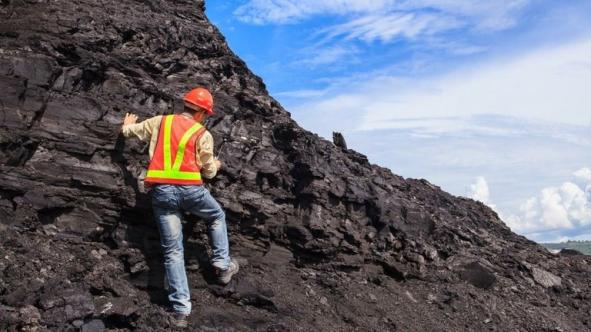
From the very beginning, you’ll participate in field trips, which allow you to directly observe rocks, soils, and landscapes in the field.
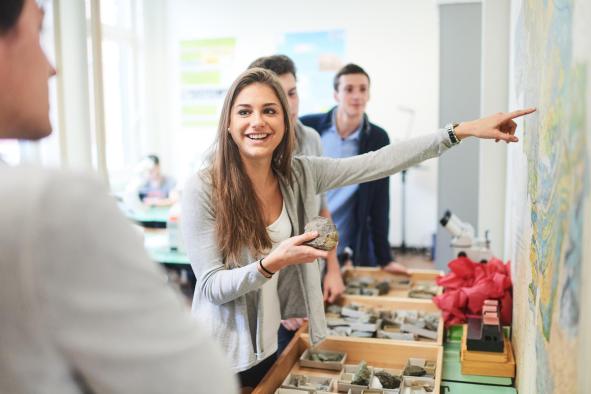
You’ll deepen your knowledge of your field through courses in crystallography, petrology, geological surveying, paleontology, and more…
Throughout your program, you’ll gain hands-on field experience (mapping surveys, geophysical prospecting, hydrogeological mapping, etc.) and learn to use computer tools for data processing (computer-aided mapping, geochemical modeling, hydrogeological modeling, processing of structural and geophysical data, etc.).
You will gain practical experience through courses in hydrogeology, mineral resource management, geophysical prospecting, and more.

You're off to a good start
- You are passionate about natural phenomena and want to unlock the secrets of the Earth;
- you have a knack for sketching or drawing simplified versions of what you observe;
- you enjoy mathematics, physics, chemistry, and biology without necessarily having taken advanced courses in high school;
- you enjoy fieldwork and being in touch with nature;
- you can adapt to living and traveling conditions that aren’t always comfortable, but are exhilarating.
Teaching Methods
Lectures, exercise sessions, laboratory practicals, field trips, and study abroad programs…every effort is made to ensure a thorough understanding of concepts and the development of practical skills.
Organized in small groups, practical work and lab sessions allow you to absorb the material and delve deeper into concepts under the supervision of a teaching assistant.
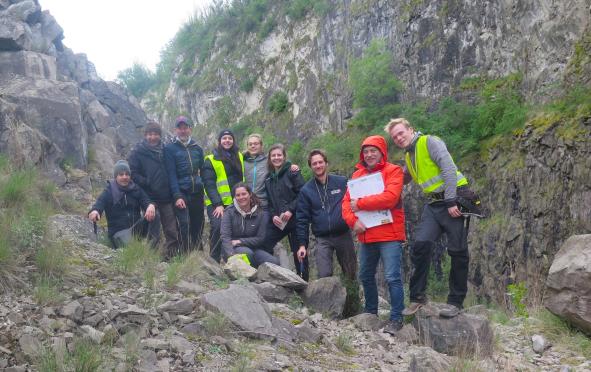
27 field days! Field trips and internships are essential for a natural science like geology. That’s why, in addition to exercises and lab work, you’ll participate in field days in real-world settings to apply your discipline.
Through exposure to scientific literature and presentations in English, you will develop written and oral communication skills in the international language of science.
As part of your bachelor’s thesis, you will conduct original research (basic or applied) that involves obtaining new results (in the laboratory and/or in the field) and interpreting them.
International experience
Would you like to combine your studies with a unique cultural experience and/or language immersion?
This is possible thanks to the Erasmus program offered in the third year of the bachelor’s degree. You can spend this study abroad period in Flanders or elsewhere in Europe (for example, at KU Leuven or the UniLaSalle-Beauvais Institute).
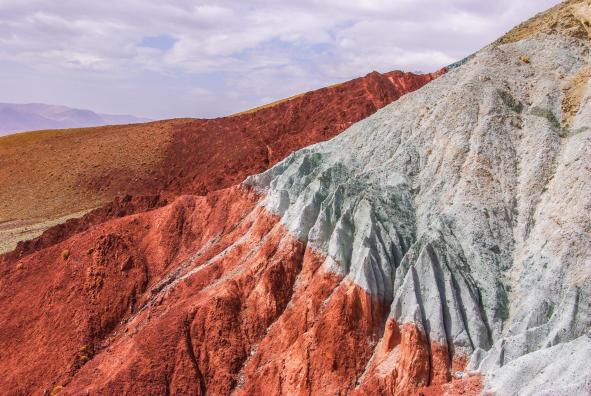
You will also be required to read scientific articles, present papers in English, and conduct fieldwork at international sites or on objects (particularly in Italy, Morocco, Tunisia, Spain, Greece, or France).
These experiences enhance the global scope of your education and familiarize you with a wide variety of geological contexts and issues.
Support for Success
Succeeding in a year of university studies involves many challenges.
To help you overcome them, we support you in developing your academic, methodological, and interpersonal skills—with the help of many professionals.
After a bachelor's degree: a master's degree
A few months before completing your bachelor’s degree, a meeting with representatives from various master’s programs will help you determine the best next steps for your education.
The UNamur bachelor’s program in geological sciences naturally opens the door to the master’s program in geological sciences offered at universities in the Wallonia-Brussels Federation, but it also allows you to consider continuing your studies abroad. Other master’s programs are also available: oceanography, environmental science, mining engineering, volcanology…
Contacts
Faculty of Science
2 Grafé Street • B-5000 Namur
Office
Ms. A. Brouir, Ms. S. Duvivier, and Ms. C. Haeck
Tel.: +32 (0) 81 72 45 00
secretariat.sciences@unamur.be
-
General scientific training
-
Geological sciences
-
Geographical sciences
Code Name Staff Th.+Ex. Credits/Block 1 2 3 SGOGB102 Cartographic representations Linard Catherine Linard Catherine 30h th. + 20h ex. 4 SGOGB101 Fundamentals of Geography - Territorial Analysis Dendoncker Nicolas 15h th. + 20h ex. 3 SGOGB110 Fundamentals of Geography - Land in Geography Dendoncker Nicolas 21h ex. 2 Sustainable developmentImage
SGOLB106 Geography and Geology of Belgium Yans Johan Dendoncker Nicolas 30h th. + 14h ex. 4 SGOGB201 Introduction to Geographic Information Systems Linard Catherine Guyot Madeleine 15h th. + 20h ex. 4 SGOGB301 Modelling and analysis of geographic information Linard Catherine Brogna Delphine 20h th. + 30h ex. 4 -
IT
Code Name Staff Th.+Ex. Credits/Block 1 2 3 SBIOB120 Data management in life sciences, basic principles De Laender Frédérik 8h th. + 12h ex. 2 SBIOB220 Data Analysis in Life Sciences Lima Mendez Gipsi 12h th. + 15h ex. 2 -
Humanities
Code Name Staff Th.+Ex. Credits/Block 1 2 3 SSPSB101 Philosophical questions Modera Astrid Sartenaer Olivier 22h th. + 7h ex. 2 Service learningImage
SSPSB102_Bloc1 Religious Studies: Anthropology, Metaphysics and Science Cazalis Roland Leyens Stéphane 30h th. 2 -
Choice of courses
Code Name Staff Th.+Ex. Credits/Block 1 2 3 SSPSB204 Logic and argumentation Sartenaer Olivier Sartenaer Olivier 22.5h th. 2 SSPSB202 History of science Sartenaer Olivier 22.5h th. 2 SSPSB203 Psychology Ravez Laurent 22.5h th. 2 SSPSB307 Formal logic Sartenaer Olivier 15h th. 2 SSPSB308 Philosophy of science Sartenaer Olivier 15h th. 2 SSPSB309 Ethical LAURENT Nathanaël Leyens Stéphane 15h th. 2
-
-
Language
Code Name Staff Th.+Ex. Credits/Block 1 2 3 SCDLB103 Introduction to Scientific English (level B1 and above) Tréfois Cindy 30h th. 3 SCDLB203 English : Communicating Sciences Effectively (level B1 and above) Tréfois Cindy 30h th. 3 SCDLB303 English : Debating Science (level B2 minimum) Tréfois Cindy 30h th. 3 -
Optional internship
Code Name Staff Th.+Ex. Credits/Block 1 2 3 SBIOB003 Pluridisciplinary scientific field trip Silvestre Frédéric Yans Johan Yans Johan Silvestre Frédéric 48h th. + 48h ex. 3 3
-
General scientific training
Code Name Staff Credits Hours/Quarter 1 2 SPHYB167 Physics supplements Louette Pierre 3 25h th. + 10h ex. SCHIB111_Géo² General chemistry Wouters Johan 5 40h th. + 15h ex. SPHYB113 Syllabus, webcampus, Teams. Colaux Julien Colaux Julien 3 30h th. + 11h ex. SMATB110 Mathematical complements De Vleeschouwer Martine 3 15h th. + 15h ex. SMATB111 Mathematics Lucas Maxime 3 30h th. + 15h ex. SPHYB124_Chimie et Géo² General physics: Mechanics Caporaletti Federico 6 46h th. + 30h ex. SBIOB114 Elements of biology adapted to darwinian evolution Messiaen Johan 2 15h th. SCHIB112_Géo² General chemistry of solutions Dehon Jérémy 3 25h th. + 10h ex. -
Geological sciences
Code Name Staff Credits Hours/Quarter 1 2 SGOLB111 Geological fieldwork Collinet Max 2 21h ex. SGOLB131 General geology 1 Collinet Max 4 30h th. + 7h ex. SGOLB132 General geology 2 Collinet Max 3 15h th. + 26h ex. Sustainable developmentImage
UNAM0043_Bloc1 Global change and the Anthropocene Yans Johan Dendoncker Nicolas Yans Johan Linard Catherine Houssiau Laurent Henry Sabine 3 24h th. -
Geographical sciences
Code Name Staff Credits Hours/Quarter 1 2 SGOGB102 Cartographic representations Linard Catherine Linard Catherine 4 30h th. + 20h ex. SGOGB101 Fundamentals of Geography - Territorial Analysis Dendoncker Nicolas 3 15h th. + 20h ex. SGOGB110 Fundamentals of Geography - Land in Geography Dendoncker Nicolas 2 14h ex. 7h ex. Sustainable developmentImage
SGOLB106 Geography and Geology of Belgium Yans Johan Dendoncker Nicolas 4 30h th. + 14h ex. -
Humanities
Code Name Staff Credits Hours/Quarter 1 2 SSPSB101 Philosophical questions Modera Astrid Sartenaer Olivier 2 22h th. + 7h ex. Service learningImage
SSPSB102_Bloc1 Religious Studies: Anthropology, Metaphysics and Science Cazalis Roland Leyens Stéphane 2 30h th. -
Language
Code Name Staff Credits Hours/Quarter 1 2 SCDLB103 Introduction to Scientific English (level B1 and above) Tréfois Cindy 3 15h th. 15h th.
-
General scientific training
Code Name Staff Credits Hours/Quarter 1 2 SCHIB206_Géologie Introduction to scientific software Leherte Laurence 2 6h th. + 18h ex. SCHIB201_Géologie Physical chemistry: equilibrium Liégeois Vincent Leherte Laurence 7 30h th. + 7.5h ex. 15h th. + 36.5h ex. Sustainable developmentImage
SBIOB207 Functional and adaptive biology Thoré Eli 5 40h th. + 25h ex. English Friendly CoursesImage
SBIOB205 Introduction to statistics De Laender Frédérik 4 24h th. + 22.5h ex. -
Geological sciences
Code Name Staff Credits Hours/Quarter 1 2 SCHIB209_Géologie Tools and methods applied to Chemistry and Geology Leherte Laurence 2 15h th. + 10h ex. SGOLB218 Mapping of sedimentary rocks Collinet Max 2 12h th. + 24h ex. SGOLB219 Sedimentary rock mapping course Collinet Max 3 42h ex. SGOLB217 Introduction to mineralogy and petrography Collinet Max 5 15h th. + 44h ex. SGOLB202 Physical geography and geomorphology Collinet Max 5 30h th. + 23h ex. SGOLB203 Introduction to sedimentology Yans Johan 4 20h th. + 19h ex. SGOLB210 Paleontology Smith Thierry 5 24h th. + 40h ex. SCHIB207_Géologie et Physique Introduction to crystallography Wouters Johan Yans Johan 3 15h th. + 15h ex. -
Geographical sciences
Code Name Staff Credits Hours/Quarter 1 2 SGOGB201 Introduction to Geographic Information Systems Linard Catherine Guyot Madeleine 4 15h th. + 20h ex. -
IT
Code Name Staff Credits Hours/Quarter 1 2 SBIOB120 Data management in life sciences, basic principles De Laender Frédérik 2 8h th. + 12h ex. SBIOB220 Data Analysis in Life Sciences Lima Mendez Gipsi 2 12h th. + 15h ex. -
Humanities
-
Choice of courses
Code Name Staff Credits Hours/Quarter 1 2 SSPSB204 Logic and argumentation Sartenaer Olivier Sartenaer Olivier 2 22.5h th. SSPSB202 History of science Sartenaer Olivier 2 22.5h th. SSPSB203 Psychology Ravez Laurent 2 22.5h th.
-
-
Language
Code Name Staff Credits Hours/Quarter 1 2 SCDLB203 English : Communicating Sciences Effectively (level B1 and above) Tréfois Cindy 3 15h th. 15h th. -
Optional internship
Code Name Staff Credits Hours/Quarter 1 2 SBIOB003 Pluridisciplinary scientific field trip Silvestre Frédéric Yans Johan Yans Johan Silvestre Frédéric 3 48h th. + 48h ex.
-
General scientific training
Code Name Staff Credits Hours/Quarter 1 2 SCHIB203_Géologie Analytical chemistry Mekhalif Zineb 5 30h th. + 51h ex. SBIOB328 Multivariate statistics and geostatistics Lima Mendez Gipsi 4 22.5h th. + 22.5h ex. -
Geological sciences
Code Name Staff Credits Hours/Quarter 1 2 Sustainable developmentImage
SGOLB303 Environment and geology Poulain Amael Storme Jean-Yves 4 20h th. + 30h ex. SGOLB301 Structural geology Collinet Max 3 15h th. + 20h ex. Sustainable developmentImage
SGOLB313 Geophysics Louette Pierre Collinet Max 3 15h th. + 23h ex. SGOLB302 Sedimentology Clausen Sébastien 4 20h th. + 30h ex. SGOLB304 Micropaleontology Yans Johan 3 15h th. + 12h ex. Sustainable developmentImage
SGOLB306 Metallogeny Yans Johan 4 25h th. + 20h ex. SGOLB307 Magmatic and metamorphic petrology Collinet Max Yans Johan 6 20h th. + 36h ex. SGOLB308 Geochemistry and mineralogy Collinet Max Yans Johan Storme Jean-Yves 3 15h th. + 15h ex. Sustainable developmentImage
SGOLB309 Mapping of endogene rocks Yans Johan 6 40h th. + 80h ex. SGOLB311 Personal works Collinet Max Yans Johan 6 25h ex. 25h ex. -
Geographical sciences
Code Name Staff Credits Hours/Quarter 1 2 SGOGB301 Modelling and analysis of geographic information Linard Catherine Brogna Delphine 4 20h th. + 30h ex. -
Humanities
-
Choice of courses
Code Name Staff Credits Hours/Quarter 1 2 SSPSB307 Formal logic Sartenaer Olivier 2 15h th. SSPSB308 Philosophy of science Sartenaer Olivier 2 15h th. SSPSB309 Ethical LAURENT Nathanaël Leyens Stéphane 2 15h th.
-
-
Language
Code Name Staff Credits Hours/Quarter 1 2 SCDLB303 English : Debating Science (level B2 minimum) Tréfois Cindy 3 15h th. 15h th. -
Optional internship
Code Name Staff Credits Hours/Quarter 1 2 SBIOB003 Pluridisciplinary scientific field trip Silvestre Frédéric Yans Johan Yans Johan Silvestre Frédéric 3 48h th. + 48h ex.
Careers in Geology
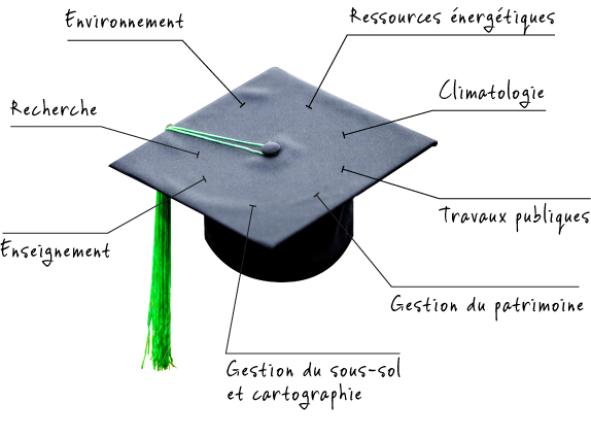
Geologists' professions
In geology, specializations in geochemistry, hydrogeology, mineral resources, and geophysics are currently in high demand.
In Europe, many engineering firms and government agencies hire geologists to conduct part of the environmental studies required for any new industrial facility (factory, barn, etc.) or civil engineering structure (bridge, highway, building, etc.) to conduct an impact study (foundation quality, risks of aquifer contamination, etc.). Geologists work with interdisciplinary teams, allowing them to broaden their areas of expertise.
Basic and applied research is conducted at universities, the Royal Belgian Institute of Natural Sciences, the Walloon Region, in public works (major projects and site protection), and in certain extractive industries, cement plants, and glassworks. Industrial and mining research focuses as much on exploration as on the management and protection of extraction sites, the environment, and groundwater. Regardless of the chosen specialization, a geology degree remains highly valued in the industrial sector due to the quality of the foundational knowledge acquired in physics, chemistry, mathematics, and other fields.
Abroad, particularly in the context of technical assistance to developing countries, several career opportunities open up each year in the extractive industry, geological and hydrogeological exploration, as well as in higher education.
Complementary specializations at the master’s level can be completed in one or two years and remain in high demand, especially when they involve degrees or certificates earned abroad. Of particular note are mineral resources, hydrogeology, geochemistry, geophysics, and the environment.
In addition, the solid foundation in basic sciences allows geologists to teach chemistry, physics, biology, and geography in upper secondary school (grades 10, 11, and 12), a field currently in high demand.
A degree in geology opens the door to a wide range of specializations: from paleontology to the extraction of underground resources (including water), including the study of meteorites, all with ample opportunity to travel. For my part, I was fortunate enough to work as a geologist for two years at a gold mine in northern Quebec. My daily work focused on finding the right veins. I was able to rely on all the skills I acquired in Namur to quickly analyze and understand the deposit I was working on. These skills were, in fact, highly valued and sought after by my supervisors. Currently, I work in Belgium in the environmental sector, but opportunities for fieldwork abroad are still very much available if the urge strikes me again.
Pierre, former student