The RFIE has its roots in a worrying observation: our education system is struggling to fulfill its missions of efficiency and equity. PISA (Programme for International Student Assessment) surveys reveal skill levels below the average for industrialized countries and a chronic inability to compensate for social inequalities. In a European context where education is seen as a lever for the development of "human capital," the Wallonia-Brussels Federation wanted to take action. Inspired by the Lisbon objectives (2009), the reform aims to enhance the status of the teaching profession, strengthen professionalization, and better prepare future teachers for the diversity of school populations. It aims to profoundly transform the culture of training in order to improve the success of all students.

Training reflective and autonomous practitioners

Teacher training is now organized around the ages and needs of students, the skills to be acquired as part of the evolution of the profession, and the Pact for Excellence in Education.

Each program is built around six areas: subject-specific training, communication, training through practice, teaching and pedagogy, humanities and social sciences, and research in education and teaching. 

Schéma explicatif RFIE

Students therefore learn to combine knowledge, practice, and research to become reflective teachers who are able to evaluate their actions, adjust their methods, and collaborate with their peers.

Diversity and differentiation at the heart of training

One of the pillars of the reform concerns taking student diversity into account. "Not everyone learns in the same way or at the same pace," points out Sandrine Biémar, vice dean of FaSEF. "We want our teachers to be able to diversify their practices without falling into extreme individualization. "
Courses in the psychology of learning, the sociology of education, and differentiated instruction allow us to approach diversity as a source of richness. "Understanding that you yourself have a particular cognitive style," adds Sephora Boucenna, "is already a way of embracing diversity. This leads to offering a variety of learning paths, rather than judging the student as incapable."

For students, this change translates into more appropriate teaching methods and a better understanding of their needs with a view to reducing inequalities. The goal is clear: to avoid repeating a year as a response to difficulties, to train competent citizens, and to contribute to a school system that regains its role as a social ladder.

Internships redesigned to anchor the profession

Another major change is that students now benefit from longer internships that are better supervised and integrated into their training program. "Taking on an intern isn't just about opening up your classroom, observing them, and evaluating them; it's also about being able to support them," emphasizes Sandrine Biémar. That's why UNamur offers a specific certificate for internship supervisors.

This support facilitates the transition to employment. Surveys show that between 30 and 40% of young teachers leave the profession within the first five years. "By strengthening training in and through practice, we want to consolidate their entry into the profession and prevent them from dropping out," she adds.

Stronger collaboration

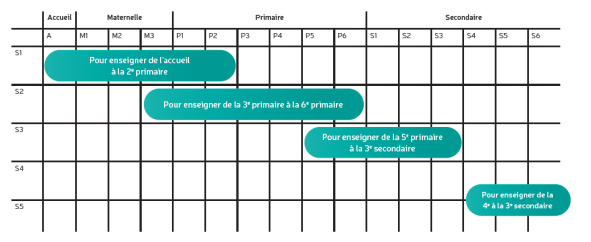
Ensuring continuity between the different levels of education is also a key objective of this reform. "Thanks to the new five-section structure (see illustration)," explains Sandrine Biémar, "a kindergarten teacher has a better understanding of what is at stake in the early years of primary school, and a secondary school teacher can see how learning is built up from the ground up. This consistency helps to avoid disruptions and strengthen continuity in the students' educational journey."

To this end, UNamur is collaborating with HENALLUX within a consortium. "Universities and colleges used to work in parallel," recalls Sandrine Biémar. "Now we are working together to develop curricula and teaching methods. Although UNamur has a long tradition of training teachers for upper secondary school, it is now involved in training teachers from kindergarten to 6th grade."

A coherent educational network

These collaborations extend to continuing education thanks to the Salle des Pros, a UNamur structure that brings together continuing education centers for teachers. 

"Through this reform, we are creating a coherent and sustainable network of educational stakeholders," summarizes Sephora Boucenna. "By linking initial training, research, and continuing education, we are laying the foundations for a strong, reflective, and supportive teaching profession." 

This article is taken from the "Impact" section of Omalius magazine #39 (December 2025).


Cover Omalius décembre 2025